Podcast: Play in new window | Download
What Is an Education Anyway — And Who Gets to Decide?
Forget every notion you have been told about what an education is.
I want to ask you something I ask every single woman I work with in coaching.
What do you believe an education is?
And the second question — the one that tends to stop people cold:
What did you believe an education was before you started homeschooling?
Most of us never actually chose our definition of education. We absorbed it. From school, from our parents, from the culture around us. Then we built an entire homeschool on that foundation and wondered why it felt so heavy.
If you’re just starting out and not sure where to begin, I made something just for you. The 7-Day Confident Homeschool Roadmap is a free guide that walks you through your first year with clarity rather than overwhelm. Grab it below.
What Is an Education Anyway? The Definition Most of Us Inherited
If you grew up in a conventional school system, your working definition probably sounds something like this:
Education is the successful delivery of academic content across subjects. Demonstrated through coverage, completion, and measurable progress.
Coverage. Completion. No gaps. Not falling behind. Making sure it’s enough.
Sound familiar?
That definition is exhausting. And it’s not even working in schools.
Teachers leave many pages of their curriculum undone at the end of every year. There are interruptions. Substitute teachers. Sick days. Stops and starts. There is no perfectly covered, hundred-percent-completed, no-gaps education happening in a classroom either.
And the very academic kids who were force-fed information and tested weekly? How much of that actually stuck? How much of it translated into a purposeful, meaningful life?
It is not possible to create a perfectly covered education. Not in a school. Not in your homeschool. The sooner you stop measuring yourself against that standard, the sooner you can build something that actually works.
If this is landing for you and you want to hear me unpack it further — I’m also diving into this on my YouTube channel. Same episode, same conversation. Watch it here →
Do You Need a Teaching Degree to Define Your Child’s Education?
And if you question whether you have the intelligence to answer that question — don’t be in self-doubt. Of course you do.
This is your child.
Does it seem daunting? It likely does. But it doesn’t have to.
I’ve stopped counting the number of times I’ve been asked if I’m a certified teacher.
Nope. I’m not.
Does being a certified teacher enable me to educate my children better at home?
Nope. It doesn’t.
In fact, statistically, being a certified teacher has no bearing on a child’s home education. Teachers have classroom management skills. They know standardized learning materials. They have years of experience that homeschooling parents might not have in the beginning — and I am not denying those skills for a moment.
But it doesn’t mean I’m not more motivated to learn how to engage my children’s education than someone else.
When I asked a kindergarten teacher about Grade 2 math, she didn’t know what to say. When I asked a high school English teacher how to approach a history discussion with an elementary-aged child, she was stumped too. Turns out, teachers don’t have the full breadth of knowledge either. And I’m certainly not claiming to either.
Why do we think we need to?
Google doesn’t have it all. Neither does YouTube. But both are pretty helpful. And when they aren’t, there are always books. Lots and lots and LOTS of books. You just need to know where to find the information. A little research and it’s findable.
So Where Do You Find What You Need?
When I was in junior high, we bought our first computer: a Tandy EX 1000. The only computer training we had was a Logo program that did next to nothing for me. I attempted to wield x’s and o’s. I’m pretty sure they meant something, but I didn’t understand.
Some thirty years later, anyone who wants to know how to use a computer knows. Anyone who wants to know how to Google, YouTube, Facebook, Tweet — they figured it out. Why?
Because they found out, by themselves. Tada.
The human mind is capable of figuring things out because it wants to.
P.S. You might wonder how I went about structuring a thirteen-year-old’s academic education.

Self-Education: The Heart of What an Education Really Is
Why do we assume kids need everything taught to them? We assume something needs to be done to them.
Before anyone sat them down and formally taught them anything, they had already learned animals, language, and how to navigate relationships. In their first year. Their second. Their fifth — long before they ever walked through a kindergarten door. Kids want to learn. It’s simply what they do.
When we ask the question — what is an education anyway? — we’ve just begun to really consider who our children are and what they need.
And that is exactly what Charlotte Mason was pointing to.
What Is an Education Anyway? Here’s What Charlotte Mason Said.
“Self-education is the only possible education; the rest is mere veneer laid on the surface of a child’s nature.” — Charlotte Mason
I have returned to this quote more times than I can count. Because it points to something we already know intuitively. We keep forgetting it when we sit down at the kitchen table and default to the curriculum, the workbooks, the boxes of books, the online programs everyone else is using.
Your job is not to pour information into a vessel. Your job is to raise up the child right in front of you.
So what does that actually look like in a real homeschool? Here’s one mom’s answer.
What Does Real Home Education Actually Look Like?
A mom I worked with had been homeschooling for six years, three kids, and had done a lot of the external work — curriculum, systems, showing up every day. And then she went deeper and found her own answer to the question of what an education really is:
“Education is a process of exposure to knowledge while learning involves personal processing and growth. Character traits like discernment, self-confidence, and self-management are important outcomes that continue developing long beyond formal education years.”
She also said something that stopped me:
“Even if no one was watching or assessing my approach, I would maintain similar objectives and methods.”
She has found her own answer — not borrowed from the school system, not borrowed from a curriculum company. Entirely hers. And that is what I want for you. For me, the answer starts in the same place it always has — in wanting to engage my child, teach them when necessary, and capture their little hearts. I am most definitely motivated to do that. And so are you. That’s why you’re here.
Want to keep going? This conversation continues on my Rethinking Education YouTube channel. Find it here →
What Is an Education Anyway? Questions to Sit With This Week
As you move through your week, gently ask yourself:
- What definition of education am I actually operating from right now?
- Did I choose it — or did I absorb it?
- Where might I be able to trust what is already working in my child?
- If no one was watching or assessing my homeschool, would I do anything differently?
You don’t need to answer all of it today. Just noticing is already meaningful work.
Want to Go Deeper?
If this post resonated, the podcast episode What Is an Education Anyway? goes much further — including the five shifts I see happen when a homeschool mom finally loosens the grip of a definition that was never really hers, and what it looks like when peace replaces pressure in a real homeschool home. Listen wherever you get your podcasts.
When you’re ready to take the next step, here are three ways I can help:
If you’re in your first year — start with the free 7-Day Confident Homeschool Roadmap. It will give you a clear, grounded foundation so you begin with confidence rather than overwhelm.
If you’ve been homeschooling for a while and something feels off — take the quiz to identify the real root of your frustration. It’s free and takes five minutes.
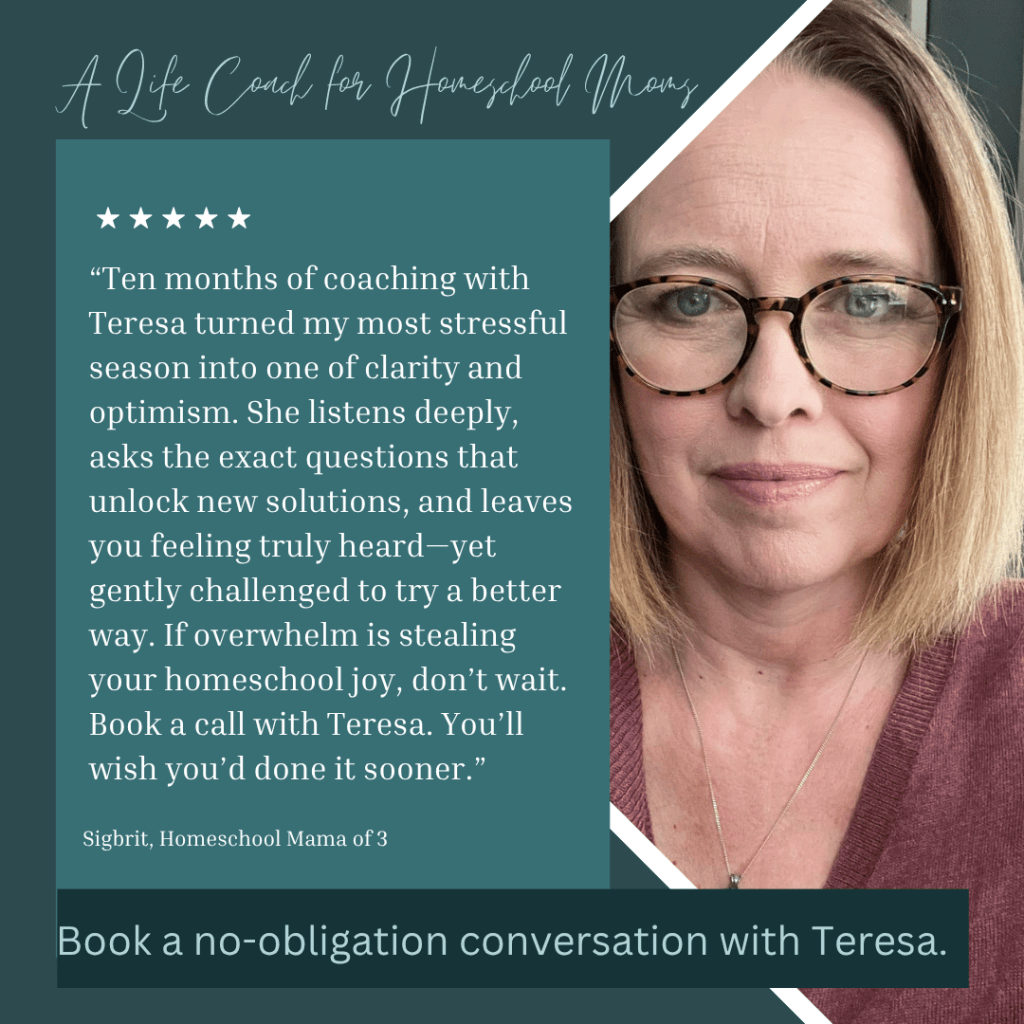
And if you’re ready for a real reset — book your free Aligned Homeschool Reset session. This is where we get clear on what’s actually going on in your homeschool and your life — and you walk away with a whole lot more peace than you arrived with.
Teresa Wiedrick is a certified life coach and graduated homeschool mom who supports homeschool moms in building a life — not just a lesson plan. Her work focuses inward, because most homeschool overwhelm has nothing to do with curriculum.
Book your free Aligned Homeschool Reset Session
I help homeschool moms trust themselves, edit expectations, and make intentional choices that create a more confident, connected, and present homeschool life.
People also ask…
- Self-Directed Learning: the Art of Encouraging Independent Homeschooling
- Building Connection with Tamara Strijack of the Neufeld Institute
- Is there an art and a science to an education?
- Why Seasoned Homeschool Moms Still Struggle (And How to Break Free)
- How do I unschool my child: 5 ways to move toward it in your homeschool
- Can you homeschool without a homeschool room?
- “Should I Homeschool My Child?” Here’s What You Need to Know
- Why You’re Losing Confidence as a Homeschool Mom (and How to Get It Back)
- How I transitioned from homeschool to public high school
- 5 suggestions about buying a new curriculum
- How to Start Homeschooling Confidently in Year 1
- What’s the connection between self-directed learning & free play?
Subscribe to the Confident Homeschool Mom podcast
Call to Adventure by Kevin MacLeod
Link: https://incompetech.filmmusic.io/song/3470-call-to-adventure
License: http://creativecommons.org/licenses/by/4.0/
