Podcast: Play in new window | Download
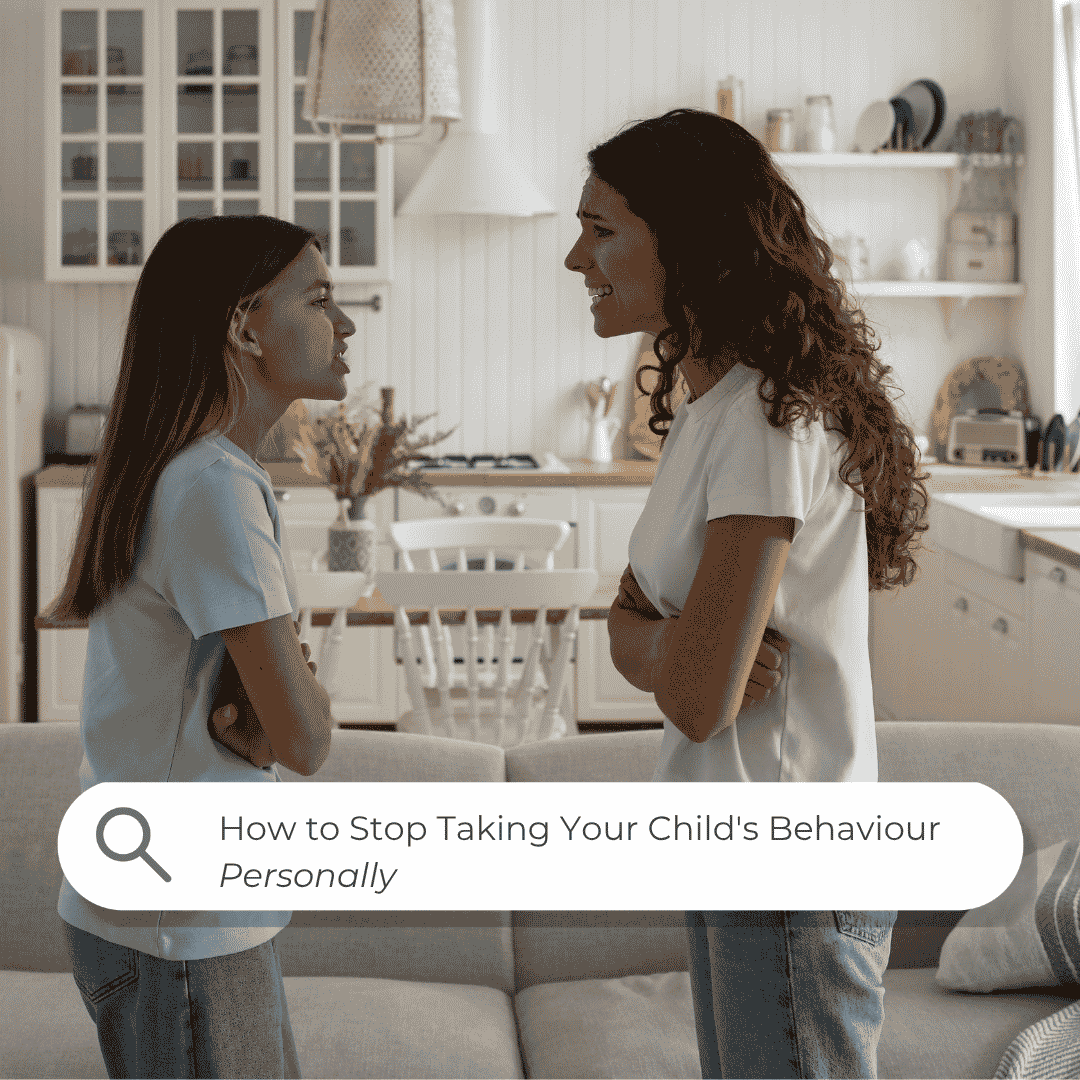
If you’re struggling as you learn how to stop taking your child’s behaviour personally, girlfriend, I get you! That feeling — that your child is doing something to you — is an easy one to fall into. Not just being difficult, but somehow, specifically, deliberately difficult, aimed at you. You’ve had the thought before, even if you didn’t say it out loud: why does he do this to me?
First of all, I want to admit, I have most definitely been there. But I want to offer you a different question to reframe that. Not because your frustration isn’t valid — it is — but because that first question keeps you stuck. It keeps you reacting instead of understanding. And once you swap it out, something in the whole relationship starts to shift.

“Why Is He Doing This to Me?” vs. “This Is Just How He’s Wired”
In a recent coaching conversation, one of the moms I work with was working through exactly this. Her son has a hard time sitting still, gets bored fast, and constantly needs something new to stay engaged — and she’d been reading that as defiance. As him pushing back against her, specifically, was on purpose.
But that constant need for stimulation, that low tolerance for boredom, that instinct to keep moving toward the next interesting thing? That could also be reframed as a personality thing. That’s a recognizable Enneagram Type 7 pattern — a child whose core wiring orients toward possibility and away from anything that feels confining. He’s not doing it to her. He’s doing it because that’s how he’s built to move through the world.
That distinction changes everything about how you respond. A defiant child needs a consequence. A Type 7 child who’s drowning in boredom needs variety, movement, and a shorter runway between tasks. Same behavior. Completely different parenting response — and you can only get to the right one once you stop making it about you.
A Quick Note on ADHD
A quick caveat: trouble sitting still, low tolerance for boredom, always chasing the next stimulating thing — that can also be part of an ADHD profile, not just an Enneagram 7 pattern. The two aren’t mutually exclusive, and this isn’t a substitute for an evaluation, and it’s a separate conversation from learning how to stop taking your child’s behaviour personally — both can be true at once. The Enneagram points to motivation; ADHD is something more neurological. A child can be both — and understanding one doesn’t rule out the other. If this is showing up across settings, not just during school time, it may be worth a conversation with your pediatrician, who can guide you toward an evaluation if needed. And if ADHD is already part of your homeschool reality, you might also like How to Homeschool When Everyone Has ADHD (And You’re Exhausted).
It’s Not Just About Kids
This same shift showed up for two other moms in a Confident Homeschool Mom Collective conversation, both talking about their husbands.
One had spent years frustrated that her husband seemed to avoid conflict at almost any cost — going quiet in arguments, smoothing things over instead of hashing them out, seeming to just… ignoring the conflict instead of addressing it. And she read that as him not caring enough to address the unmet needs under the conflicts. Once she understood he was a Type 9, whose deepest instinct is toward peace and away from friction, she wasn’t excusing the pattern — but she stopped taking it personally. It wasn’t about her. It was his wiring, doing what it’s always done.
Enneagram coaches often see 9s and 8s pair up in marriage — and 8s aren’t afraid of conflict at all. So imagine how he was receiving her in those moments: not as someone smoothing things over peacefully, but as someone withholding, someone who wouldn’t engage. (If you want to see this dynamic from the other side, I loved this Enneagram 8 mom’s story of growth — it’s a great window into how an 8 experiences conflict, connection, and homeschooling.)
Kids, partners — the pattern is the same. The behaviour that used to feel like a verdict on you turns out to be almost entirely unrelated to you. It’s wiring. And wiring isn’t personal.
How to Stop Taking Your Child’s Behaviour Personally When You Think in Black and White
If you’re someone who tends to see things in black and white — this behaviour is good, another behaviour is bad — this shift can feel disorienting at first. It’s not that boundaries stop mattering or that behaviour stops having consequences. That is certainly not my goal here. However, it IS that you stop assigning motive where there isn’t one.
Your child avoiding boredom isn’t defiance — in fact, there’s a bounty to boredom when it’s handled well (I go deeper on that in how to deal with your kids’ homeschool boredom). Your partner avoiding conflict isn’t apathy. Once you can separate the behaviour from an imagined motive aimed at you, you’re free to respond to what’s actually happening instead of reacting to a story you’ve built around it.
And if it’s you who’s the bored one some days — bored of the routine, bored of the sameness, bored in a way that feels a little taboo to admit as a homeschool mom — that’s real too, and worth naming (here’s a whole post on being the bored homeschool mom).
What Changes When You Stop Taking It Personally
You start responding instead of reacting. You start getting curious instead of assuming offense or hurt. Instead of why does he do this to me, you start asking:
- What does this behaviour tell me about how he’s wired?
- What does he actually need right now?
- Is this about me at all, or is this simply him?
That question — is this about me, or is this just them — is one of the most useful tools I know for a homeschool mom learning how to stop taking her child’s behaviour personally. It doesn’t make the hard moments disappear. Your Type 7 son will still get bored mid-lesson. Your Type 9 husband will still go quiet when things get tense. But you’ll stop absorbing those moments as a referendum on you, and that alone changes how much of the day you carry home with you emotionally.
Where to Begin
You don’t need to become an Enneagram expert overnight to make this discussion valuable. Start small: the next time your child’s behaviour sends you into a spiral of why does he do this, pause and ask instead, is this wiring, or is this really about me? If you do that, you’ll find it’s the former — and that single shift in framing can be enough to bring you back to curiosity instead of hurt.
Certainly, if you want to go further, understanding your child’s — and your partner’s — Enneagram type is one of the fastest ways to build this reframe into a daily habit rather than something you have to remember to do in the moment.
If this resonated, I’d love to help you think through it. Book a free Aligned Homeschool Reset Session and let’s find out what’s really driving the dynamics in your home — and how to stop carrying what was never yours to carry.
Two Ways to Join the Homeschool Mama Book Club 2026
The Homeschool Mama Book Club 2026 is the one thing I wish someone had offered me in my early homeschool years.
1. Join the Book Club Newsletter — free, every Wednesday
Every Wednesday morning, a warm, thoughtful email lands in your inbox drawn from the books we’re exploring together. Reflections, journaling prompts, and practical takeaways — even if you haven’t read the book.
Sign up for the free Book Club Newsletter here →
2. Join us live in the Confident Homeschool Mom Collective
Every Friday at 10am Pacific, a group of homeschool mamas gathers to talk about the things that actually matter — roundtable conversations, book club discussions, Writer’s Room sessions, actionable strategy sessions, and real talk about what it actually feels like to do this every day.
Your first Friday is completely free.
Join the Confident Homeschool Mom Collective here →
Come Talk Through How to Stop Taking Your Child’s Behaviour Personally With Us
This is exactly the kind of conversation we have, every single week, in the Homeschool Mama Book Club.
A place where you say the thing out loud — why does he do this to me — and a room full of women nod because they’ve thought it too. We read together, we talk it through in book club discussions, we bring our real questions to Writer’s Room sessions and strategy conversations, and in the middle of all that, you get tools to really support your homeschool mom life.
The women who show up every Friday will tell you it feels like a reset — a space where they’re actually seen, understood, and encouraged, without competition or judgment. If you’ve been carrying how to stop taking your child’s behaviour personally all on your own, this is where you bring it instead.
You’re Invited — Join the Book Club →

Want to Go Deeper?
- Understanding the Enneagram for Homeschoolers
- Enneagram For Homeschool Moms: A Self-Awareness Tool That Makes You a Better Educator, Mom & Partner
- Sibling Bickering in Homeschool Families: What’s Normal & How to Handle It
- The Guilt Journal for Homeschool Moms
- You’re Invited to the Homeschool Mom Book Club 2026
- How to Reimagine Your Homeschool Support: 7 Essential Lessons
- How to Create a Personalized Homeschool High School That Fits Your Teen
- Tired of Homeschool Sibling Fights? Try These 3 Simple Strategies!
- Understanding the Enneagram for Homeschoolers
- Interest-Led Homeschool for Confident Moms: An Enneagram 8 Mom’s Story of Growth
- 5 Reasons Your Homeschool Child Won’t Do Work & How to Motivate Your Child
- Child-Led Learning Benefits Your Kids (& You) Will Love
- How to Facilitate Child-Led Learning in Your Homeschool
Subscribe to the Confident Homeschool Mom podcast
Call to Adventure by Kevin MacLeod
Link: https://incompetech.filmmusic.io/song/3470-call-to-adventure
License: http://creativecommons.org/licenses/by/4.0/
