
When your homeschool child won’t do work, it’s rarely just about laziness—it often signals a deeper need for curiosity, connection, and meaningful engagement.
If you’re a homeschool mom, you’ve probably said or thought something like:
“My kids don’t really care about their lessons. They just want to get through it so they can get on their screens.”
“I think my daughter only enjoys going to coop because of her friends, not any actual learning.”
“He races through his work without engaging—he’s just checking boxes.”
“There’s outright resistance now. I don’t know if it’s the work or if it’s me or if he’s just rebellious.”
These situations are very common, not unusual. And the question behind them is universal: how do you help your child become an independent learner who is genuinely curious and engaged—not someone who treats learning like a chore to avoid?
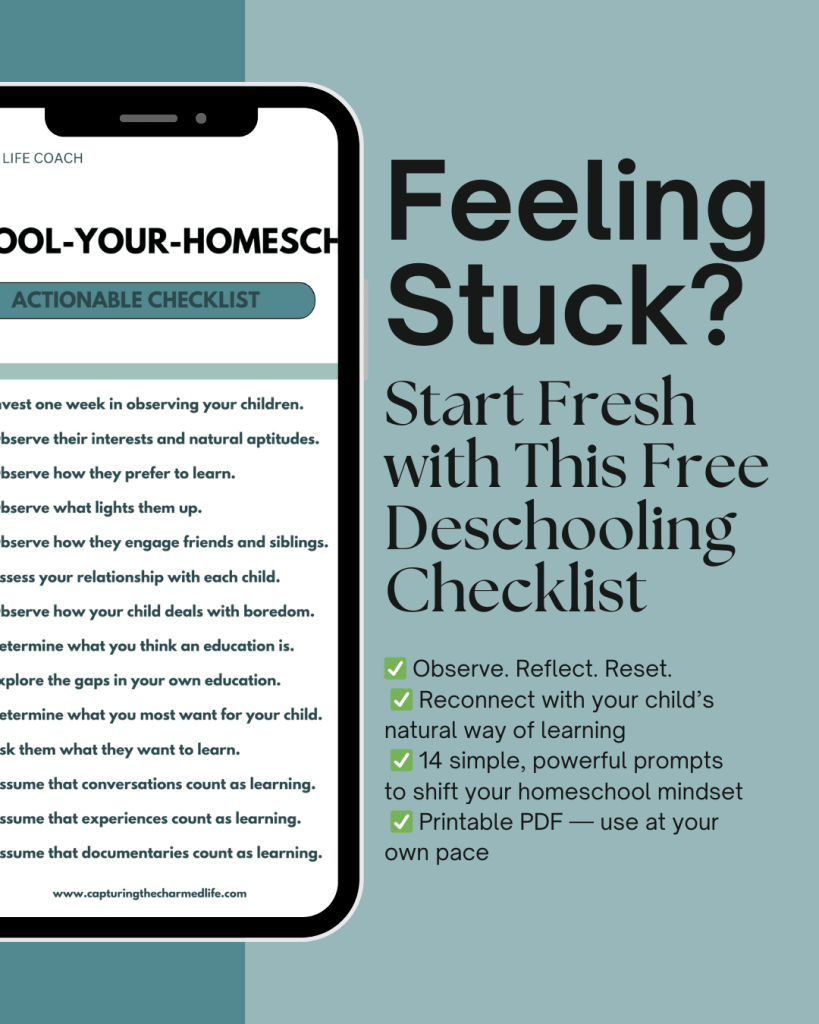
If this resonates with you, a great first step is my free Deschool Your Homeschool Checklist, which helps you step back from school-y thinking, reconnect with how your child naturally learns, and create space for curiosity, calm, and connection.
5 Reasons Why Your Homeschool Child Won’t Do Work
Reason 1: Learning Feels Like a Chore
Many children resist because they’ve learned to associate “learning” with compliance or tedium. They may rush through assignments just to get them done or outright refuse work that doesn’t interest them.
To be fair, we adults do that too. When someone says, “Hey, you know what would make tax season easier and more satisfying? Take a course on filing your taxes.”
Interesting, you think, and clever, that’s exactly what I should do! (No, you don’t think that. You think, naw, thanks, I’ll do what I have to do until next tax season.) Can I hear an amen? ps don’t respond if you actually enjoy doing taxes, ha–it won’t serve my point;)
Well, ditto for your kids.
Stanford psychologist Carol Dweck explains that a fixed mindset develops when children feel their worth is tied to “doing it right.” In these cases, resistance is not a character flaw—it’s a protective response.
What you can do:
- Follow your child’s curiosity whenever possible.
- Show them that learning happens everywhere: in the kitchen, in nature, in everyday problem-solving.

Reason 2: When Your Homeschool Child Won’t Do Work—Check Your Own Motivation First
Kids are highly sensitive to the adults around them. If you’re scattered, anxious, or uninspired, they pick up on it. Angela Duckworth, author of Grit, notes that parents who raise resilient, motivated children model passion and perseverance in their own lives.
And isn’t that what we all want? This homeschool lifestyle isn’t just equipping our kids to do live a purposeful life, it’s offering us that opportunity too! (And I encourage you to take it!)
What you can do:
- Reconnect with your own curiosity and goals. Are you motivated? What gets you up in the morning?
- Model learning and persistence in ways your child can observe. Show them you’re engaged by joining a book club, starting your own business, or simply signing up for a class at the local community college.
- Show them that you’re learning math concept right alongside them (or whatever other topic you find challenging, I chose math because I had to learn it before I taught it😉)
Reason 3: Structure Alone Isn’t Enough
Many homeschool moms implement schedules or expectations without including their kids in the process. Without buy-in, structure becomes a battle.
Duckworth calls this “wise parenting”—demanding and supportive at the same time. High expectations and warmth foster engagement, grit, and independence.
What you can do:
- Invite your children into creating the schedule and deciding how work is done.
- Ask: What time of day works best? Which subjects energize you? Which feel draining?
- Let them have voice and choice—engagement increases when they co-create their learning plan.

Reason 4: Consider Development & Learning Differences
Some children struggle with attention, sensory processing, or social learning differences. Others are naturally extroverted or highly active, making sitting still for traditional lessons difficult.
What you can do:
- Observe and adapt: maybe shorter, hands-on sessions work better, or learning outdoors is more effective.
- Seek resources or support if neurodiverse needs are affecting motivation.
- Tailor learning to each child’s natural rhythms and strengths.
Reason 5: Repairing Past Learning Experiences
A child who’s been burned out by school, shamed, or pressured to perform may resist homeschooling simply because it reminds them of those experiences. Resistance can sometimes look like rebellion—but it’s often about relationship and trust.
The relationships we have with our caregivers and our educators directly impact our capacity for learning. I have stories from my own childhood, and I’m confident you do too, that reveal this truth:
- when we feel shamed, our brain doesn’t want to learn, it wants to hide.
- when we feel pressured, our brain likes to turn off or panic.
- when we are overwhelmed or tired, we just need rest.
“No significant learning can occur without a significant relationship.”
— Dr. James P. Comer, Yale professor and child psychiatrist
What you can do:
- Assess your expectations (signing up for that Deschool Checklist will definitely help with that).
- Focus on curiosity, connection, and joy in learning rather than grades or completion.
- Rebuild confidence through small wins and playful, meaningful learning experiences.

What You Can Do Right Now
Check in with yourself. Are you motivated, present, and energized? Kids pick up on your energy.
Talk with your kids. Not “here’s the schedule, follow it”—but “what’s working, what’s not, how can we do this together?”
Notice the context. Resistance often points to developmental, relational, or environmental factors worth exploring.
If You Don’t Have to Figure This Out Alone
Rebuilding motivation, creating a homeschool life that feels purposeful and enlivening, and addressing deeper layers isn’t always simple when you’re doing it alone.
If you’re ready to stop spinning your wheels and build a homeschool that works for your real life, book a free Aligned Homeschool Reset Session. We’ll create a personalized plan that meets your family where you are right now.
Book your free Aligned Homeschool Reset Session
I help homeschool moms release pressure, edit expectations, and make small, intentional shifts that lead to a more confident and connected homeschool life.
Turning Resistance Into Curiosity and Collaboration
If this sounds familiar, know this: when your homeschool child won’t do work, it’s rarely a reflection of failure. Often, it’s a signal that they—and the family system—need more curiosity, engagement, and connection.
When you pause, observe, and involve your children in shaping their learning—and when you check in with your own motivation—you can turn resistance into curiosity, engagement, and collaboration. Whether it’s through small shifts in approach, creating structure with buy-in, or getting support in untangling relational or developmental challenges, there’s a path forward.
Further Resources You Might Enjoy
For more guidance and inspiration, check out these posts and tools:
- How to Motivate Your Homeschool Child toward Curiosity & Independence
- Reimagine Homeschool: Nine Simple Steps to Plan for Confidence & Clarity
- Curiosity and Education: How to Facilitate It
- How to Homeschool Middle School with Confidence
- How to Incorporate Play Into Your Homeschool Day
- How to Deal With Homeschool Boredom
- Homeschooling Mom Shares 10 Useful Tips to Empower Your Teenagers
