Homeschool mama, years of parenting and homeschooling responsibilities occupy your attention.
Yet all these activities don’t necessarily reflect your core individuality.
Do you know who you are homeschool mama?
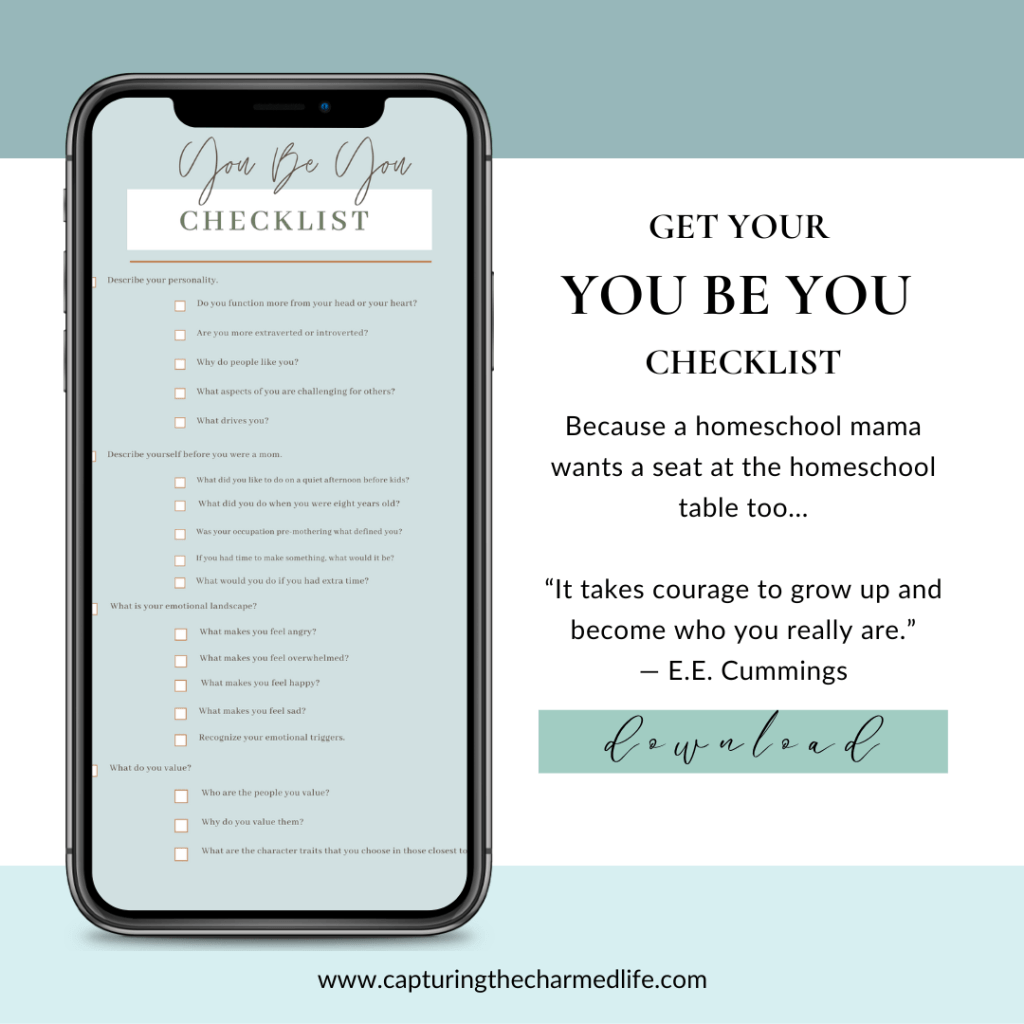
“It takes courage to grow up and become who you really are.”
— E.E. Cummings
Introducing me: a homeschool mama of four kids.
I am a homeschool mama who is organized, empathic, no-nonsense, impatient, spontaneous, fun, methodical, intentional, and I’ll add, occasionally perseverating. I am a philosopher and a natural-born encourager.
You know that I can talk to anyone, yet I tire of small talk.
I like to share what I know, but I’m not a teacher. I’m a planner, an idea creator, and a creative, but not in the sewing, watercolour art way.
Before I was a parent, I was a newly trained registered nurse with adventurous hopes of practicing in the Arctic and Africa.
I liked…
- watching movies, my very favourite is Age of Adeline, my second favorite, Almost Time,
- perusing bookstores with a coffee,
- and writing stories since I was printing,
- compiling pictures, my phone is full, and my Instagram is easy to curate,
- and creating photo albums,
- and I was timid in social scenarios.
Who are you & what do you know about you?
Have you learned more about yourself through the enneagram, meyers briggs, or human design profile? Do you understand your core motivations and how your core motivations align (or don’t align) with those in your family?
Recognize yourself as a separate person with a unique personality, needs, and interests. You are not just a homeschooling mama.
“You be You,” the cool folks say. But who be you?
Who were you before you were a mother?
- What occupied your spare time before you had a family?
- What activities did you love?

Our interests become distilled over time and we’re confident in being them. And we’re confident in not being other things.
Let me tell you about me:
We don’t care that others downhill ski in the winter months and that we might be the only family in town that doesn’t.
We don’t care that some think our interest in finishing a Goodreads reading list is boring.
There’s no place I’d rather be on a weekend evening than reading a book with a glass of wine in front of my wood-burning fireplace with a cozy blanket.
Just as important as acknowledging our interests is acknowledging our internal experiences.
What do you know about your emotional atmosphere? It’ll tell you a whole lot about the climate of your soul: your penchant for melancholy, or your penchant for always looking on the bright side?
You need to pay attention to your internal world.
- What can you tell me about your feelings and thoughts, and how you react, feel, or think in different scenarios?
- What makes you feel angry, disappointed, cheerful, sad, or delighted?
- Do you consciously know what thoughts preoccupy you throughout the day and why?
Over time, when we have repeatedly listened to our internal world, we know who we are and what we’re about and we also know what we’re not.
- We become familiar with our internal thought and emotional landscapes.
- We know how we react to a child whose legs are flailing in the children’s section at the Bay (not to be specific), and what we react to (like a child who gets anxious when asked to find her shin pads), and learn to curb those emotional triggers (we move to the other room.
- We recognize that when more than one child talks at the same time, we feel overwhelmed.
- When more than three kids fight, we want to yell louder to get their attention.
- We know that when someone says, “Oh, you homeschool? I couldn’t do that. I’m just not patient enough”. (And you’re not sure what to say because you know you aren’t either).
- We know that when we watch them sleep, we know they’re the most perfect beings in this world and we declare we have the best job in the world.
When we know these things about ourselves, we can learn to accept ourselves.
Who are you when you don’t care what other people think of you?
Instead of trying to be what we understand others expect of us, we need to let ourselves just be. Trying to be what others need us to be isn’t real. We can be ourselves without requiring others’ approval.
Keep learning, keep paying attention, and keep growing.
If the journey of becoming yourself wasn’t encouraged in you since the day you were wandering toddlers in a shopping mall, you need to nurture it for yourself.
Not everyone is interested in you becoming your own self. Others might have a different prescription for you.
If you become more you, and change from what they know, you might not fill the same role in their world. But they’ll learn and adjust and come to appreciate the real you.
If we are self-nurturing and self-affirming, we learn not to listen to other’s prescriptions. We’ll develop such a strong sense of self that we will be able to listen to others’ perspectives with respect, honour their feelings when they don’t make any sense to us, and acknowledge their ways of doing things as simply different, not bad.
We’ll become people who are comfortable being ourselves but also comfortable with others being themselves.

Steps to becoming more you:
- Remember who you were before you were a mother.
- Acknowledge what you liked to do before you were a mother. Do you want to resurrect a few childhood interests & what might they be?
- Acknowledge what new aspects you enjoy now. What additions have been made in your life now?
- What are your lifelong emotional challenges? Where do they originate?
- In the middle of the night, when you wake up and can’t get back to sleep, what occupies you?
- Make something. Peruse Pinterest, a magazine, or YouTube. What would you want to make if you had all the time in the world or had someone teaching you?
- What kind of musical concert would you attend if you had the money or time? Sit with Spotify and a favourite drink and listen to a taped concert, the whole thing. Or book concert tickets.
What else could you do the become more you, homeschool mama?
- Write a list of the people you value, and why.
- Write a list of your three most important values, and why they are important to you.
- Find your mantra. For a while, mine was ‘carpe diem. Now that I’ve seized enough days, and that notion is built into my bones, I’m seizing other mantras, like “this life is for learning, for authentically sharing, and being” or “everything is working for good in my direction.”
- Choose your daily words. Write them in your journal each morning. I have four this year: Monetize. Understand. Expand. Separate. These are daily reinforcements that help me focus.
- Support others as they make choices that don’t seem instinctively natural to you. For example, permitting young kids to make musical choices in the car that you would never listen to.
- Spend a day away from the kids. Don’t do anything FOR the family. Then you’ll see what interests you. Have no expectations for the day.
- Meditate. Every day. This facilitates listening to the inner voice, to identify what’s going on inside you.
Try these thought experiments from Psychology Today author Hal Shorey, Ph.D., professor of clinical psychology at Widener University’s Institute of Graduate Clinical Psychology.
1. Look up from your screen and observe your surroundings. Suspend judgment and think about this thought independently of your feelings. Is there anything wrong at this moment? Many who do this exercise will respond ‘no’. Sometimes we focus too much on what has happened in the past or our painful stories. But really, everything is okay right now.
2. If you lose your memory tonight and cannot recall any painful past, could your day be different tomorrow? Would you go about your day and enjoy the things you see and the people you encounter?
3. Daydream, imagine that you are in a different world, how might you carry yourself or see yourself in the world? Would you feel differently? Allow the emotions and thoughts of that other form to come into your body.
4. Look into your eyes in the mirror and ask “What am I?”
The self-learning journey is for a lifetime. You’ve got you to explore your entire life.
Teresa Wiedrick, author of Homeschool Mama Self-Care: Nurturing the Nurturer
A Daily Homeschool Mama Journal for You!
Introducing the Daily Homeschool Mama Journal, your perfect companion to build time for yourself! With daily journal questions, weekly planner, and self-care activities, enhance your self-awareness and explore your identity while taking care of yourself. Start practicing self-awareness today!
People also ask…
- How to become more you as a homeschool mom?
- Do you know who you are as a homeschool mama?
- my identity as a home educator
- Tell me more about your homeschool mama retreat.
- I’m a new(er) homeschooler, do you mentor me too?

Teresa Wiedrick
I help overwhelmed homeschool mamas shed what’s not working in their homeschool & life, so they can show up authentically, purposefully, and confidently in their homeschool & life.
