Picture this: Your teenage daughter is deep in her sketchbook, completely lost in a world of colour and ideas. Hours have passed. You’ve reminded her twice about the history reading she hasn’t touched. The tension in the room is rising — and so is your frustration. You love her creativity. You also love her future. And right now, those two things feel like they’re at war.
If you’ve lived a version of that moment, you already know how quickly a homeschool day can slide from connected to conflicted. The Enneagram for homeschool moms exists for exactly this — to help you understand why those moments happen and what to do about them.
That’s where the Enneagram can help you. And it’s exactly why the Enneagram for homeschool moms is such a powerful place to understand every person under your roof.
The Enneagram is a self-awareness system that goes deeper than behaviour. It uncovers the core motivations, fears, and default settings that drive how we show up — in our homeschools, in our marriages, and in our own hearts.
It doesn’t just describe what you do. It illuminates why. And when you understand the why, everything changes.

Why the Enneagram for Homeschool Moms Goes Deeper Than Other Tools
Most personality tools describe your tendencies. The Enneagram reveals your wiring.
It identifies nine distinct types, each rooted in a core motivation — what you’re moving toward, what you’re afraid of, and how you respond under stress. These aren’t labels that box you in like some personality profiling systems. Rather, they are maps that help you find your way out.
When I first learned I was an Enneagram Type 2 — the Helper — it landed with a kind of quiet recognition. But I wasn’t proud of it. (Specifically because it revealed to me that I was of the proud sort of person;)
Of course I want to help people. That part felt obvious. (It’s why I’m coaching).
What surprised me was the deeper layer: the way I can help to a fault, pouring myself out for others, and then quietly wondering why no one seems to be bringing that same energy back to me. It’s not resentment, exactly. It’s more like…confusion. Why isn’t anyone else doing what I’m doing?
That’s the gift of the Enneagram. It helps you see the invisible rules you’ve been living by — and gives you the freedom to choose differently.
For homeschool moms, this matters enormously. We are teachers, parents, partners, household managers, and if we’re pursuing self-growth, we’re also coaches of our own hearts. Understanding our own type is the foundation that makes all of that sustainable.
Understanding Yourself First: Enneagram for Homeschool Moms
In my coaching work, I see certain types show up often among homeschool moms: the Type 9 who keeps the peace at all costs, the Type 1 who holds the standard high and feels the weight of getting it right, the Type 2 who gives and gives and forgets to receive, the Type 4 who feels things deeply and craves meaning in every day, the Type 5 who researches every curriculum decision three times before committing. Sound familiar?
Wherever you land on the Enneagram, your type shapes how you experience the homeschool day — what energizes you, what depletes you, and what sends you into stress patterns you might not even recognize until you’re already in them.
The Enneagram works through motivations, not just behaviours. Two moms can both yell at their kids when things go sideways — but one might be driven by a fear of disorder, the other by a fear of being overlooked. The action looks the same. The root is completely different. And the path forward for each of them is different, too.
When you understand your own default settings, you stop blaming yourself for being ‘too much’ or ‘not enough.’ You start seeing yourself clearly — with grace and with honesty — and that changes how you show up for your kids every single day.
Understanding Your Kids Through a New Lens
Let’s go back to that moment with your daughter and her sketchbook. Now let’s say you know she’s a Type 4. Type 4s are driven by a need for authenticity and meaning. They lose themselves in creative work not because they’re avoiding responsibility, but because that immersive creative space is where they feel most alive. Interrupting it feels, to them, like being pulled out of the only place that makes sense.
And let’s say you’re a Type 1. You hold a high standard. You believe deeply in doing things right — and giving your daughter an excellent education is part of that. Your frustration isn’t controlling. It comes from love and a genuine sense of responsibility for her future.
Neither of you is wrong. But without that understanding, you’re both just reacting to each other’s surface behaviour. With it, you can actually talk about what’s happening — and find a rhythm that honours both her need for creative immersion and your need to know she’s prepared.
This is exactly the kind of breakthrough I’ve seen happen in coaching. Here’s what one mom shared after doing this work:
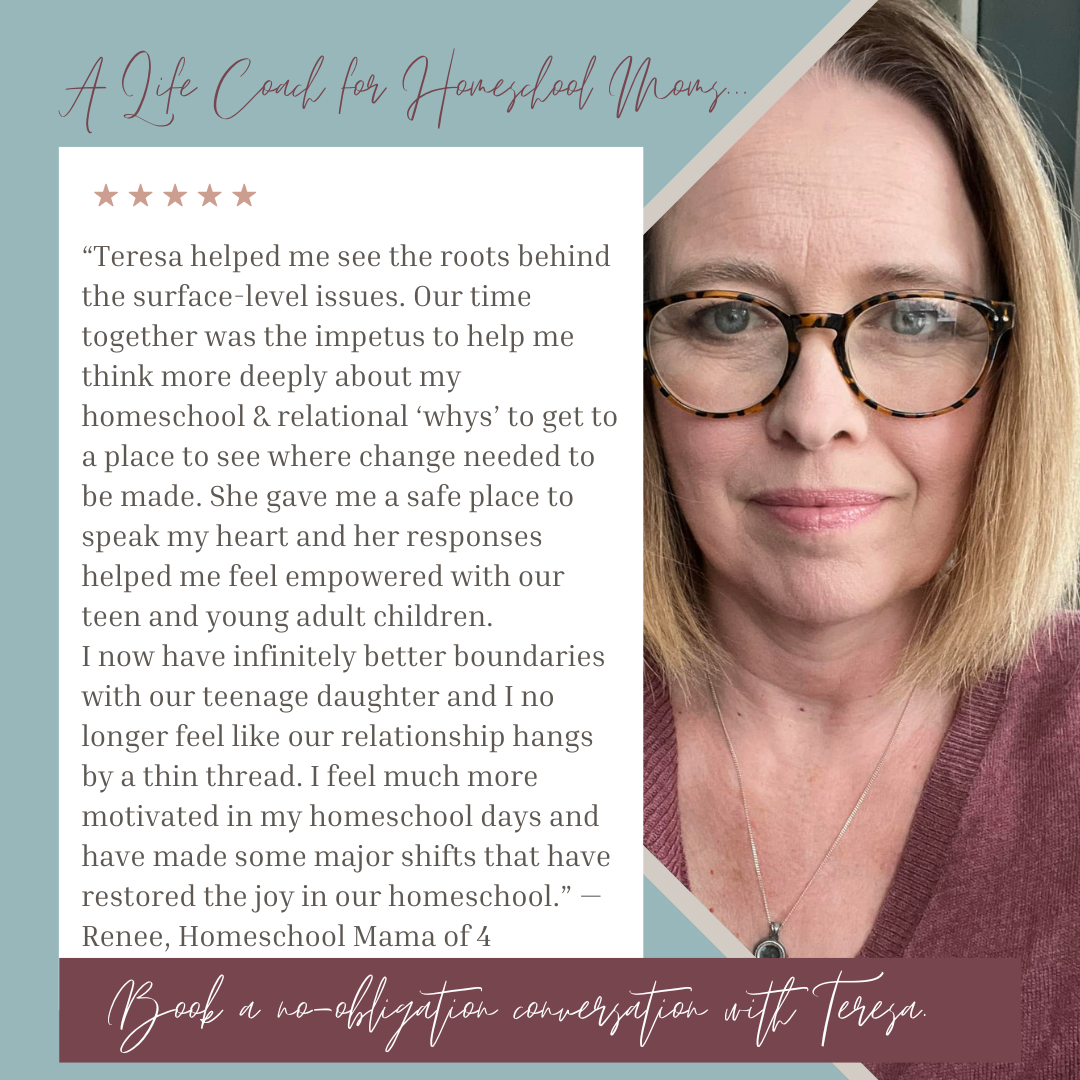
That transformation didn’t happen by accident. It happened because she finally understood the why — hers and her daughter’s — and that understanding gave her something to work with.
Different types also learn differently. A Type 3 child is motivated by achievement and thrives with clear goals and measurable progress. A Type 9 child may need more transition time between activities — not because they’re slow, but because their inner world moves at a different pace. When you use the Enneagram as a homeschool mom, you stop forcing a square peg into a round hole and start designing a homeschool that actually works for who your child is.
Understanding Your Partner (and Why You Parent So Differently)
Here’s something nobody tells you before you become a parent: you will not agree on everything.
You will, in fact, sometimes feel like you’re parenting on opposite ends of the universe — one of you drawing hard lines, the other softening every edge.
And you probably entered parenthood without a clear philosophy. You thought you had one, because you were parented yourself and you had ideas about what you’d do differently or better. But until you’re actually in the thick of it — navigating a toddler’s meltdown or a teenager’s silence — you don’t really know what your default settings are.
Those defaults? They come from the same hardwired motivations the Enneagram speaks to.
Take the Type 9 mom and the Type 8 dad. She leads with a deep desire for harmony — conflict feels costly to her, and keeping the peace isn’t weakness, it’s her default way of holding the family together. The Type 8 dad leads with directness and confidence. He’s not anti-harmony, but he is mostly unafraid of conflict. He says what he wants, expects what he expects, and assumes everyone will work it out. Neither of them is wrong. But to each other, they can look baffling.
She can feel steamrolled. He can feel like he’s pushing against someone who won’t tell him what she actually needs.
Their kids are caught in the middle — sometimes getting firm limits from dad, sometimes getting gentle flexibility from mom — without either parent fully understanding why the other operates that way.
The Enneagram doesn’t solve this overnight. Parenting alignment is a long journey, and the Enneagram is a compass, not magical fairy relationship dust.
But it gives couples a language. It helps the Type 9 mom find her voice — to confidently and competently assert her needs and expect her partner to actually hear them. It helps the Type 8 dad understand that his partner’s quietness isn’t passive agreement; it’s self-protection. And it helps both of them see that their kids may actually benefit from the range — that having one parent who sets firm expectations and one who offers a soft landing isn’t a flaw in the family system. It can be a gift when it’s understood and chosen rather than fallen into by default.
The goal isn’t to parent identically. (That ain’t happening!)
The goal is to understand each other well enough to parent collaboratively — and to honour that each of you will have a different relationship with your children, and that is okay.

Self-Awareness Is Just the Beginning
Understanding your type, your child’s type, and your partner’s type gives you the map. But a map without action doesn’t get you anywhere.
The real transformation happens when awareness becomes action — when you take what you know and apply it to the daily rhythms of your home.
That means setting boundaries that actually fit who you are. It means learning to start your day grounded instead of reactive. It means knowing your own stress patterns well enough to interrupt them before they spill onto your kids. And it means having language for why your daughter needs what she needs, and why your husband parents the way he does, and why you give the way you give — so that all of it can be talked about, worked with, and grown from.
That’s the work. And it’s worth it.
Ready to Take the Next Step?
If this resonated with you, I’d love to give you something practical to work with right away. My free Boundary & Relationship Building Checklist and email series will help you:
- Start each homeschool day grounded and protected, with daily practices that put you first
- Set boundaries that create respectful, connected interactions with your kids and partner
- Work through the guilt, overwhelm, and emotional triggers that show up in your homeschool day

Want to Go Deeper? Start Here.
These are my favourite resources for learning the Enneagram:
- The Road Back to You by Ian Morgan Cron — a warm, accessible introduction to all nine types
- The Enneagram Guide to Waking Up by Beatrice Chestnut and Uranio Paes — a deeper dive into motivations and growth paths
- Enneagram podcasts and YouTube channels — search for episodes on parenting and family dynamics to see the types come to life in real relationships
- Take your free Enneagram test
The Enneagram for homeschool moms isn’t about fitting yourself or your kids into a box. It’s about finally having a framework that makes sense of the complexity you’re already living. It won’t make the hard days disappear. But it will change how you see them — and how you move through them. You’ll understand yourself better, teach your children with more intention, and partner with your spouse with more grace. That’s not just a better homeschool. That’s a better life.
You May Also Want to Read:
- Understanding the Enneagram for Homeschoolers
- Grow Yourself Up: A Guide for Homeschool Mom Personal Growth
- Foster Strong Relationships in Your Homeschool Family
- Where is your Relationship RESET Workbook
- Relationship Revolution: Level Up Your Homeschool Mom Connections!
- The Ultimate Guide to Building Boundaries and Healthy Relationships for Homeschool Moms
- How to Stop People-Pleasing as a Homeschool Mom (One Mom’s Story)
- How to Stop the Inner Critic as a Homeschool Mom: The Charmed Life I Was Chasing (& the Pattern I Didn’t Know I Was Living)
- Interest-Led Homeschool for Confident Moms: An Enneagram 8 Mom’s Story of Growth
- 5 Reasons Your Homeschool Child Won’t Do Work & How to Motivate Your Child
- Fed Up with Homeschool? 18 Strategies to Regain Joy