
Podcast: Play in new window | Download
Prefer to listen? I go even deeper on this in Episode 2 of the podcast — “Root Yourself in Your Vision.”
There were seasons of homeschooling that weren’t easy; they weren’t freedom-filled, and I got really REALLY tired of the homeschool thing. I will show you how to create a homeschool vision statement.
Ever feel like you’re running a private school at home instead of living the freedom-filled homeschool life you dreamed of? Trust me, I’ve been there.
But first, does this sound familiar?
Maybe you’re struggling with:
- Trying to keep a private school at home
- Hoping your house will stay clean (ha!)
- Navigating relational issues with your kids
- Feeling like you’re always defending your homeschool choice
- Getting upset daily because of kid conflict, big emotions, or complaints about routines
(If this list hit close to home, I’ve also written about 6 Great Challenges Every Struggling Homeschool Mom Faces — and How to Transform Them.)
Before we go any further — if any of that sounds familiar, start here. Take the free 8 Things quiz to name what’s actually driving your overwhelm right now. It takes about five minutes, and it’ll make everything below land more specifically for you.
The Story I Didn’t Expect to Tell You
A few years ago, I went in for a routine eye exam. I’d been nearsighted since grade six — decades of it, so normal to me I’d stopped noticing it wasn’t. But something had shifted. Things felt a little darker at night. Meanwhile, headlights from oncoming cars started genuinely aggravating me — which was strange, because I am not, as a rule, a “triggered driver.” At first, my optometrist couldn’t tell exactly what was going on. Possibly MS. Possibly something behind my eyes. Understandably unsettling.
The actual answer, from my ophthalmologist: cataracts. (Officially too young for those, thank you very much.)
Here’s what nobody prepared me for. When they removed the cataracts and replaced the lenses, I didn’t just go back to how I used to see. Instead, I stopped being nearsighted entirely — for the first time since childhood. Suddenly, I could read signs a mile down the road. My family was in awe.
In fact, I didn’t return to some earlier baseline. I saw better than I ever had.
That’s what this work does for your homeschool vision, too. It’s not about getting back some clarity you lost. It’s about seeing further than you’ve ever seen — for the first time, not the first time in a while.
Why Every Homeschool Needs a Vision Statement
Years ago, at a homeschool conference, someone challenged me to create a vision statement. My first thought? “I don’t have time for that!”
Months later, half-jokingly, we wrote our first one anyway. My kids and I, together. Here’s just the first couple lines:
“We, the Wiedrick siblings, in order to form a more healthy relationship and have a happier home, do solemnly intend to do the following: help a sibling out, take turns, and share…”
(I won’t share the whole thing — it went on much longer.)
It went on the fridge. In fact, it stayed there for a very long time. And though it was mostly written by a couple of pre- and early-adolescent homeschool teens who were at the absolute end of their patience with younger siblings — that fridge document actually set the tone for our vision and our expectations, for years.
Later, I started choosing one word for the year, just for myself. Sometimes a word for each child, each year. Sometimes it was a whole blog post where I worked through what our vision actually was for that particular homeschool season. It became a practice, not a project.
But here’s what I didn’t realize back then: a vision statement becomes the Google Maps of your homeschool journey. It tells you how to get where you’re going, what turns to take, and helps you navigate the terrain.
That’s exactly why you need to create a homeschool vision statement of your own.
This is How to Create a Homeschool Vision Statement Together
Step 1: Envision Your Ideal Homeschool Day
Take 15 quiet minutes (I know, I know, it’s hard to find 15 minutes – but find them! This matters.) and imagine your ideal homeschool day:
- What time does everyone wake up?
- What’s the atmosphere in your home?
- How are your kids engaging with learning?
- What does connection look like?
- How do you feel at the end of the day?
Write down everything that stands out. For me, the word “freedom” kept appearing. Which led to some uncomfortable questions…
Once I had that word, I started asking myself the question constantly. In fact, it became a ritual — during this fifteen-minute window I’d carve out after lunch. First, coffee. Then, a couple of Italian cookies I kept hidden under the white armchair in the corner of my bedroom, so nobody else would find them. Just fifteen quiet minutes with my own thoughts. So: is what we’re doing today actually serving freedom? Also, are the activities we picked this week serving freedom? And is the way I’m making my kid sit through this workbook actually serving freedom?
Which led to some uncomfortable questions…
Was it freedom that:
- Equipped me to keep an 8:00 to 3:30 schedule?
- Required me to check off every box in that expensive curriculum?
- Compelled me to keep my home pristine?
- Fueled my approach to kid conflict?
(Spoiler alert: NOPE!) …that one word became the seed I used to create a homeschool vision statement I actually stuck with.
Step 2: Align Your Values for Your Vision Statement
Grab some index cards and write down words that matter to you. Here are some to start:
- Freedom
- Connection
- Curiosity
- Growth
- Joy
- Peace
- Creativity
- Adventure
(ps — go to Google for more value words)
Sort them into three piles: “Must Have,” “Nice to Have,” and “Not Essential for Us.” Pick your top 5. These become your compass points.
(Stuck on finding your own word? How to Choose Vision Words for Your Homeschool and 5 Creative Ways to Design a Homeschool Mom Personal Vision can both help you.)
Want to go even deeper than index cards? The Reimagine Your Homeschool mini-course walks you through this exact process, step by step, for $17.

Step 3: Reality-Check Your Homeschool Vision Statement
Draw a circle and divide it into 8 sections:
- Academic Progress
- Family Relationships
- Physical Environment
- Parental Well-being/Engagement
- Child Well-being/Engagement
- Life Skills
- Community Connection
- Resource Management
Rate your satisfaction in each area from 1-10. This shows you where your vision might need extra attention.
When I did this exercise years later, I discovered something profound: clarifying my values helped me know whether this homeschool thing was really accomplishing what I had deeply hoped – freedom.
Turning Your Vision Statement into a Homeschool GPS
A finished homeschool vision statement helps you:
- Make curriculum choices that align with your values
- Handle routine or schedule decisions with confidence
- Navigate challenging days with purpose
- Say “no” to things that don’t serve your family’s mission
- Say “yes” to opportunities that matter most
This isn’t just another task on your to-do list. Rather, it’s the foundation for building the homeschool life you’re dreaming of — one where your values and your daily reality actually match up.
And when I finally leaned into that value, everything changed.
Ready to create your vision statement? Grab a cup of coffee, find those 15 quiet minutes, and let’s turn your homeschool dreams into reality. Because knowing your WHY changes everything.
Ready to Create Your Vision Statement?
If today’s post has you wondering what your own word might be — the Reimagine Your Homeschool mini-course is $17 and walks you through the full process, one small step at a time.
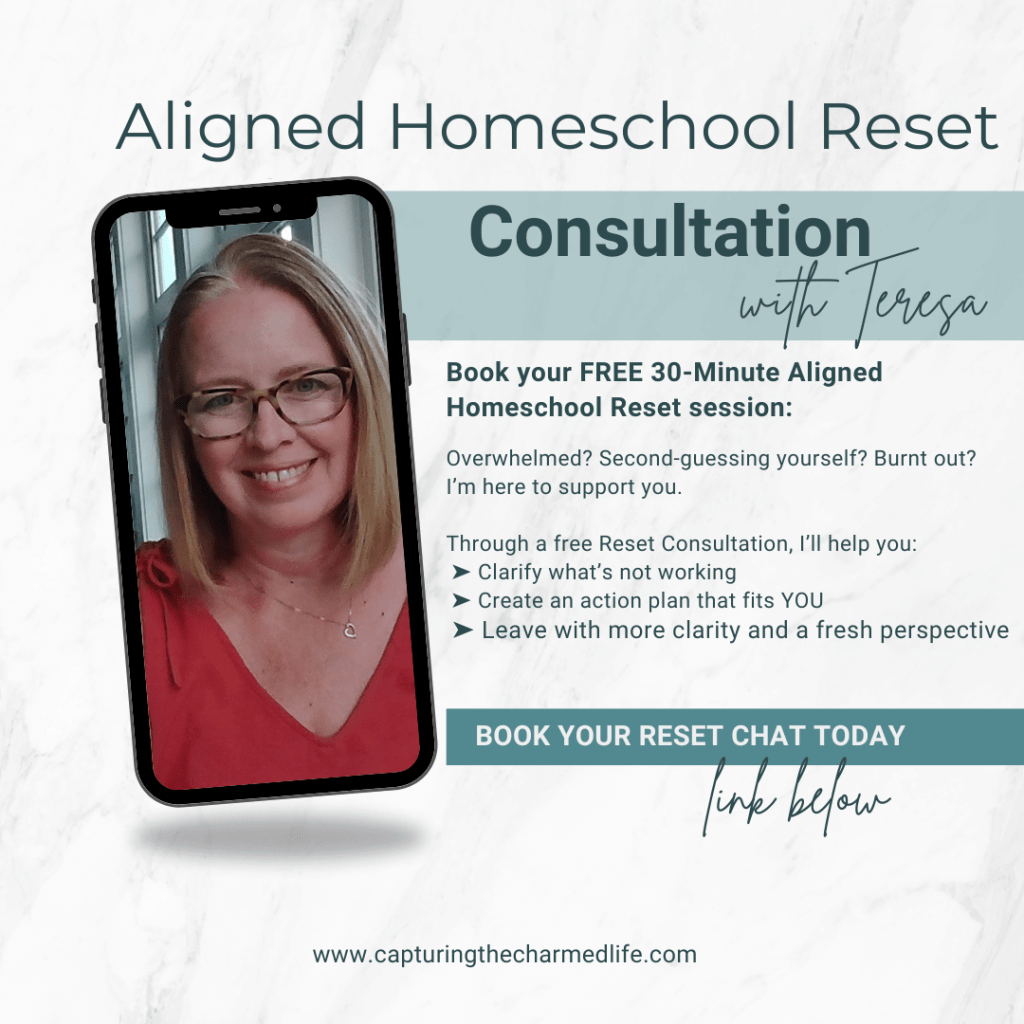
Not ready for that yet? Book a free Aligned Homeschool Reset Session with me instead — no obligation, just a real conversation about what you’re actually carrying.
(Curious what working with a coach actually looks like? 8 Great Reasons a Life Coach for Homeschool Moms Will Benefit You walks through it.)
Not ready for a full vision statement session?
Book a free Aligned Homeschool Reset call, or start smaller with the free Homeschool Mom Permission Slip Checklist — a reminder that you’re allowed to rest, simplify, and build a rhythm that supports your whole family.
Either way, here’s what I want you to hear: your homeschool isn’t just about your children’s education. It’s also about the person making it possible. You are your kids’ greatest curriculum.
— Teresa Wiedrick, Certified Life Coach, host of the Confident Homeschool Mom Podcast
People also ask:
Crafting a Vision Statement with Your Family Values walks through the process.
A vision statement is the compass — a planner is what helps you actually navigate by it, week to week. The Homeschool Mom Vision Planner is built to do exactly that.
More than people expect — how your day starts often decides whether your values or your reactions are running the show by 10 am. Here’s what I think about a homeschool mom morning routine.
The help you need might be a different kind entirely. Unique Homeschool Help to Reimagine Your Homeschool.
Your vision and your family’s vision aren’t always the same conversation — here’s how to bring them together. Find a Vision for Your Homeschool Family.
Sometimes clarity comes faster with company. Join the Homeschool Challenge for Clarity, Confidence & Vision.
Short answer: no — and chasing the “right” philosophy can actually get in the way. Homeschool Philosophies and Why You Don’t Need to Care.
That’s a completely normal place to start from. Homeschool Mom Challenge: Turn Struggles into Confidence.
Also in This Season of Coming Home to Yourself
Episode 1: Coming Home to Yourself
Who this podcast is for, why you are the most important curriculum in your homeschool, and the permission you may not have been given yet.
Episode 2: How to Create a Homeschool Vision Statement
Why we skip our “why,” what it costs us, and how a vision can guide your homeschool year.
Episode 3: How to Understand Homeschool Mom Anger
The emotional atmosphere of your home, why anger is the tip of the iceberg, and the small 11 a.m. check-in that changed my mornings.
Episode 4: Why Do I Lose Motivation Homeschooling Every October?
Why the hope of September fades by mid-October, why you’re not inconsistent but a seasonal being, and how your body and your load change what you can hold.
Subscribe to the Confident Homeschool Mom podcast
Originally published January 8, 2025 at 4:00 am — republished August 15, 2026

Nice post 🌅🌅
Thank you. I’d love to hear why you think so. Are you a homeschool mom?