You might want to consider the Five Love Languages for homeschool families if you identify with this…
Picture this: Your fiercely independent teenager who seems to push you away actually craves your undivided attention. Your hardworking perfectionist who gets teary-eyed when she can’t master something needs to hear “you’re enough” more than she needs another challenge. Your creative free-spirit who loves learning but resists structured lessons just wants to connect with you without an agenda. And your energetic son who craves bursts of connection followed by space to roam and recharge is asking for a different rhythm than his sisters.
Sound familiar?
For years, I thought I was missing something because my well-intentioned efforts kept landing differently than I expected with each of my four kids. Hannah’s independence felt like she didn’t need me. Madelyn’s drive for perfection was worrisome – why couldn’t she accept that mistakes were okay? Rachel seemed so scattered and unfocused, despite being clearly intelligent. Zachary’s need for intense connection followed by alone time felt like such a different pattern from what worked with the girls.
I was speaking love… but they weren’t necessarily hearing it.
Introducing the Five Love Languages for Homeschool Families
That’s when I discovered Gary Chapman’s “The 5 Love Languages” – and realized I’d been having four different translation failures under my own roof. The very behaviours that puzzled me most weren’t problems to solve – they were love languages asking for something different.
Hannah’s independence? A protective response when Quality Time was missing. Madelyn’s perfectionism? Deep attempts to earn Words of Affirmation. Rachel’s less structured approach? Longing for Quality Time without structure. Zachary’s connect-then-roam pattern? His unique way of needing Physical Touch and space in his own rhythm.

Getting to the Root of the Translation Problem
Maybe you’re reading these stories and thinking, “That’s my kid too!” You recognize the translation failures, the well-intentioned efforts that somehow miss the mark, the feeling that you’re working so hard but your child isn’t receiving the love you’re trying to give.
Here’s what I’ve learned: these “lost in translation” moments aren’t just about love languages – they’re often about boundaries and relationship dynamics that we haven’t quite figured out yet. Before we can effectively speak our child’s love language, we need to understand the relationship foundation that makes that language meaningful.
Once you have that foundation in place, understanding and applying the five love languages becomes so much more effective…
If you’re feeling this disconnect with one of your children, I’ve created a practical checklist that helps you identify the relationship and boundary patterns that might be interfering with your connection. Download the “Boundary and Relationship Building Checklist for Homeschool Families” – it’ll help you spot the underlying dynamics before you dive into love languages.
Once you have that foundation in place, understanding and applying the five love languages becomes so much more effective…

Understanding the Five Love Languages in Your Homeschool:
Chapman identifies five primary ways people give and receive love: Words of Affirmation, Quality Time, Physical Touch, Acts of Service, and Receiving Gifts. But here’s what he doesn’t tell you specifically – how these play out in your daily homeschool rhythm.
Words of Affirmation isn’t just “good job” – it’s “I love watching how your mind works through this problem” or “You have such a gift for asking thoughtful questions.” For kids like Madelyn, this language says “you’re valued for who you are, not just what you accomplish.”
Quality Time goes beyond being in the same room. It’s putting down your phone during read-alouds, sitting beside them during math struggles, or letting them lead the conversation during before bed. Hannah and Rachel both needed this, but in completely different ways.
Physical Touch might be high-fives after completing assignments, shoulder rubs during difficult lessons, or respecting when your child needs space after intense connection – like Zachary’s pattern of engage-then-roam.
Acts of Service could be preparing materials ahead of time, helping organize their workspace, or stepping in when they’re overwhelmed – but being careful not to rob them of independence.
Receiving Gifts isn’t about expensive purchases – it’s thoughtful tokens that say “I was thinking of you.” A special pencil for the new physics class, a box of Smarties for the first day of homeschool, or their favorite snack during Fun Friday’s games.
The Homeschool Game-Changer:
When you understand your child’s primary love language, the energy shifts. The resistant child becomes cooperative. The emotional meltdowns decrease. Learning happens in an atmosphere of connection rather than constant correction.
You stop trying to pour love into a bucket with holes and start filling the bucket they actually have.
But here’s the thing – identifying the love languages is just the beginning. The real transformation happens when you learn to integrate these languages into your daily homeschool rhythms, your discipline approaches, and even your curriculum choices.
What’s Next for your Homeschool Family:
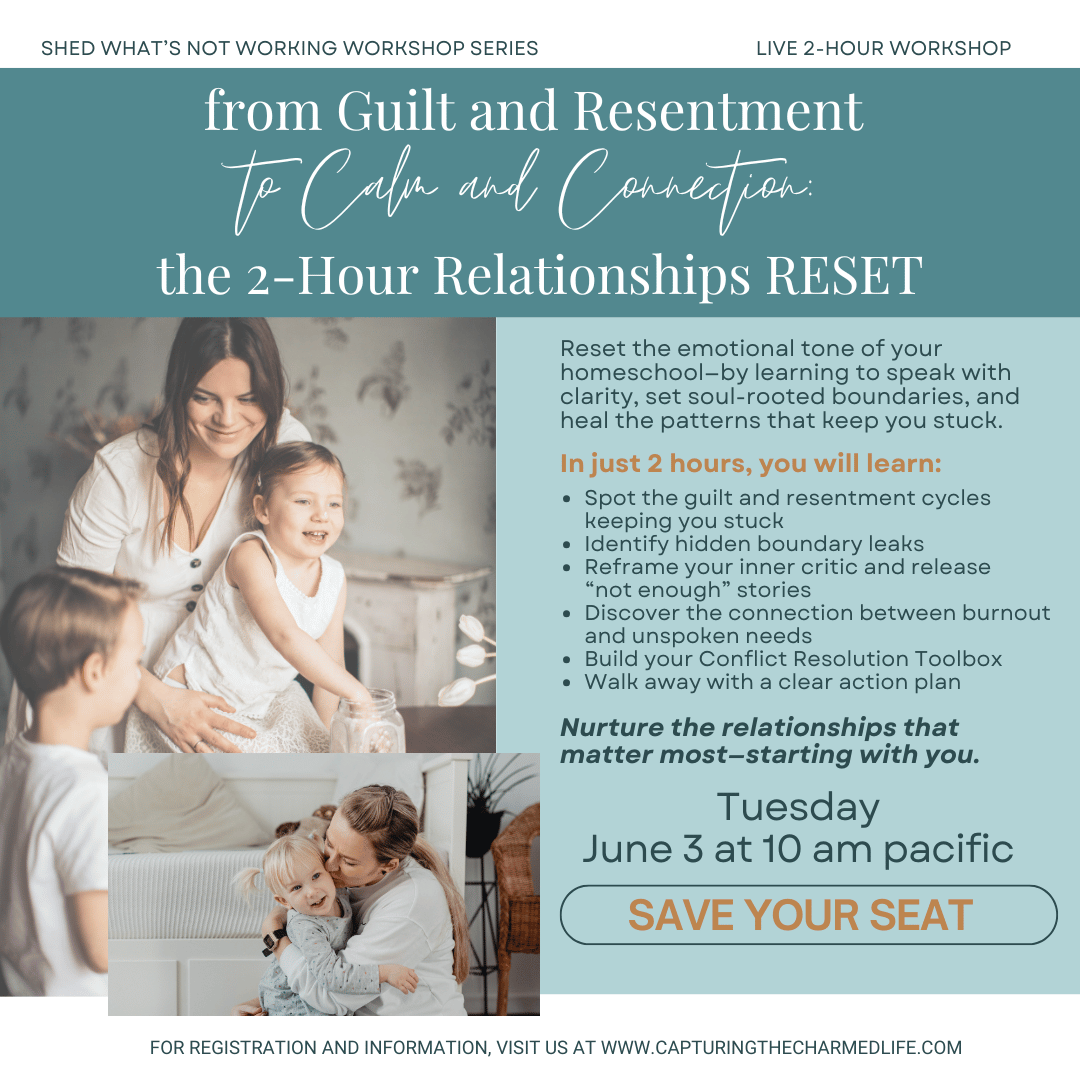
Understanding these love languages changed everything for our family, but implementing them consistently in the midst of busy homeschool days? That’s where the real work begins. On June 3rd, I’m hosting a Relationship Reset workshop specifically for homeschool moms who want to dive deeper into creating these connected rhythms with each of their children.
We’ll be exploring “The 5 Love Languages” together in our Confident Homeschool Mom Collective Book Club this month, where we can share real stories and practical applications with other moms walking this journey.
We’ll be exploring “The 5 Love Languages” together in our Confident Homeschool Mom Collective Book Club this month, where we can share real stories and practical applications with other moms walking this journey.
And if you’re ready for personalized support in applying these concepts to your unique family dynamic, I’d love to chat about how coaching can help you create the connected, thriving homeschool environment you’re dreaming of. Book a no-obligation conversation to discuss it with me.
Because when love gets lost in translation, nobody wins. But when you finally speak the language your child understands? That’s when connection happens.
People also ask:
- introducing Hannah Wiedrick
- Tired of Homeschool Sibling Fights? Try These 3 Simple Strategies!
- introducing Madelyn Wiedrick
- Homeschool Mom Boundary Issues? You’re Not Doing This…
- Meet Rachel: The Free-Spirited, Creative, and Smart Enthusiast
- 7 Practical Boundaries for Homeschool Moms to Protect Energy & Time
- introducing Zachary Wiedrick
- Homeschool Mom Boundaries: 6 Truths That Will Set You Free
- How to Show Up in Your Homeschool
- Homeschool Kids are the Audience to the Homeschool Marriage
- How to Love My Homeschool Husband
- Sibling Bickering in Homeschool Families: What’s Normal & How to Handle It
- How to Love your Homeschool Kids
- homeschool mama book club
- How to LOVE your Homeschool Kids
- Break the Cycle of Homeschool Mom Guilt—and Reclaim Yourself

Teresa Wiedrick
I help homeschool mamas shed what’s not working in their homeschool & life, so they can show up authentically, purposefully, and confidently in their homeschool & life.

