Does it feel like nothing in your homeschool happens unless you make it happen? Here are five signs of overfunctioning as a homeschool mom, and how to start handing responsibility back to others too.
A homeschool mom I follow shared a video this week that made me laugh out loud. She’d wandered into the living room to sit near her kids with a book. Within minutes, she said she realized she “didn’t know I was opening up customer service.”
- Hey Mom, can you get me a snack?
- Did you find that gymnastics form?
- Can I go to Emma’s house to play?
She sat down to read. She ended up running the front desk.
I laughed because I’ve been there. And I’m guessing you have too.
But underneath the joke is a pattern I see clearly in women’s lives:
They’re working so hard, unaware that they are burning out because they’re taking on the responsibility of everyone and everything and not creating space for themselves.
For so many of the homeschool moms I work with, it’s not because their children are demanding or their husbands don’t care. It’s because somewhere along the way, they came to believe something that runs their entire life.
The belief behind the signs of overfunctioning as a homeschool mom
If I don’t hold it, it will fall apart.
One mom told me she’s the only one in her family with the emotional regulation and executive functioning to keep things together. Another told me she carries 95% of the homeschool. Her own number. Not an exaggeration.
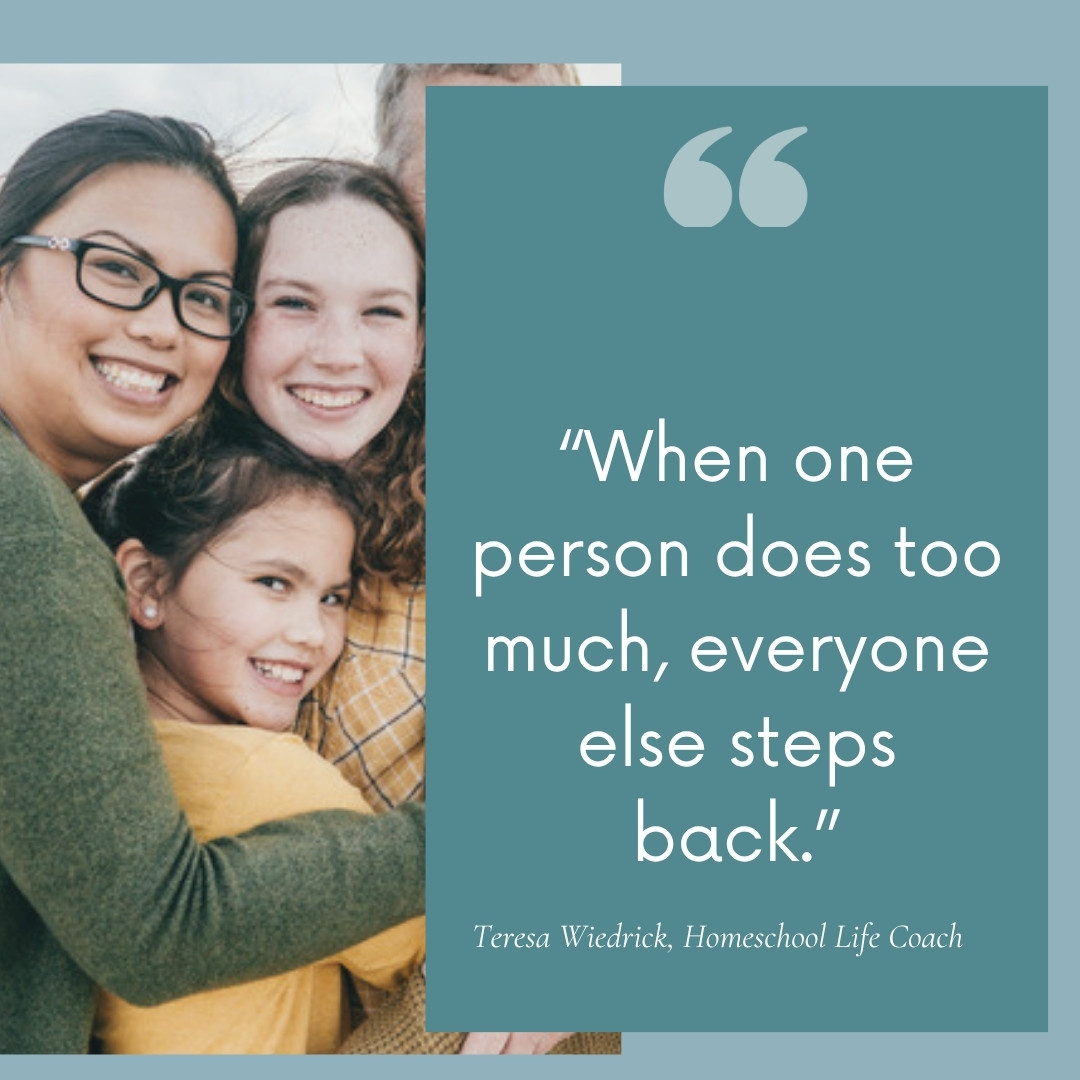
Here’s what makes this belief so hard to shake: it keeps proving itself true. When one person does too much, everyone else steps back. The kids stop offering. The husband stops noticing. The whole family organizes itself around the one who carries it.
And then she looks around and thinks, See? If I don’t do it, no one will.
That’s overfunctioning. However, it rarely looks the way you’d expect.
Not sure whether these signs of overfunctioning fit you as a homeschool mom? Take the Wheel of Personal Growth assessment first, then read on with your results in mind.

Five signs of overfunctioning as a homeschool mom
These are the signs of overfunctioning I see in homeschool mom after homeschool mom.
1. You take your child’s learning struggles personally
Your child doesn’t grasp the concept. Again. And something in you sinks. Not because she’s struggling, but because you feel like you’re failing.
And if you’re measuring your homeschool against someone else’s standard, these signs you need to deschool may hit close to home.
That’s not a woman having a hard day. Instead, that’s a mom who has taken responsibility for an outcome that isn’t entirely hers to control. Of all the signs of overfunctioning, this is the one that hides best in a homeschool mom, because her efforts appear to be dedication.
One mom I work with treats every learning struggle as evidence against herself. When one daughter can’t focus, when another falls behind in reading, when her youngest resists every writing assignment, she doesn’t see her children learning at their own pace. She sees proof that she isn’t enough as a mother or an educator, and she adds each struggle to a running verdict against herself.
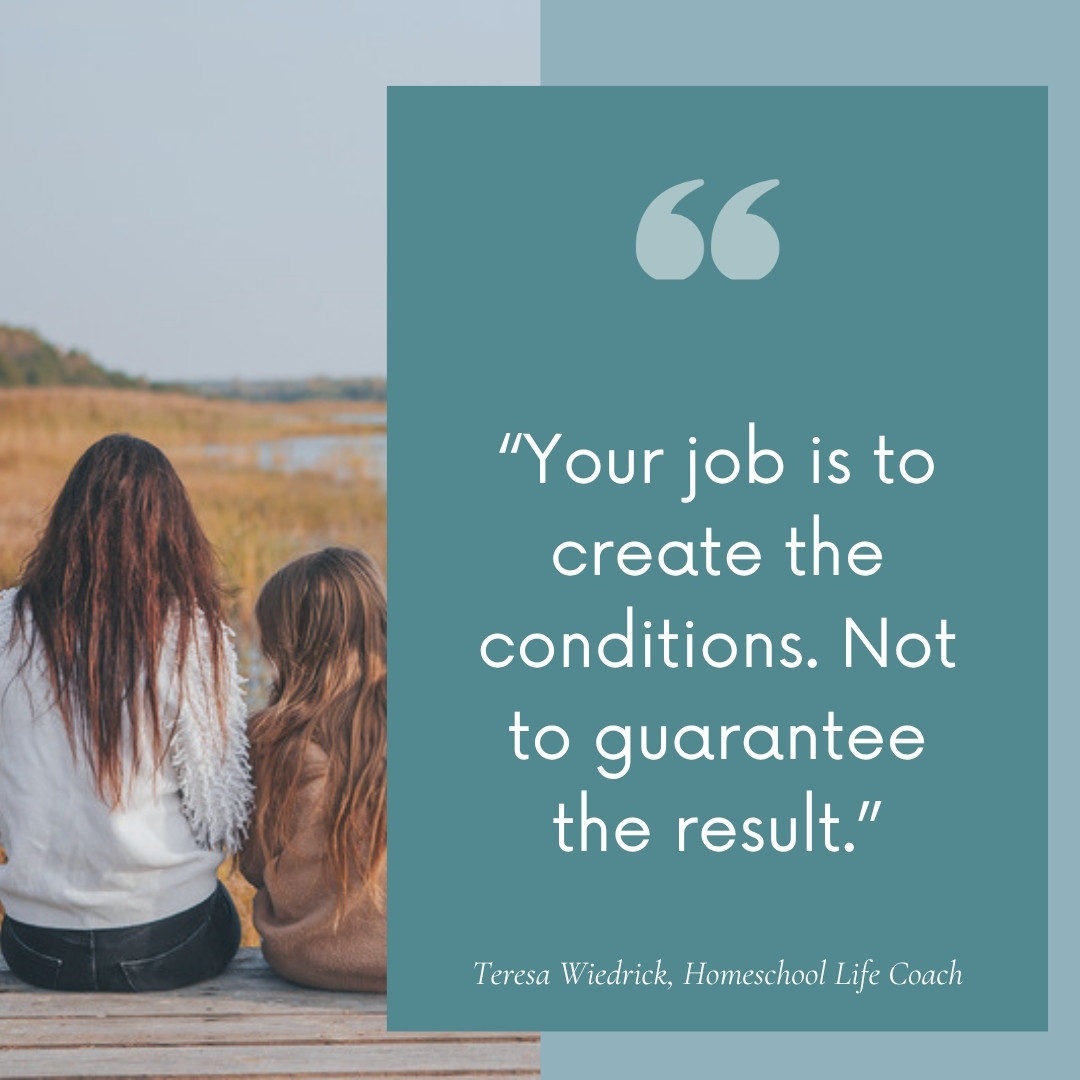
Here’s the truth: your child’s learning is your child’s learning. Your job is to create the conditions for learning, not to guarantee the result (which was never in your purview).
If you’re not sure whether what you’re seeing is a struggle or something else, read the signs your child needs to deschool. Sometimes what looks like a learning problem is your child decompressing from schooled expectations.
Sit with this: Whose report card are you really grading?
2. You smooth over conflict instead of resolving it
Something’s off. Someone’s upset. And before anyone has to sit in the discomfort, you’ve fixed it. Changed the subject. Softened the edges. Made everyone comfortable again, including the person who caused the problem.
That feels like peacemaking, I’m sure. But it really isn’t effective; also, it’s actually exhausting.
And it doesn’t stop just in your partnering relationship (but it definitely sits in this relationship). One mom I coached navigates carefully around her mother’s intensity rather than having the direct conversation about what her kids actually need. She became very good at managing others’ feelings. She hasn’t owned what she really thought and what she wants for herself and her kids.
Sit with this: What conversation have you been managing around instead of directly having?
3. You manage your husband instead of partnering with him
This is the one I couldn’t have understood if I hadn’t lived it myself.
Managing a husband looks like this: you anticipate his reactions before he has them. Instead of saying what you want, you work around his preferences. Your tone, your requests, even your needs all get adjusted to avoid friction. And when he’s anxious or low, you tiptoe around it instead of letting him carry his own experience.
Sometimes it looks like trying to fix him. One mom asked me how to encourage her husband to re-engage when he isn’t emotionally aware enough to see the problem for himself. That question came from love, of course; but it’s also not her responsibility to address someone else’s growth journey. (ps I get why you’d want to; I empathize with your frustration, but it just isn’t yours to solve.)
Another mom was about to organize her family’s entire future around her husband’s preferences, without once saying out loud what she wanted. It took a direct question for her to name it.
What managing your husband costs you
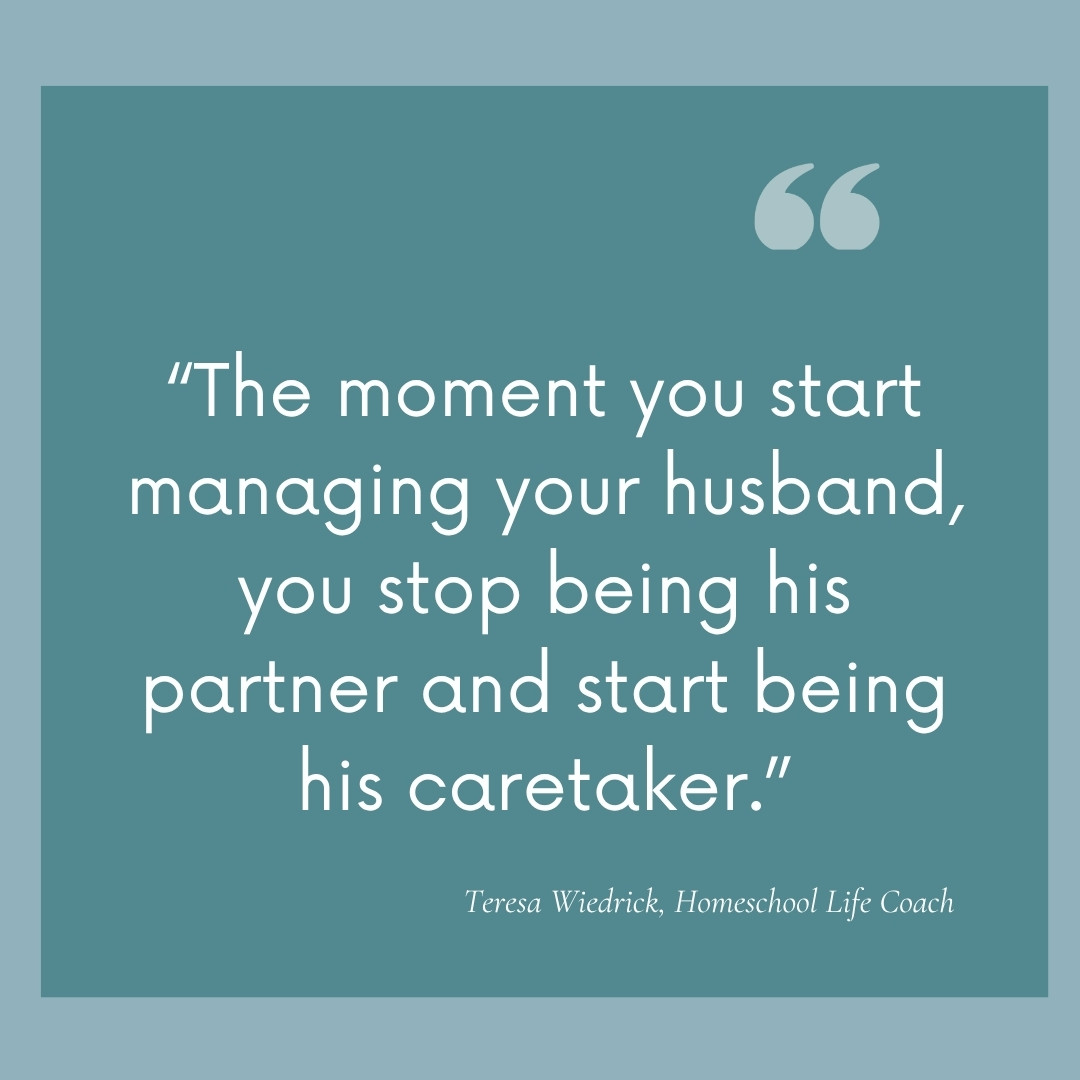
Here’s the hard reality: the moment you start managing your husband, you’ve stopped being his partner and started being his caretaker. And caretaking comes at a cost. When you’re always adjusting to keep him comfortable, you hide what you actually need, feel, and think. He ends up relating to the role you’re playing, not to you. You can’t be truly close to someone who never gets to see the real you.
Partnership asks for something managing never does: the direct, honest conversation about what you need.
When it’s necessity, not overfunctioning
A gentle caution here. If your husband truly can’t engage right now because of illness or crisis, some of what you’re carrying may be real necessity. So the question isn’t Am I doing too much? It’s Which of these are mine to carry, and which am I holding because no one else has been asked?
Sit with this: What would you say to him if you weren’t trying to manage how he’d react?
4. You’ve set aside your own interests
This one appears like a very “last on the list” challenge. And that is exactly what makes it so troublesome.
One mom I worked with put her creative life on hold for nearly a decade. This particular creative project was something she’d loved to do since she was little; she even did post-secondary training to study it. Not because she forgot she had one. However, everyone else’s needs always felt more urgent, and more legitimate, than her own interests.
Overfunctioners cut themselves from the list first, long before anyone else is asked to give anything up.
Sometimes it shows up in even simpler ways. You can’t stop for a coffee alone after errands without checking first, asking permission from her husband. Can he look after his kids? Because she wants a half hour to herself. (As though grocery shopping was a pastime).
Many moms’ older kids identify that they give and give and give and recognize that she never does anything except care for her kids. “What did you used to do, mom?” might be a concerned child’s question.
For a homeschool mom, this is the deepest of all the signs of overfunctioning. You’ve set your own growth (& becoming) aside so completely that you’ve stopped noticing it’s missing.
If that’s where you are, here’s how to find yourself again when you’re feeling lost in homeschooling.
Sit with this: What did you used to love that you’ve quietly stopped doing?
5. You absorb stress instead of addressing it
I saved this one for last because, of all the signs of overfunctioning I see in a homeschool mom, it’s the one that looks most heroic. (And therefore, most difficult to recognize).
Her husband comes home with news that his job is gone. That same week, the oldest has another blowup that leaves everyone rattled. Then her sister calls from the hospital, and a friend is grieving a miscarriage and needs someone to lean on. Hard news lands on top of hard news, and she doesn’t fall apart. Instead, she takes it all in, keeps the house running, gets the lessons done, and checks on everyone else. Everyone counts on her to be the strong one, the one who holds steady no matter what.
We praise women like this. We call it strength. And some of it is.
But here’s what I want you to see: absorbing is self-protective. It lets you skip the hard conversation. It keeps you the one who holds everything together. And it means you never have to find out whether the people around you could grow and rise if you let them.
Meanwhile, the people who should be carrying part of it lose the chance to. And your body notices even when you don’t, because the body keeps the score with tight shoulders, maybe a racing heart, and sleepless nights.
Absorbing everyone’s emotions and needs isn’t strength. It’s carrying what should have been shared or addressed.
If it’s your teenager whose storms you keep taking in, start with the first principle in parenting homeschool teenagers: observe, don’t absorb.
Sit with this: What are you carrying right now that someone else could, and should, hold with you?
A house where the questions have somewhere else to go
Remember that mom who sat down with a book and ended up running customer service? She said she doesn’t think the answer is a stricter house. She thinks it might be a house where the questions have somewhere else to go.
I love that, because that’s exactly what begins to change when you start handing things back.
Not all at once, of course. However, start small. Pick one low-stakes thing this week, a chore, a question, a decision, and hand it back. Then watch how it is engaged (notice that it isn’t done your way, but it’s done, and someone else dealt with it).
What most moms discover surprises them: their family can grow and rise. They just haven’t been asked to yet.

And if you recognized yourself in these signs of overfunctioning as a homeschool mom, take heart. Seeing it is where change begins. Every mom I’ve described here noticed her pattern before she changed it. One of them said simply, “I see my role in it.” (And that really is the first step).
So here’s what I’ll leave you with:
Where in your life right now do you feel responsible for something that might not actually be yours to carry?
And what would happen if you put it down, even just for today?
Join me on October 30 for the 90-Minute Homeschool Reset.
If you saw yourself in these signs, this is a good place to start putting things down. It’s a live, virtual working session with no more than 8 moms. Together we’ll get to the root of what’s really driving your overwhelm, practice two boundary techniques for when you’re tired of being everything to everyone, and build a personalized 30-day reset plan that fits your real life.
October 30 at 12:30 pm PT · $57 USD · Recording available if you can’t attend live. Registration closes October 28, or sooner if spots fill.

FAQ: Signs of overfunctioning as a homeschool mom
Overfunctioning is doing for others what they could, and should, do for themselves. It usually starts with a belief: if I don’t hold it, it will fall apart. For a homeschool mom, that can mean carrying the learning, the emotions, the logistics, and the partnering relationship, while everyone else quietly steps back.
They’re two sides of the same coin. When one person overfunctions, others tend to underfunction. Not because they don’t care, but because there’s no room left for them to step in. The more you carry, the less they’re asked to. Hand something back, and you’ll often see them rise.
No. A good mom creates the conditions for her family to grow. An overfunctioning mom takes responsibility for outcomes that aren’t hers, like her child’s learning or her partner’s awareness. The difference shows up in you: are you giving from a full place, or running on empty and quietly resentful?
Start small. Pick one low-stakes task, question, or decision this week and hand it back. Let it be done imperfectly. Then notice what happens. Most moms find their family can rise; they just haven’t been asked. You’re not dropping everything. You’re testing the belief that it all depends on you.
Because for a long time, doing everything has been how you’ve proven you’re enough. When you stop, the guilt isn’t evidence that you’re failing. It’s the old belief protesting. Notice it, name it, and keep going. If it feels too heavy to sort out alone, that’s exactly what an Aligned Homeschool Reset Session is for.
Seeing the signs of overfunctioning as a homeschool mom? Where to go from here…
If this post stirred something, you don’t have to sort it out alone. Here are three places to start, depending on where you are.
Start with the Wheel of Personal Growth. If you’re still not sure this is you, take this 5-minute assessment. You’ll answer 32 reflection questions and get a snapshot of eight areas of your homeschool life, including Emotional Load and Boundaries & Personal Space, the two places overfunctioning usually shows up first. You’ll see where you’re steady, where you’re stretched, and what may need to shift first.
Book a free Aligned Homeschool Reset Session. If you already see yourself in these signs and want help deciding what to hand back first, let’s chat. Together we’ll get underneath the overwhelm to what’s really driving it, name what’s truly yours to carry, and begin setting down what isn’t. Book your free Reset Session.
Not sure coaching is for you? These 10 signs you need a homeschool life coach can help you decide.
Start the Reimagine Your Homeschool mini-course.
If you’d like to begin on your own, this $17 course walks you through 8 short modules, one story and one actionable step at a time. The Emotional Load module helps you stop carrying everyone’s feelings, and the Boundaries module gives you a real script for the one boundary you’re ready to set.

Subscribe to the Confident Homeschool Mom podcast
