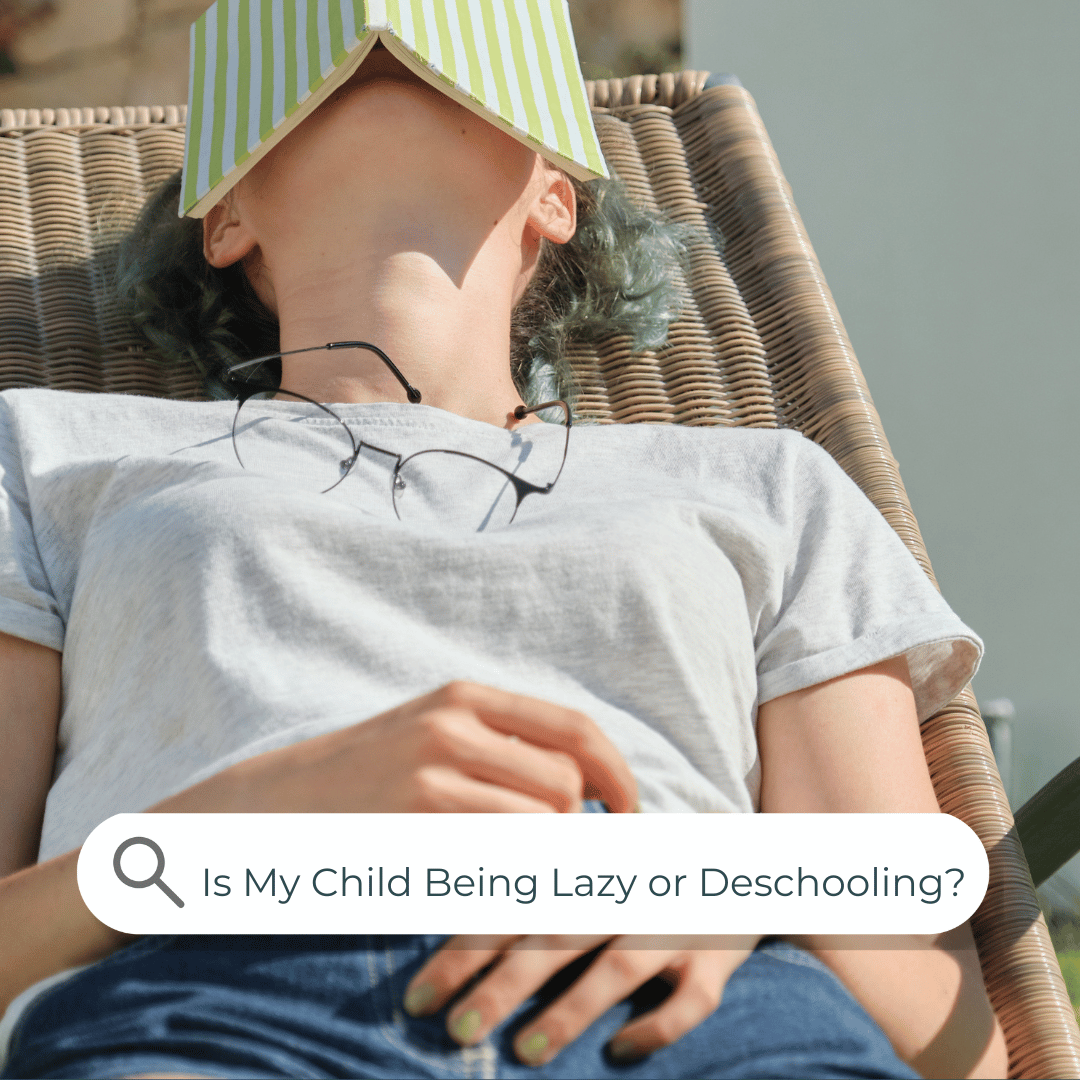
If you’ve been searching for the signs your child needs to deschool — and quietly wondering
if you might be making things harder, not easier — you’re in exactly the right place. What
you’re seeing in your homeschool right now has a name. And understanding it changes
everything.
Picture this. It’s a Tuesday morning. You’ve got a plan — a good one. You’ve thought about
it. Maybe even written it out the night before, arranged it carefully, felt genuinely hopeful
about it.
And your child is on the floor. Building something. Or staring at the ceiling. Or reading
something that has absolutely nothing to do with what you had in mind.
You watch, you wait, and you feel the spiral begin.
Is she being lazy? Is he just refusing to try? Have I somehow raised a child who is
fundamentally resistant to learning?
And underneath all of it, the real question — the one that wakes you up at 2am: Am I failing
her?
What you’re seeing in your homeschool has a name
Here’s what I want to tell you, from someone who has been exactly where you are: the signs
a child needs to deschool are almost never what we expect them to look like. What you’re
watching is not laziness. Not defiance. Not a character flaw in your child or evidence of your
failure as a homeschool mom.
It’s deschooling. And the fact that it’s happening — right there on your living room floor —
is actually a sign that something is working.
The harder question isn’t whether your child needs to deschool. It’s whether you are
deschooling too — and whether your unfinished work is quietly getting in the way of theirs
Signs My Child Needs to Deschool
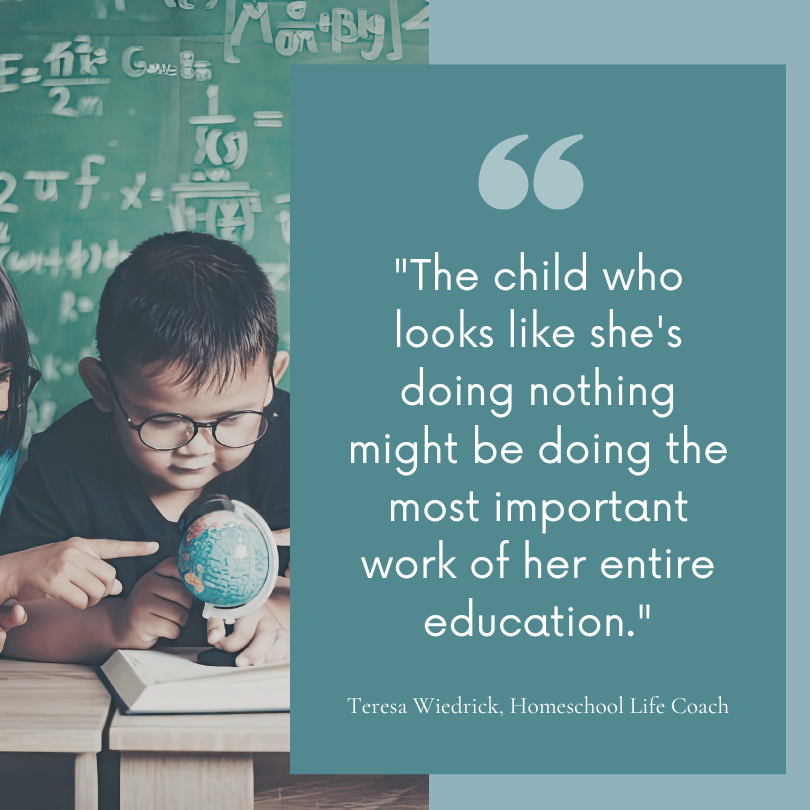
Deschooling in a child doesn’t look like learning — and that’s exactly the point.
We talk a lot about deschooling as something moms need to do — the unlearning of deeply
grooved assumptions about what a good education looks like. And that’s true. It’s real work,
and it matters enormously.
But your child spent years in that system too. Or they absorbed its logic through you,
through the culture, through a lifetime of being told that learning looks like sitting still,
following a plan, and producing something measurable at the end of it.
When a child comes home — or when the homeschool finally loosens its grip on the school
at-home approach — they don’t immediately bloom into a curious, self-directed learner.
First, they decompress. They unlearn. They deschool.
And when a child needs to deschool, it looks, to the untrained eye, like a whole lot of
nothing.
Signs your child needs to deschool (and needs you to let it happen):
- She wanders through the morning with no apparent purpose or direction
- He gravitates to screens, Lego, or “unproductive” play the moment structure loosens
- She asks “what are we doing today?” — not with curiosity, but with anxiety, because she doesn’t know how to exist without a plan handed to her
- He reads only things he chooses, and nothing you assign
- She needs to know if something “counts” before she’ll engage with it
- He asks “is this going to be on a test?” even though there is no test
- She seems bored, flat, or disengaged — not defiant, just… absent
- He was a model student at school and is now completely lost without external direction
- She starts projects and abandons them. Multiple times. In one day.
- He pushes back on everything you suggest — not to be difficult, but because he’s learned that someone else’s plan is usually not for him
These signs that your child needs to deschool are not problems to solve. They are processes
to protect.
Your child is doing something important in those wandering, apparently aimless hours. Slowly, quietly, she is learning that learning doesn’t require your permission — that curiosity doesn’t need to be scheduled, that being is enough without producing something to show for it.
Not nothing. Everything.
Start Here: Free Checklist to Know If Your Child Needs to Deschool
Before you change anything — find out where you actually are.
When you start recognizing the signs your child needs to deschool, the instinct is to
immediately do something — fix the schedule, switch the curriculum, find a better approach.
But the most powerful first move is actually simpler than that: get clear on where you and
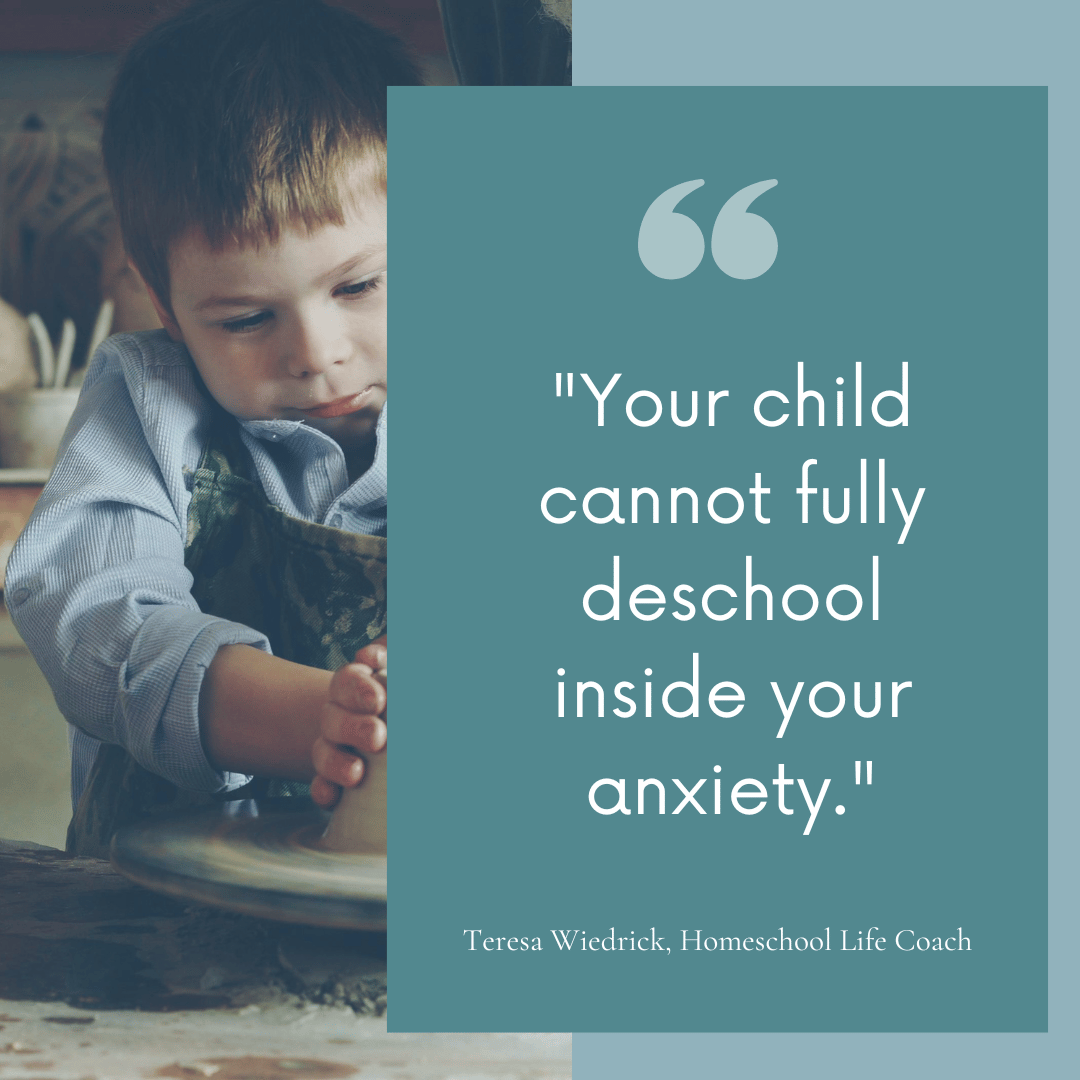
your child are right now. The free Deschool Your Homeschool checklist is designed to help
you do exactly that. It walks you through the key signals that schooled thinking is still
running the show — in your homeschool and in yourself — so you can stop reacting and
start responding to what’s actually in front of you.
Download the free checklist → Identify the signs your child needs to deschool,
see where your own schooled mindset is creating friction, and get clear on your
first real steps.
Are You Getting in the Way of Your Child’s Deschooling?
The harder truth about what your anxiety does to their deschooling process.
I want to say this as warmly as I mean it, which is very warmly — but also with the kind of
directness I’d want someone to offer me, because nobody did, and I spent years getting in my
own children’s way before I figured this out.
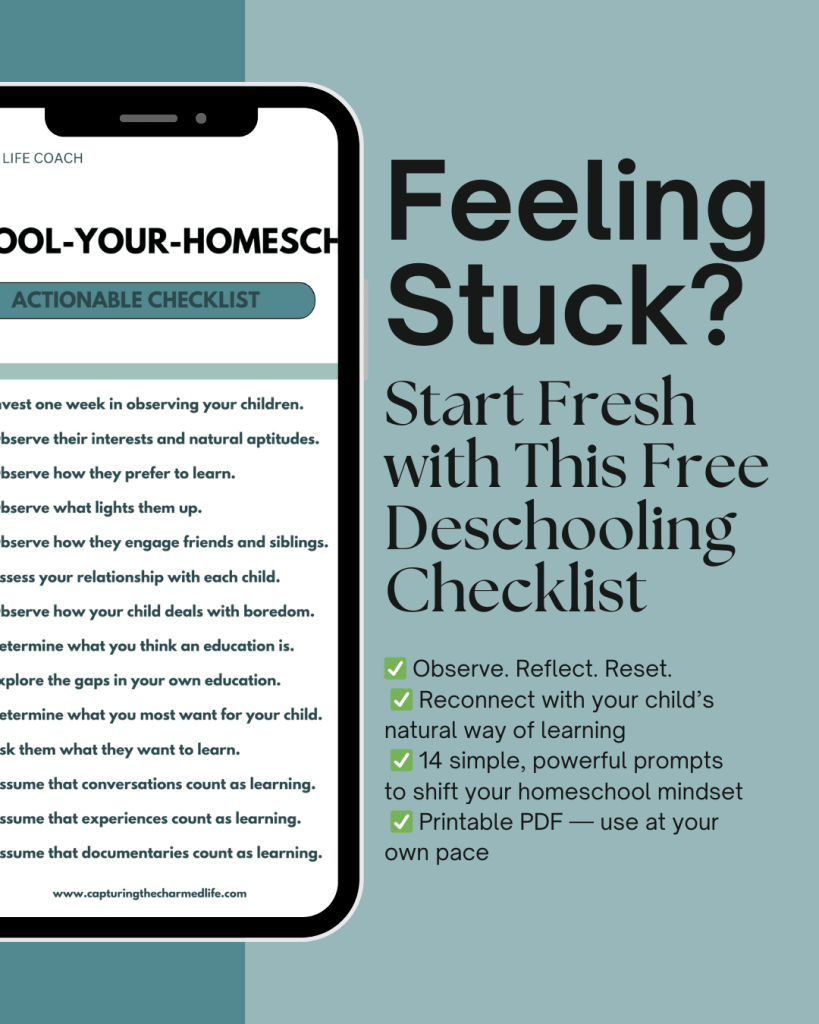
Your child cannot fully deschool inside your anxiety.
When you’re still in school mode — still measuring, still adding subjects, still scanning
every hour for evidence that something is being learned — you are sending a signal. And
your child, who loves you and is wired to regulate with you, picks it up immediately.
The signal says: this isn’t safe yet. Someone is still watching. Someone is still keeping score.
And so they don’t fully let go. They can’t. They keep one eye on you, trying to read what you
need, calibrating their behavior to manage your worry. That’s not deschooling. That’s
performance — just a quieter, more exhausting version of what they were already doing in a
classroom.
Here’s what that can look like from the outside: a child who oscillates between apparent
freedom and sudden compliance. Who plays freely for an hour, then anxiously asks
what they’re “supposed to be doing.” Who seems fine — until you introduce a plan, and
then resists it completely. That oscillation isn’t a behavior problem. It’s a mirror. It’s reflecting your own unresolved push-and-pull back at you.
I know this because I lived it. My oldest daughter wasn’t resistant because she was difficult — she was resistant because she was perceptive. Able to see clearly that the elaborate, rigorous, multilingual homeschool I’d built was for me — my expectations, my anxiety, my need to prove this was all worth it — more than it was for her. And she was right.
More Latin was never the answer. She needed me to get out of her way.
More signs my child needs to deschool — and so do I
These aren’t meant to make you feel bad. They’re meant to make you feel seen — because
almost every first-year homeschool mom I talk to recognizes herself in at least a few of
them:
Honest signals that schooled thinking is still running the show:
- You script the day — and feel a low-grade dread when the kids don’t follow it
- You’ve declared an “unschool day” out of exhaustion, not intention — and felt guilty the whole time
- Or you’re adding subjects or activities to feel productive, not because they’re serving your child
- Someone asks what you “do” for school and you immediately feel the urge to justify, list, or impress
- You can’t define “enough” — but you’re quietly certain you’re not hitting it
- You read the signs your child needs to deschool as laziness, before considering they might be information
- Free time makes you anxious. For them, and if you’re honest, for you.
- You find yourself comparing your homeschool to others’ — and the comparison always leaves you feeling behind
None of this makes you a bad homeschool mom. It makes you a human being who spent
twelve or more years being taught — very effectively — that this is what education looks
like. That conditioning doesn’t dissolve the moment you bring your kids home. It comes with
you. And until you do the work of examining it, it quietly shapes everything: the schedule
you build, the curriculum you buy, the way you interpret the signs your child needs to
deschool.
What to Do When You See the Signs Your Child Needs to Deschool
When you see the signs — shift your posture, not your curriculum
I’m not going to give you a seven-step protocol here. Because deschooling — yours and your
child’s — isn’t a protocol. It’s a shift in how you hold the whole thing.
But here’s where to start:
Get curious before you get concerned. When your child is doing something that looks like nothing, ask yourself: what might this actually be? Not to talk yourself out of a valid worry, but to genuinely investigate before you assume. That ceiling-starer might be processing something she heard yesterday. The Lego builder could be working out a spatial problem that no workbook could touch. And the book-abandoner? She might be learning, finally, that she gets to have an opinion about what’s worth her time.
Watch your interventions. Every time you step in with a plan, a suggestion, a subject, or a
“what if we tried—” — notice what’s driving it. Is it genuinely for your child? Or is it for the
anxious part of you that needs the day to look like something? Both are human. Only one is
helpful.
Do your own work. This is the one that changes everything. The moms I’ve watched
transform their homeschools — from frantic, school-flavored, exhausting operations to
genuinely purposeful, child-centered learning lives — didn’t do it by finding the right
curriculum. They did it by finally turning the lens on themselves.
Ready to Go Deeper on the Signs Your Child Needs to Deschool?
From recognizing the signs to building something that’s actually theirs.
Recognizing the signs your child needs to deschool is the first step. But knowing what to do
next — how to honestly assess where you are, how to reimagine your homeschool
atmosphere, how to build routines that work with your child’s nature instead of against it —
that’s the deeper work.
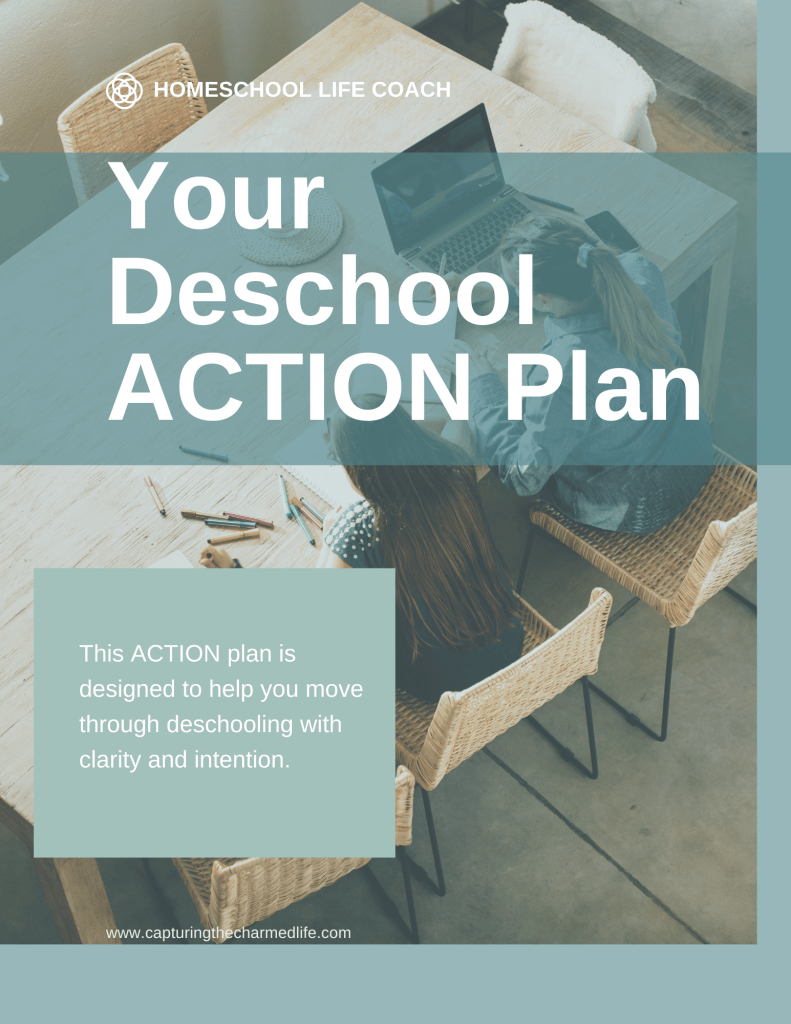
The Deschool Your Homeschool Action Plan is a self-directed printable workbook designed to walk you through that process. From understanding why schooled thinking keeps sneaking back in, to building a purposeful, child-intended education that finally feels like yours.
The Deschool Your Homeschool Action Plan — trade stress and second-guessing for confidence, clarity, and a homeschool that genuinely serves your child. Includes a journaling workbook and coaching session guidance.
Deschool Action Plan for New (& Stuck) Homeschoolers
The Deschool ACTION Plan is a printable PDF guide to help you reset your homeschool mindset, reconnect with your child’s natural learning style, and take intentional steps toward a more confident, calm, and custom-fit homeschool.
Want Personal Support? Book an Aligned Homeschool Reset Session
Sometimes you don’t need a course — you need a conversation.
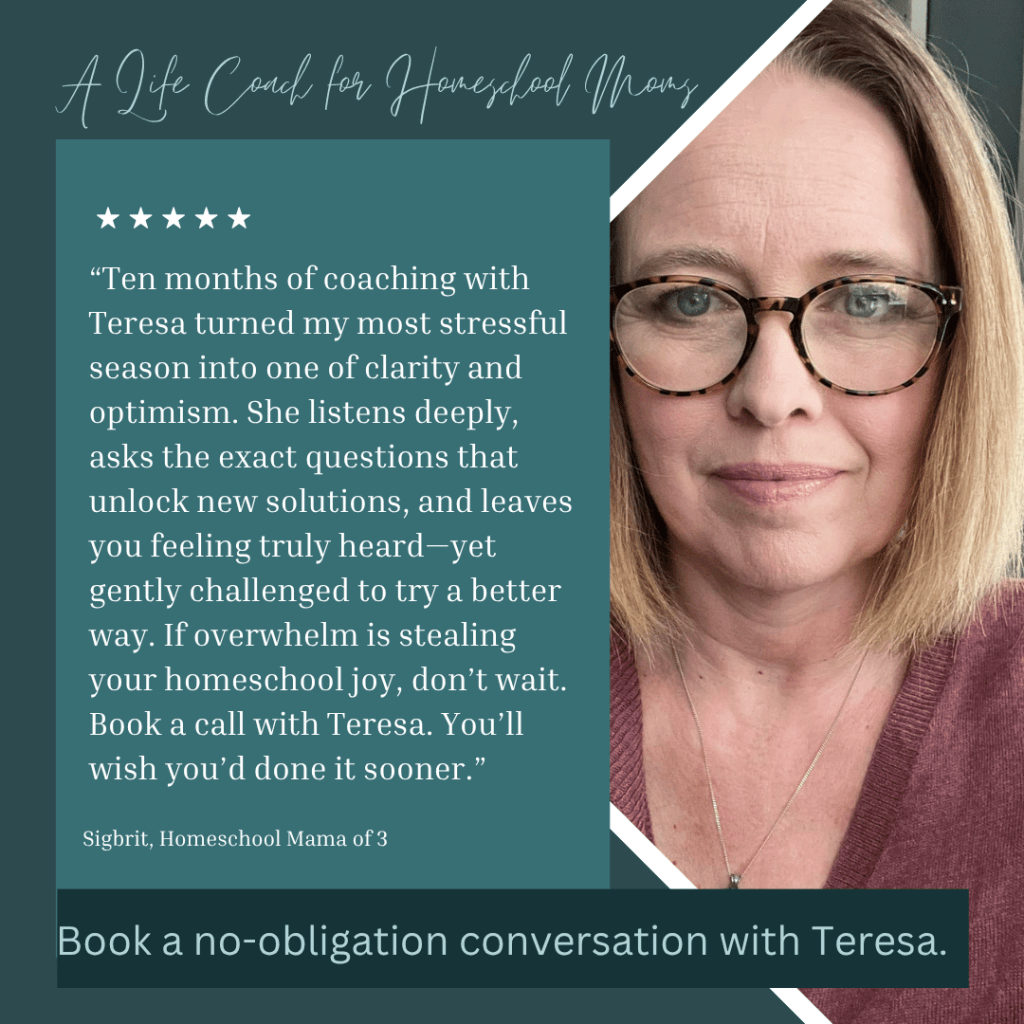
If you’re seeing the signs your child needs to deschool and you’re not sure where to begin — or if you’ve been at this a while and keep hitting the same walls — a one-on-one Aligned Homeschool Reset Session might be exactly what you need.
In a single focused session, we’ll look honestly at what’s happening in your homeschool right now, identify where schooled thinking is creating friction, and leave you with a clear, actionable direction built around your child and your family — not borrowed from a system you already chose to leave.
What does deschooling look like in your home right now — for you, or for your child? Drop it in the comments. I read every one.
— Teresa Wiedrick, Homeschool Life Coach & Your Newest Cheerleader 💛
Book your free Aligned Homeschool Reset Session
I help homeschool moms trust themselves, edit expectations, and make intentional choices that create a more confident, connected, and present homeschool life.
Your Child Is Already Showing the Signs They Need to Deschool
The Tuesday morning scene — your child on the floor, your plan sitting untouched, the
spiral beginning — doesn’t have to be a crisis. It can be information.
It can be the moment you look up from the schedule and really look at your child. At what
she’s actually doing. At who he actually is, right now, in front of you — not who he’ll be
when he’s finally “on track,” not who impresses the grandparents, not who vindicates your
decision to homeschool.
Just him. Just her. This moment, right here.
That kind of looking is where child-led learning actually begins. Not in the curriculum. Not
in the philosophy. In the moment you decide to get curious about your child instead of
anxious about your plan.
The deschooling work — yours and your child’s — isn’t a detour from the real homeschool.
It is the real homeschool. And it starts the moment you stop trying to fix the signs your child
needs to deschool — and start trying to understand them instead.
Continue Exploring How to Start Homeschooling Confidently
Want to keep going? Here’s where to head next:
- 1st-Year Homeschool FAQs: Top Questions every New Homeschooler Asks
- How to Know if Deschooling is Right for You: 7 Signs you Need to Deschool
- how to deschool 101: Embrace Freedom and Individualization
- Why Deschooling? To Feel Confident, Certain & Good Enough
- 5 Reasons Your Homeschool Child Won’t Do Work & How to Motivate Your Child
- Crush 1st-Year Homeschool Frustrations and Plan a Smooth Year 2
- Discover 10 Signs You Need a Homeschool Life Coach to Thrive
- How to Homeschool Middle School with Confidence
- Mistakes First-Year Homeschool Moms Make (& How to Avoid Overwhelm)
- 9 Mistakes That Make Your 1st Homeschool Year Stressful (& How to Avoid Them)
- How to Help your Kids Read with Confidence
- Stop Second-Guessing as a Homeschool Mom (& Use Your Magic)
- Homeschool Mom Challenge: Turn Struggles into Confidence
- Self-Care & Deschooling: Is there a Helpful Connection?
- Tired of Second-Guessing as a Homeschool Mom? Here’s How to Trust Yourself Again
- 9 Steps to Thrive: Confident Homeschool Mom in Year 1
- How to Make Confident Homeschool Decisions (Without Seeking Permission)
- The Truth About Homeschooling the “Right Way” — But What Works
- Why Seasoned Homeschool Moms Still Struggle (And How to Break Free)
- Top Tips for New Homeschool Moms in Season 3
- Rethinking Homeschooling: It’s About the Child, Not the Method
Subscribe to the Homeschool Mama Self-Care podcast
