If you’ve ever typed “am I homeschooling my child the right way” into a search bar at 11pm — this post is for you.
Most homeschool moms have experienced some version of that same question — am I homeschooling my child the right way? — and most of them are asking it for exactly the right reasons.
Not out loud, necessarily. More likely, as a quiet voice at the end of the day, after the books are closed and the planner is put away.
Here’s the truth: there is no single “right way” to homeschool your child. But there is something that works — and it’s more accessible than you think.
Am I Homeschooling My Child the Right Way? (& Why the “Right Way” to Homeschool Is a Myth Worth Busting)
The homeschool world has a way of making moms feel like there’s a correct answer they haven’t found yet. The right curriculum, the right schedule, and the right philosophy. Classical or Charlotte Mason. Structured or unschooling.90 minutes a day or seven hours?
And so the search begins — and the second-guessing never quite stops.
Every mom who has ever asked “am I homeschooling my child the right way” deserves a better answer than another curriculum or method recommendation.
Here’s what I’ve noticed after many conversations with homeschool moms who are deep in this: the ones who feel most lost are rarely the ones doing it wrong. They’re the ones paying close enough attention to notice the gap between what they planned and what their child actually needs.
That gap isn’t failure. It’s information.
The “Right Way” Is a Moving Target — And That’s Actually Good News
The truth about homeschooling the “right way” is that right was never a fixed destination. It’s a moving target — and it moves because your child moves. She grows, shifts, changes her mind, surprises you. The mom who is asking am I getting this right? is almost always the mom who is watching closely enough to ask better questions.

What “Right” Actually Means for Your Child
Let me tell you about a mom I’ll call Joni.
Joni had done everything by the book. Researched curricula for months. Built a beautiful schedule. Joined a co-op. Colour-coded her planner. By any external measure, she was homeschooling the “right way.”
And yet her daughter — bright, curious, twelve years old — was disengaged. Resistant. Going through the motions, most of the time, so she could put her books back in her designated basket so she could run off and play.
Joni kept adjusting the external pieces. Different workbooks. Different incentives beyond playtime or screentime. She offered her daughter more flexibility. Less flexibility. The result was always the same.
Not the daughter she’d hoped to homeschool. Not the child the curriculum would work for. The specific, real, living girl in front of her — with her own interests, her own learning rhythms, her own quiet signals about what was and wasn’t working.
The Question Underneath the Question
That shift — from am I following the right method? to is this right for this child? — was where freedom lived.
Am I Homeschooling My Child the Right Way? A Framework for Making Decisions You Can Trust
After many conversations like the one I had with Joni, I built something I call the Right-for-This-Child Framework — six questions designed not to grade your homeschool, but to help you think with your child instead of about her.
It’s not a lens into the reality of your homeschool kiddo and your homeschool plans.
Here are two of the six questions, because they tend to be where the most immediate relief lives when you’re wondering if you’re homeschooling your child the right way:
“Does this approach honour who she is right now?”
Not who she was six months ago. Not who you’re hoping she’ll grow into. Who she is today — her interests, her energy, her actual learning preferences.
This sounds obvious until you realize how often we design our homeschool around a future version of our child who doesn’t quite exist yet. The more focused, more compliant, more grateful version. Or even the child that doesn’t exist. And I’ll add that sometimes we’re trying to build a homeschool around the “child” that is within you! You might be, like me, trying to build a homeschool you would LOVE at age 28-54;)
Meanwhile, the real child in front of us is sending signals we’re too busy adjusting the plan to receive.
Observing your child’s energy — not just her output — is data. When she lights up, that’s data. When she goes quiet in a particular way, that’s data. Small, genuine check-ins about how she’s experiencing things give you more useful information than any progress tracker.
“Am I reacting out of fear right now — or out of clarity?”
This one requires self-awareness. So much of what looks like a homeschool problem is actually a mom’s nervous system problem. When a child resists or stalls, it can activate something old — a fear about falling behind, about not being enough, about her future narrowing in some irreversible way.
From that place, we tend to push harder, control more, and inadvertently make the resistance worse.
The practice is simple but not easy: pause before you respond. Five or ten minutes. Journal a sentence. Let the reactive emotional wave pass. What’s left after the pause is almost always much closer to your actual wisdom.

The Other Four Questions (And What They Cover)
The full framework goes further — into aligning decisions with your core values, weighing short-term discomfort against long-term growth, building flexibility into your plans rather than demanding perfection, and creating a simple weekly rhythm of reflection and recalibration.
Together they give you a repeatable way to move through doubt. Not by eliminating it — but by using it as a starting point rather than a stopping point.
The real answer to “am I homeschooling my child the right way” is never yes or no. It’s: are you paying attention, staying curious, and adjusting as you learn?
If yes — you’re doing it right.
The Doubt Is Not the Actually the Problem
Joni didn’t need a new curriculum. She needed permission to trust what she already knew about her daughter — and a structure to help her hear herself think.
If you’re in that place right now — doing the work, carrying the worry, wondering if anyone else feels this too — I want you to say this out loud:
The fact that I’m asking this question means I’m the right person for this.
Say that sentence again. And again. Remember that “bad homeschool moms” don’t lie awake wondering if they’re getting it right. The negligent homeschool moms aren’t googling “am I homeschool my child the right way” at midnight? (ps If I’m right and YOU are googling those words and that’s why you found me, drop me a comment below, I’d love to hear!)
If you’d like support figuring out what “right for this child” actually looks like in your specific home, with your specific kid — that’s exactly the kind of conversation I’m here for.
Start there. The rest tends to follow.

Free Resources to Help You Homeschool With Confidence
You’ve made it this far in this post because something here resonated. Maybe it was the question you’ve been carrying quietly. Or maybe it was Joni’s story. Maybe it was simply the relief of someone finally saying there is no single right way.
Whatever brought you here — whether you googled “am I homeschooling my child the right way” or stumbled in through a friend’s share — I don’t want you to leave empty-handed.
Depending on where you are in your homeschool journey, I’ve created something specific for you. Take the one that fits.
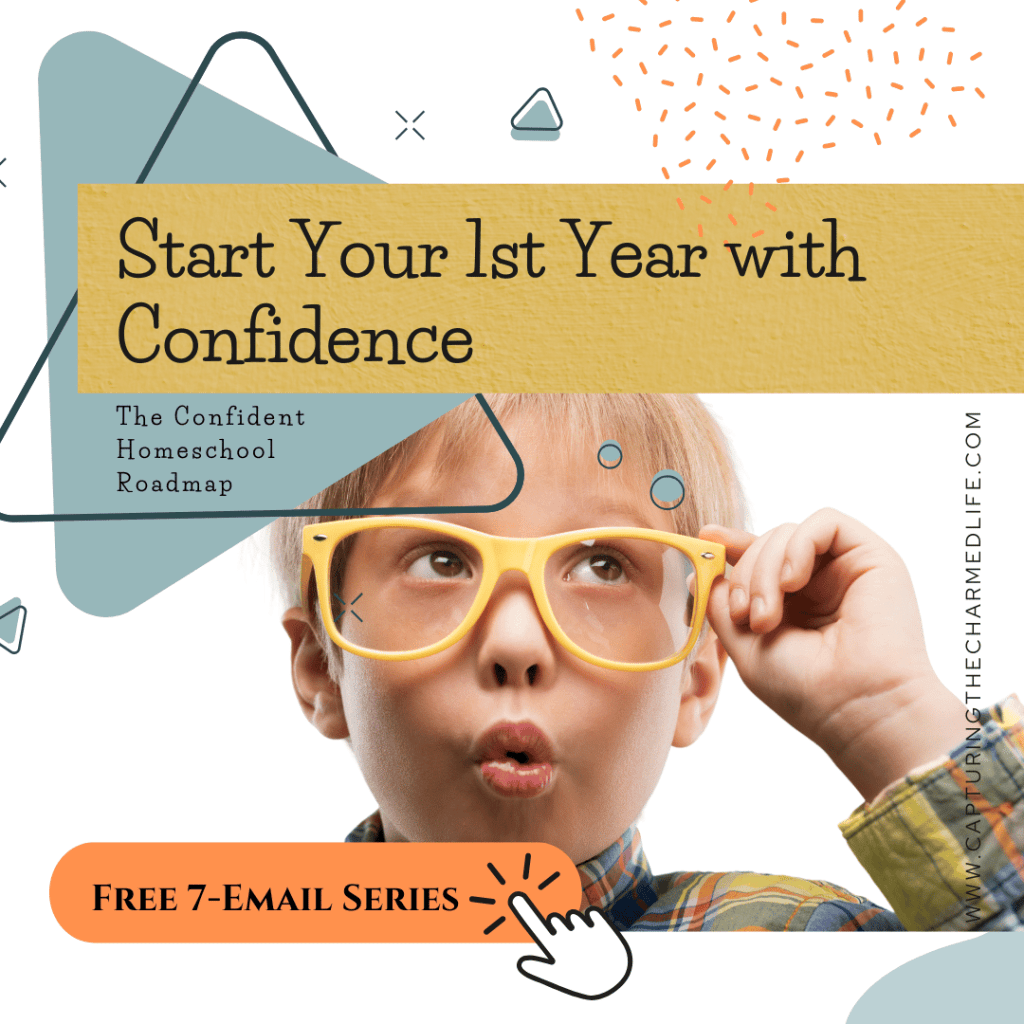
For First-Year Homeschool Moms: The Confident Homeschool Roadmap
Starting your homeschool journey is one of the bravest things a mom can do — and one of the most disorienting. You pulled your child out of traditional school (or never put them in) because you believed there was something better. And now you’re staring at a blank calendar wondering where to begin.
The Confident Homeschool Roadmap is your starting point. It walks you through the foundational decisions every new homeschool mom needs to make — in the right order, without the overwhelm — so you can stop spinning and start building something that actually fits your child and your family.
Inside you’ll find a clear sequence for getting started, questions that help you define what you want homeschooling to look like, and a simple structure that creates confidence without locking you into someone else’s method.
When you download the Roadmap, you’ll also receive the Purposeful Homeschool Mom Weekly newsletter — a short, grounding note each week with practical encouragement, honest reflections, and tools to help you keep trusting yourself through every stage of this journey.
→ Grab Your Free Confident Homeschool Roadmap
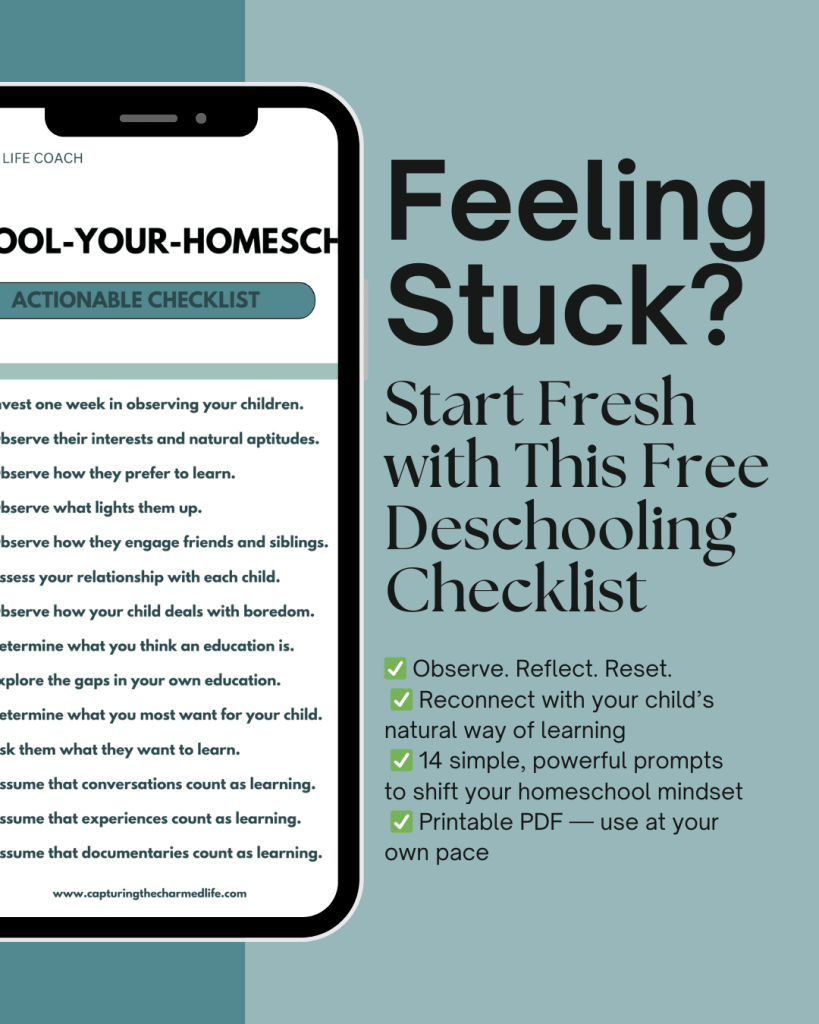
For Moms Who’ve Been At It a While: The Deschool Your Homeschool Checklist
You homeschool to give your child something better. So why does it still feel like you’re just recreating school at home?
Your child resists anything that looks like “school.” You’re stuck somewhere between structure and freedom, second-guessing every decision, and quietly wondering if you’re doing it wrong.
Here’s the truth: you’re not doing it wrong. You just haven’t deschooled yet. Or maybe you need to deschool deeper or for a new season of your family life.
Deschooling is the most commonly skipped step in homeschooling — and the one that makes a ginormous difference. It’s the process of letting go of traditional school thinking so you can build something that actually fits your child, your values, and your real life.
What You’ll Work Through Inside the Checklist
The Deschool Your Homeschool Checklist is your reset button. It’s a free, simple guide that helps you:
- Step back from school-y mindsets that are quietly running the show
- Reconnect with how your child actually learns — not how school said she should
- Create space for curiosity, calm, and genuine connection
- Set a new course with intention and clarity
Inside you’ll work through seven foundational shifts: observing your child’s natural interests, noticing what genuinely sparks their excitement, understanding their real learning style, examining the rhythms of your family relationships, getting curious about boredom instead of fixing it, defining your own version of education, and embracing the gaps instead of fighting them.
When you download the Checklist, you’ll also be joining the Purposeful Homeschool Mom Weekly newsletter — where each week I share honest encouragement, practical tools, and gentle reminders that you are more capable of this than you think.
→ Download the Free Deschool Your Homeschool Checklist
Ready to Go Deeper? Book Your Free Aligned Homeschool Reset Session
Sometimes what you need most isn’t another resource — it’s a real conversation with someone who can see what you can’t yet see about your own homeschool.
The Aligned Homeschool Reset Session is a free 30-minute call where we look at what’s working, what isn’t, and what one shift could change everything for you and your child right now. You’ll leave with clarity, a concrete next step, and the feeling that someone actually gets what you’re trying to build.
For many moms, this conversation is also where something unexpected happens: they realize that the homeschool struggle on the surface — the resistance, the self-doubt, the feeling of recreating school at home — runs a little deeper than curriculum choices or daily schedules. It lives in the mindset they inherited from their own school experience. The beliefs about what learning should look like. The internalized pressure to perform, produce, and prove.
That’s the work I love most — helping moms deschool not just their homeschool, but themselves. Because when you shift, everything shifts. Your child feels it. Your days feel different. The decisions get clearer.
Am I Homeschooling My Child the Right Way — Or Is My Own Mindset Getting in the Way?
Coaching is where that deeper deschooling happens — and the Reset Session is where we find out if that’s the conversation you’re ready to have.
No pitch. No pressure. Just a focused, honest conversation about what you’re building — and what might be quietly getting in the way.
→ Book Your Free Aligned Homeschool Reset Session
Warmly,
Teresa
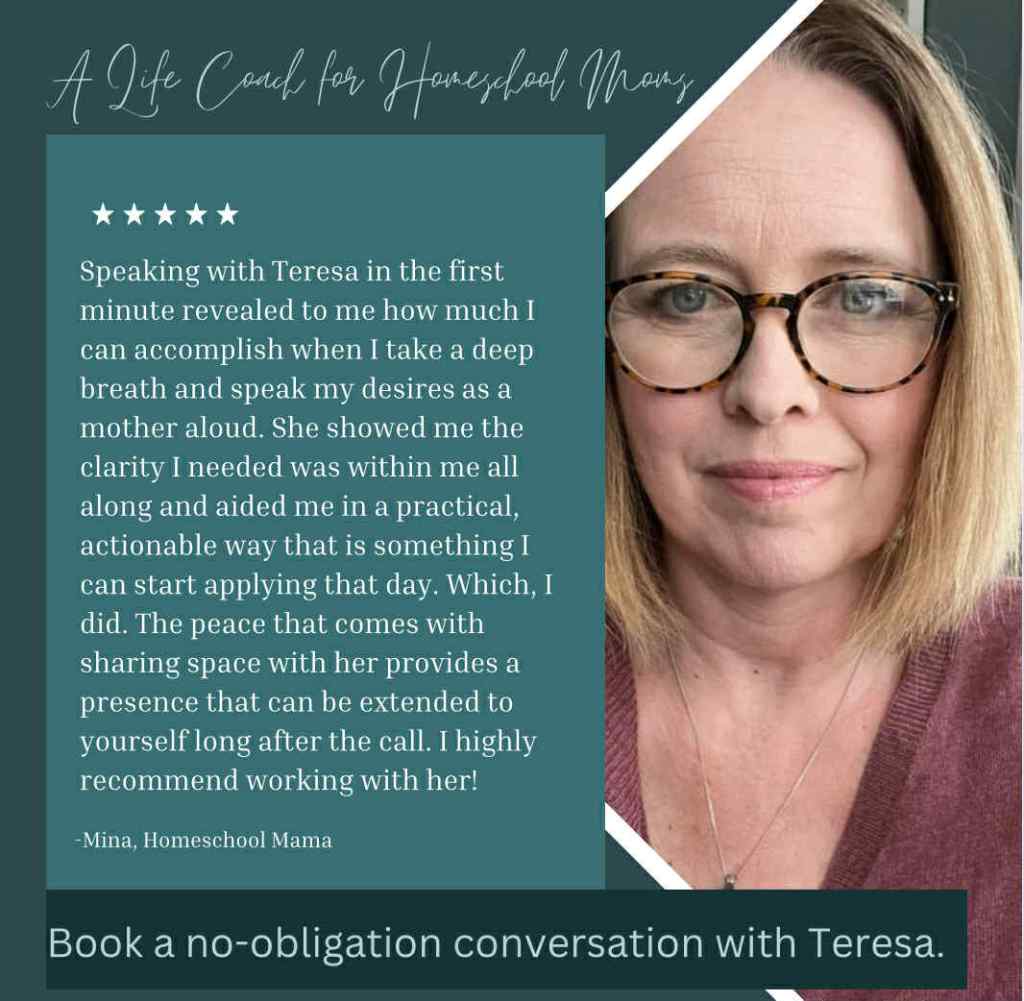
Book your free Aligned Homeschool Reset Session
I help homeschool moms release pressure, edit expectations, and make small, intentional shifts that lead to a more confident and connected homeschool life.
Frequently Asked Questions
A good rule of thumb: if you’re in your first year of homeschooling and still building your foundation, start with the Confident Homeschool Roadmap. If you’ve been homeschooling for more than a year and things feel stuck, stale, or like you’re still doing school-at-home, the Deschool Your Homeschool Checklist is your next step. When in doubt, grab both — they’re free and they complement each other.
It’s a short weekly email written specifically for moms who are homeschooling intentionally — not just checking boxes. Each issue includes honest encouragement, a practical tool or reflection, and real conversation about the emotional side of this work. No overwhelm, no noise. You can unsubscribe any time, though most moms tell me it’s the one email they actually look forward to.
It’s a focused 30-minute conversation — just you and me. We’ll look at where you are right now, what’s creating friction in your homeschool or your confidence, and what one meaningful shift could open things up. You’ll leave with a clear next step and a stronger sense of what you’re actually building. There’s no sales pressure and no obligation beyond showing up ready to think out loud.
Not at all. I work with moms across the full spectrum — from structured classical educators to relaxed unschoolers and everyone in between. What matters is that you care deeply about your child and you’re willing to get curious about what’s actually working. The rest we figure out together.
More normal than you know — and more common among the most thoughtful, dedicated homeschool moms than among anyone else. Sustained doubt isn’t a sign of failure. It’s often a sign that you’ve outgrown your current approach and it’s time to recalibrate. That’s exactly what the Reset Session and the Deschool Checklist are designed to help with.
Then it wasn’t the right fit at the right time, and that’s okay. There’s no commitment, no obligation, and no wrong answer here. You’re always welcome to reach out directly if you want help figuring out what would actually serve you best.
You May Also Want to Read:
- How to Make Confident Homeschool Decisions (Without Seeking Permission)
- Free (&/or Affordable) Homeschool Coaching Options for You!
- Stop Second-Guessing as a Homeschool Mom (& Use Your Magic)
- A Summer Reset for Homeschool Moms: The Secret to a More Peaceful Year Ahead
- 5 Reasons Your Homeschool Child Won’t Do Work & How to Motivate Your Child
- Stop Asking These 6 Homeschool Questions (That Sabotage Your Life)
- Free Resources for the Homeschool Mom Who’s Ready to Thrive!
- You’re Not Failing. You’re Caught In An Inner Critic Loop. Here’s How to Get Out
- Homeschool Help for the Homeschool Mama
- How to Address Doubt in your Homeschool Choice with Confidence
- Mistakes First-Year Homeschool Moms Make (& How to Avoid Overwhelm)
- How to practically deschool your homeschool mindset
