Podcast: Play in new window | Download
If you’re ready to get started homeschooling in 2026, you’re in the right place — and you’re not alone in feeling that mix of excitement and overwhelm that comes with this decision.
When you first step off the beaten path — leaving the conventional school system behind — you might feel a swirl of excitement, uncertainty, and the overwhelming urge to research everything. That’s completely normal. Every new homeschool mama goes through it.
But here’s what I want you to know from the start: you really can do this. Not perfectly, not without challenges, but confidently and with joy.
I’m Teresa Wiedrick, and I’ve been walking this road for over two decades. My three daughters are grown up. My son is nearly heading to post-secondary. What started as a vision of girls in white dresses reading Anne of Green Gables on a white Ikea couch (please don’t ever buy a white couch) turned into something messier, richer, and far more meaningful than any utopia I’d imagined.
This guide is my gift to you: a grounded, honest, and warmly practical roadmap for getting started homeschooling.
Start your first step toward getting started homeschooling with confidence — not a pile of browser tabs. Download the Confident Homeschool Roadmap.
Should You Get Started Homeschooling? Ask This First
Before we talk about curriculum and schedules, let’s ask the question underneath everything else: Is homeschooling actually right for your family?
There is no single right answer. Homeschooling offers incredible freedom, deep connection, and the ability to tailor education to your child. It also asks a lot of you — your time, your patience, your willingness to grow.
If you’re on the fence, I’ve made a YouTube video walking through the honest considerations you need to weigh before you decide. Search “Should I Homeschool” on the Homeschool Life Coach channel. Watch it, sit with it, and then come back here.
Still in? Good. Let’s go.
8 Things You Need to Know to Get Started Homeschooling
1. Know the Legal Requirements
Every province, state, and country has its own rules for home education. Research yours early — not just to stay compliant, but because understanding the legalities will give you confidence when people question your choice. (And some will.)
If you’re in Canada, I have two podcast episodes specifically for you: one covering homeschooling across Canada, and one focused on starting homeschooling in British Columbia.
Fun Fact Though I live in Canada, I actually work with homeschool families from around the world.
2. Choose Curriculum Thoughtfully (and Cheaply)
There are more curriculum options than you could ever explore. The best advice I can give you for year one: borrow before you buy. Get a library card. Join Facebook groups where families sell used curriculum. Assume you will overbuy — almost every new homeschool parent does — and know that just because something is beautifully designed doesn’t mean it’s the right fit for your child.
Here are 5 suggestions about buying curriculum.
Start simple. You can always add more later.
3. Understand How Your Child Learns
Your child’s learning approach will shape your homeschool — which curriculum clicks, which methods feel natural, which approaches create friction. Spend time observing before you prescribe.
And here’s something I wish someone had told me earlier: invest as much energy researching child development and family dynamics as you do researching curriculum. The parents who do this are happier four years in.
Spoiler Alert Many homeschool moms burnout or feel overwhelmed by year 3-4 if they haven’t created a burnout prevention plan.
4. Build a Routine (Not a Schedule)
There’s a difference between a rigid schedule and a supportive routine — and routines are what actually work in homeschool life. A routine gives shape to your days without boxing you in. It accounts for the fact that you’re a person too, with your own needs, wellness rhythms, and limits.
In the Confident Homeschool Mom Collective, we walk through exactly how to build a routine that fits your real life — whether you work outside the home or not.
5. Keep Records (They’re for You, Not Just the Authorities)
Yes, some jurisdictions require record-keeping. But more importantly, tracking your child’s progress is one of the most effective ways to build your own confidence as a homeschool parent. When you look back and see the breadth of what you’ve covered — the conversations, the projects, the books, the life experiences — you’ll see clearly that you are doing right by your child. (IMO that is the most compelling reason to keep track.)
6. Build a Support Network
You will need other homeschool families around you. Go to the playground on a school day and ask the kids playing on the monkey bars if they’re homeschooled — they probably are. Join a local co-op, a Facebook group, or a virtual community.
The Confident Homeschool Mom Collective exists for exactly this: so you have a place to land, be encouraged, and find community — both virtually and in your real life.
7. Embrace Flexibility
Flexibility isn’t just a perk of homeschooling — it’s a muscle you’ll develop. Where are you naturally flexible? Where do you resist? That’s worth exploring in your journal.
(If you haven’t started journaling, this is a good time. Any notebook will do. Write whatever comes to mind at the same time each day. She’ll become your most honest companion.)
Fun Fact Journaling is the reason I started this blog — to keep track of my homeschool days! And all the fun memories I’ve collected.
8. Cultivate Patience and Persistence
Homeschooling will ask you to grow — in ways you didn’t anticipate when you signed up to teach fractions. You’ll reorganize relationships. You’ll learn to emotionally regulate alongside your kids. Oh, and you’ll face critics, and you’ll have to decide whose opinions actually matter.
The good news: every challenge is also an invitation. (Spoken from a life coach, right? Yup, that’s me! A life coach for homeschool moms.) The parents who lean into the personal growth aspect of this journey are the ones who thrive — not just in their homeschool, but in their whole life.

Learning Doesn’t Only Happen in Workbooks
One of the most liberating shifts you can make as a new homeschool parent is expanding your definition of education. Academics are not synonymous with learning.
Your child is learning when they:
- Play a strategy game like chess — building logical thinking and foresight
- Have a conversation about something they read, saw, or heard
- Spend an afternoon with a community mentor who knows something you don’t
- Watch a documentary, listen to a podcast, or read a book they actually chose
- Work through a conflict with a sibling
Learning is happening all the time, in and out of your homeschool room (if you even have one). Trust that.
ps I offer you a podcast series entirely dedicated to the new homeschool mom, because I want you to feel confident trusting that. Oh, you’re about to learn so many new things. Oh, and your kids will learn too;)
Plan for the Socialization Question
Someone will ask. Probably many people. Probably more than once.
“But what about socialization?”
Here’s the thing: most of us know intuitively that spending six hours a day in a room with 25 people your exact age, where talking is not encouraged, is not the gold standard for social development. (And spoken from an ambivert perspective, it’s overwhelming too.) And yet, the question persists.
So prepare your answer now — a calm, genuine, non-defensive one. Practice it until it feels natural. Then let it go and get back to living your beautifully social homeschool life.
Want to really be prepped for that question? Read or listen here. This the best book on this discussion IMO.
A Word About Research Before You Get Started Homeschooling
You will research a lot this first year. That’s good and right — this is a big responsibility.
But there’s a tipping point where research becomes a way of avoiding the actual doing. The resources will never run out. The perfect curriculum will always be one more click away (ps there really isn’t a perfect curriculum, but there will always be one more you could try!)
Meanwhile, your kids are growing up right now, whether you’re glued to your screen or not.
Set a time block for homeschool planning. Listen to a podcast on your morning walk. Spend a Wednesday evening at the library. And then close the laptop and go be with your kids.
You will never feel fully ready. That’s not a sign to keep researching — that’s just what the beginning feels like. Begin anyway.

What I Thought Homeschool Would Be (And What It Actually Was)
I’ll be honest with you: I came into this expecting utopia. White dresses, tea and readalouds, Prince Edward Island homestead vibes. (We live in British Columbia. The white couch lasted approximately one season.)
What I got instead was something harder and more beautiful: a long, rich, imperfect journey of learning alongside my children. The freedom I imagined did show up — just not in the form I expected. It showed up in who my kids became. In who I became.
Homeschool is not utopia. But it is an extraordinary life, if you’re willing to show up for it fully — including the parts that ask you to grow.

Ready to Get Started Homeschooling? You Don’t Have to Figure It Out Alone
There’s a version of your first homeschool year where you piece it together from blog posts and Facebook threads and hope for the best. That’s valid. Many people do it that way.
But there’s also a version where you have someone walking alongside you — helping you clarify your vision, troubleshoot your challenges, and actually enjoy this season instead of surviving it.
That’s what I’m here for.
When you get started homeschooling, remember, there is no ONE right way to homeschool.
Since there are only one to 15 children in your home, and you are only responsible for homeschooling 1 to 15 children, you only have to find one to 15 ways to homeschool.
And from one homeschool mom to another, I’ve learned that you never get things fully right for any of them.
Sure, we can try, and we are constitutionally bound to do so, I believe.
But as with every area in our lives, perfection will not be found. Because perfect ain’t a thing.
Growth is a thing, process is a thing, and learning is a thing.
So I believe there is not one right way to homeschool. So take a deep cleansing breath, and accept your perfectly imperfect homeschool life.
Do it in whatever way seems right to you today and continue to learn and process and grow and discover a new way tomorrow.
To get started homeschooling, people also ask:
- Planning for Upcoming Homeschool in 11 Essential Steps
- How to Do Child-Led Learning
- Why do you want to deschool?
- How do I unschool?
- How do I decide what kind of curriculum I should use?
- A simple guide to homeschool without a homeschool room
- Can I teach my own kids?
- How do I know if I’m successful in homeschooling?
- Reimagine Your Homeschool: Nine Simple Steps to Plan
Welcome to the most demanding, most rewarding thing you’ll ever do. I’m so glad you’re here.

Hey, and can I just say, welcome to homeschooling!
You can do this — really, you can.
Teresa Wiedrick, Homeschool Life Coach
If you’ve read this whole post and thought — I see the possibility, but I genuinely don’t know where to start for MY family — you don’t have to figure it out alone.
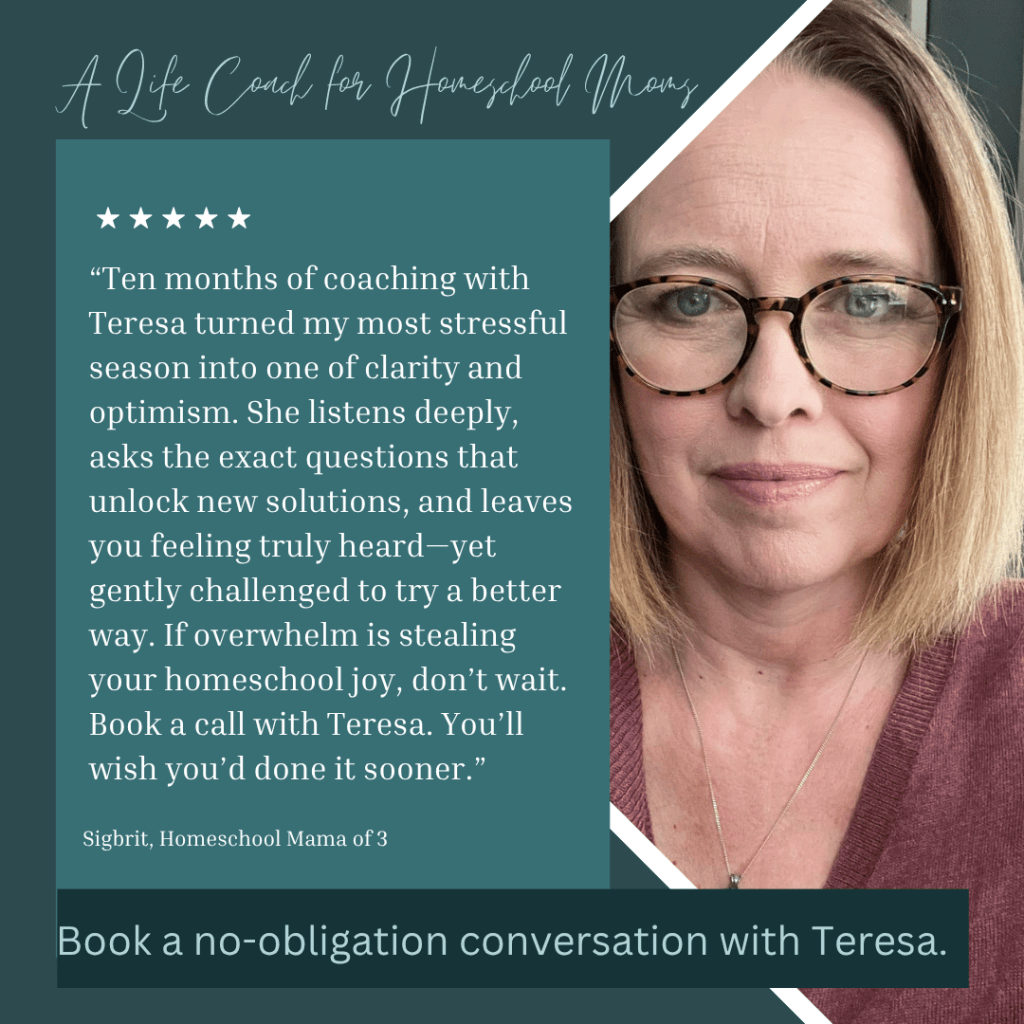
The Aligned Homeschool Reset Session is a free 30-minute coaching conversation where we talk about what’s working, what’s not, and what you actually need right now — in your homeschool and in your life. It’s a warm, grounded conversation, mom to mom, to help you gain clarity and find your next step.
You got into homeschooling to give your kids something better. You deserve to actually enjoy it.
👉 Book your free session here and take the first step toward reclaiming your rhythm, your joy, and your homeschool.
Book your free Aligned Homeschool Reset Session
I help homeschool moms trust themselves, edit expectations, and make intentional choices that create a more confident, connected, and present homeschool life.
Subscribe to the Homeschool Mama Self-Care podcast
Originally published May 11, 2024 · Updated April 11, 2026
Call to Adventure by Kevin MacLeod
Link: https://incompetech.filmmusic.io/song/3470-call-to-adventure
License: http://creativecommons.org/licenses/by/4.0/
