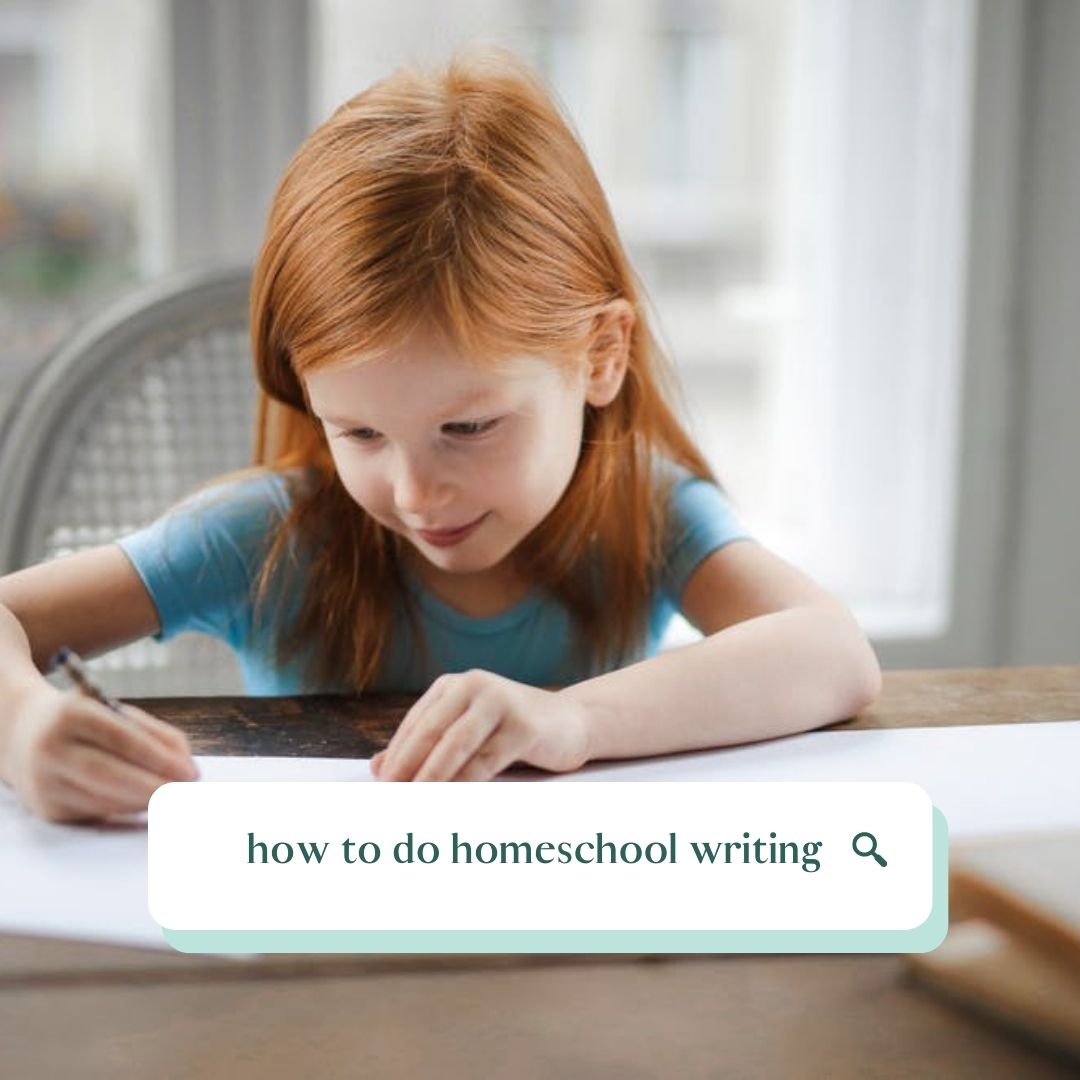
So many writing curricula, and not enough children. The more children we have, the more writing curricula we’ve sampled. We homeschool mamas are just trying to figure out how to choose homeschool writing activities that actually work for our kids. (And yet we never quite land on “the perfect one.”)
But there are a lot of great ones. I’ve used many writing curricula over my fifteen years — and if you’re staring down a wall of options, here’s what I’ve actually used, and what I learned along the way.

How to Choose Homeschool Writing Activities for Different Ages and Personalities
Since every child has a different approach to learning, reading, and writing, I’ve approached it differently every time:
- Essentials in Writing for my junior high and high school-aged kids, because it covers all the formal writing they’ll need for life and post-secondary school (if they choose that direction).
- First Language Lessons by Susan Wise Bauer for first and second-grade grammar, because it’s so easy to follow her directions (and I learned so much!). But I didn’t want to expend the energy her curriculum takes in the older grades. (Girlfriend, you work harder than I want to work as a homeschool parent.)
- Brave Writer’s approach and online classes, which I’ve shared at length before. My favourite takeaway from Julie Bogart so far: don’t teach them the mechanics of writing — teach them that they have to have something compelling to write.
- Write Shop, which I’d dabble in if I added yet another curriculum to the mix. Their online guidance and resources are right in line with everything I’ve learned about writing.
If sorting through curricula like this feels like a full-time job on top of everything else you’re carrying, that’s exactly the kind of overwhelm the Reimagine Your Homeschool Mini-Course was built for. It’s a short, practical course for stepping back and rebuilding a homeschool life that actually fits your family. Register now →
All Homeschool Writing Activities Take Practice — Not Perfection
The longer I write, the clearer I become. Said everyone about everything they’ve ever practiced with regularity. Practice makes competent. (Not perfect. There’s no such thing as perfect communication.)
So why do I talk about Write Shop when I haven’t used it myself? I attended a Write Shop seminar at the Washington Writer’s Conference once upon a time, and I gained more from it than I expected.
The biggest takeaway I learned was that my writerly, type-A, firstborn personality demands a lot from me and everyone around me. What I heard, loud and clear, was this:
My second daughter was grateful for that insight. It affected her the moment we got home.
How Perfectionism Gets in the Way
Perfectionism shows up in a lot of sneaky ways when you’re teaching writing:
- Trying to say something “right,” “clever,” or “creative” — without ever getting to the heart of what you actually want to say.
- Thinking there’s one right answer to an essay question.
- Focusing on grammar and sentence or paragraph construction before ideas have even been developed (when the ideas are the point of written communication).
- Focusing on sentence diagramming — sentence diagramming, begone!
- Or focusing on the flaws in a child’s logic instead of appreciating that they’re attempting to process a concept at all.
This is the same tug-of-war a lot of us feel across the whole homeschool, not just writing — if that sounds familiar, Why You Should Teach Kids to Handwrite (in 23 Easy Ways) digs into a related version of the same “let it be imperfect” lesson.

How to Help a Beginning Writer Build Stronger Homeschool Writing Skills
Start by having your child self-edit the first time around. Sure, they’ll miss the big things — obvious spelling mistakes, missing periods, overusing “that.” But until they assess their own writing, they won’t become an independent writer.
Then give your child a mama-edit on the second pass. Unless they’re academically minded or an eager post-secondary-focused high schooler, leave it there. No more editing. You’re not sending their copy to a magazine editor for a five o’clock deadline. Let them gradually learn what they need to learn.
Over time, your child’s writing — their communication — will get stronger. The more they write, the more competent they get. Push too hard, though, and they’ll just learn to hate it.
There’s nothing better for building a love of writing than giving kids time to free write. When they’ve finished their masterpiece, enjoy it with them — relish the word choices, laugh at the silly parts, and save the grammar and spelling corrections for later. Once a week, one of our study days is built entirely around a free write. It’s one of the simplest habits that’s helped my kids actually want to write, the same way [Why (& How) to Get Your Homeschool Kids to Journal] talks about low-pressure daily writing building real skill over time.
“Your child needs your patience, not your urgency.” — Julie Bogart
The Real Answer to How to Choose Homeschool Writing Activities
In the end, with a plethora of writing curricula to choose from, the quest for the “perfect fit” can be daunting — and honestly, a little bit of a trap. Flexibility is essential, because every child’s writing journey is unique. Whether you land on Essentials in Writing, First Language Lessons, Brave Writer’s approach, or Write Shop, remember: practice, not perfection, is what actually grows your child’s writing skills.
If you want to take that same “practice over perfection” mindset and apply it to your whole homeschool year — not just writing — the Reimagine Your Homeschool Workbook walks you through reflecting on what worked, what didn’t, and what you actually want to build next. Shop now →
And if you’re noticing you keep circling the same frustration — curriculum after curriculum, year after year, and it’s not really about the writing anymore — that’s usually a sign of a bigger cycle worth looking at, not another program to buy. That’s exactly what an Aligned Homeschool Reset Session is for: a free, no-obligation conversation where we get clear on what’s really going on, what might need to shift, and how you might begin to do that. Book your free session →
People also ask:
- How to Teach Writing in a Child-Directed Way
- 8 Useful Things I do to Develop my Homeschool Mom Identity
- just write, they say: how to teach writing in homeschool
- 🎧 Reimagine your Homeschool: Podcast Season #6 🎧
- How to Teach Writing Through Your Child’s Interests
- Why (& How) to Get Your Homeschool Kids to Journal
- Get more encouragement in the book: Homeschool Mama Self-Care: Nurturing the Nurturer
Subscribe to the Confident Homeschool Mom podcast
Originally published April 10, 2020. Updated September 17, 2026.
