
Podcast: Play in new window | Download
The homeschool to high school transition is, well, different from what I expected.
There’s a bracing moment in every homeschool mama’s world where she realizes her homeschooled kiddos aren’t staying kiddos forever. And though in theory she knew this, she also finds the transition unexpected in its emotional weight.
In this article, I share my honest experience of what the homeschool to high school transition actually looks like — the emotional side, the logistical side, and everything in between.

Our Homeschool Kids Are Growing Up
Our homeschool kids are moving on, moving up, growing into their own persons, and deciding to approach their lives independently — just as they should be.
Despite fully acknowledging that I knew I wasn’t going to be “mommy” forever, it always comes as a surprise when every single child shifts how they engage with me differently — yet at about the same developmental phase for each of them.
I typically see a push/pull dynamic: them wanting to be separate and showing me that in their unique ways, while also pushing back if I’m too insistent, forceful, or demanding. Gordon Neufeld discusses this beautifully in his book on adolescence.
This individuating thing comes as a surprise to my heart — because my heart hasn’t changed.
I’m the same mom who pushed them from my womb and clung tightly to them just moments after their entrance into the world. (Hmm, a push/pull dynamic there too.)
The Emotional Reality of the Homeschool to High School Transition
I want the same things for my kids. I want the same closeness. And I’m the same mom.
One day I’m tucking them into bed with a routine of hugs, kisses, blessings, and songs — the next, they’re going to bed by themselves.
One day I’m mediating sibling arguments, and the next they groan: “Mom, I can figure it out by myself.”
Their educational choices shift the same way.
One day I’m reading fairy tales and Trumpet of the Swan aloud. The next we’re working through To Kill a Mockingbird and The Great Gatsby. One day I’m teaching subtraction; the next I’m watching a math video lecture, genuinely unsure what language they’re learning.
Moving on. Growing up. Individual. Unique. In fits and starts.
At this age, they are very much beginning to see their own vision for their lives — or at least becoming aware that they will be the ones doing the envisioning.
You can hear about her experience homeschooling high school here.

Homeschool College? My Daughter’s Answer Said It All
Like many homeschool mamas, I had a clear educational plan for my kids’ high school years.
One of my girls was once asked an odd question: “When will your mom stop homeschooling you?”
Her answer: “She probably won’t teach college.”
I laughed in surprise. The person asking did not. They couldn’t believe that might even be a consideration.
For the record — my daughter was right. She graduated from college this past month. You can hear about her full homeschool to high school experience here.

Doing the Homework for Homeschool High School
I had to do a lot of homework, of course.
Navigating the homeschool to high school transition is a whole different kettle of fish from homeschooling K–9. If the high school student plans to attend post-secondary school, there’s likely an expressed area of interest and some focused work already underway.
I attended online courses, read books, and went to workshops on creating high school transcripts, grading, and rubrics. Then I learned about SATs, ACTs, portfolios, and recordkeeping. I studied post-secondary admissions requirements, high school diploma expectations, and spoke directly with university admissions officers about alternative routes to entry.
Girlfriend, I was prepared.
An Alternate Route to the Alternate Route
Then it happened: my first daughter wanted to attend public high school.
I shouldn’t have been surprised — but I was. She has always been fiercely independent, and she has always followed her own path. She completed her high school diploma in two years, decided she wasn’t sticking around for a third, saved money to travel independently to Mexico for five months, and then applied on her own to a university across the country to study social sciences and languages — including Latin, which we had started together.
My Second Daughter’s Homeschool High School Journey
My second daughter entered the homeschool to high school transition differently — she chose to continue homeschooling, even as all her peers moved into public school.
Last year she loved her Apologia Chemistry class, BraveWriter Essay classes, and a private Comparative Governments course. This year she’s tackling Apologia Physics, learning French through Rosetta Stone, and working independently through her literature reading list — all while continuing with Math-U-See, working as a hostess at a local restaurant, spending hours in dance classes, and maintaining an active social life.
This year’s new addition: a college English class.
I took a deep breath before calling our local community college. I presented the situation confidently: I have a focused, engaged homeschooled high school student who is eager to try a college English composition class.
We were initially redirected to high school upgrading — not what we were looking for. So I called back, asked for the English department chair, and had an honest conversation about my daughter’s learning goals. The department chair was enthusiastic and invited her to join English 110, pending a placement exam. I submitted her portfolio alongside the application — comparative government essays, persuasive essays, formal lab reports, and more–she was welcomed into the class.
She’s now more than halfway through, loving it, and recently completed a three-hour Language Proficiency Index exam at a provincial university four hours away.
She takes on learning responsibilities like a college freshman. Her drive, organization, and consistent effort will absolutely get her where she wants to go.
One of the most surprising things about our homeschool to high school transition? It’s been far less work on a day-to-day basis than K–9 homeschooling. More upfront planning, yes — but once the structure is in place, her streamlined and personalized education runs itself.
Tips for Navigating the Homeschool to High School Transition
Foster independence and time management. High school is a critical time for teens to develop self-discipline, responsibility, and ownership over their lives. Give them as much ownership of their education as possible. Stop dictating. Start collaborating. Work yourself out of the “telling them what to do” role.
Plan ahead — then stay flexible. Think about where they might be heading in four years, then plan backward. Then assume they might go somewhere entirely different. Both are true at once.
Help them live purposeful lives, not just finish high school on the honour roll. Your real goal — whether you’ve fully accepted it yet or not — is to equip them to live intentionally. Let them start practicing that now.
Lean hard into child-led learning, because it becomes adult-led living. Release the control, dear homeschool mama. If you can’t quite hear that yet, at least one of your kids will eventually try to teach you. They arrived on this planet for their own unique reasons — not to become a copy of you.
Remember: each child is unique. The homeschool to high school transition looks different for every family and every kid. Deschool yourself from the idea that there is one right way to do this. There isn’t. Never was.
The Mindset Work That Changes Everything in Homeschool High School
If the homeschool to high school transition has you questioning yourself, your methods, or your sanity — this journal and workbook was made for you. The Mindset Shifts for Thriving Homeschool Moms in the High School Years gives you the prompts, the perspective shifts, and the space to reset and move forward with intention.
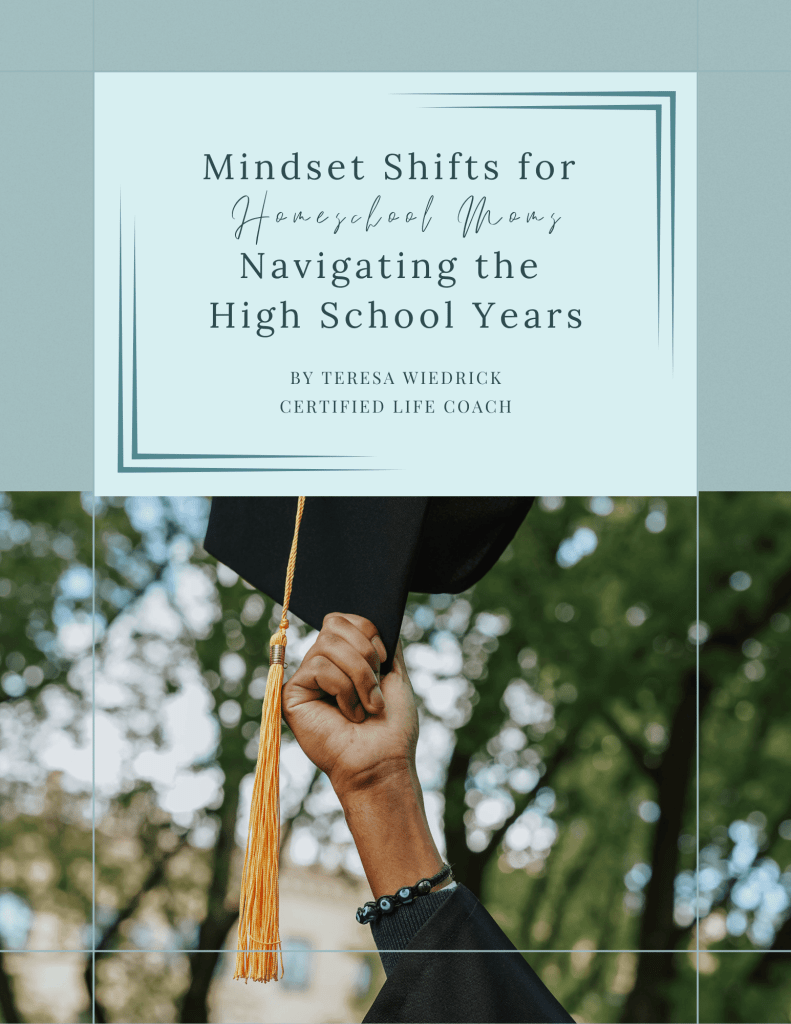
Mindset Shifts for Homeschool Moms: Thriving Through the High School Years
Confidently Homeschool Through the High School Years
FAQ: Homeschool to High School Transition
Is the homeschool to high school transition hard?
It can feel emotionally heavy — even when you were expecting it. Watching your child individuate and take ownership of their own learning is beautiful and bittersweet at the same time. Logistically, it requires more upfront planning than earlier homeschool years, but many families find the day-to-day teaching load actually decreases as teens take on more independence.
Can a homeschooled student take college classes during high school?
Yes — and it’s a great option for motivated students. Community colleges are often the most accessible path. Call ahead, ask to speak with the department chair for the subject you’re targeting, submit a strong portfolio, and advocate clearly for your student. Many colleges will accommodate homeschooled high schoolers who demonstrate readiness.
Do homeschooled students need a high school diploma?
It depends on your goals. Many universities accept transcripts created by homeschool parents, portfolios, and standardized test scores in place of a traditional diploma. If your student plans to attend post-secondary school, research your specific university’s admissions requirements early and work backward from there.
How do I create a high school transcript as a homeschool parent?
Start by researching workshops, books, and online courses specifically on homeschool transcript creation. Document courses, grades, credit hours, and extracurriculars. Many homeschool communities and co-ops also offer guidance. The earlier you start tracking, the easier it becomes.
What if my homeschooled teen wants to switch to public high school?
Let them. Seriously. Their desire for a different experience is part of their individuation process, and it doesn’t mean homeschooling failed. Many homeschooled teens who enter public high school are exceptionally well-prepared and thrive. Trust the foundation you’ve built.
How do I know if my teen is ready for the homeschool to high school transition?
Readiness looks different for every child. Academically, look for the ability to work independently, manage their time, and take initiative. Emotionally, watch for a growing desire to direct their own learning and make their own decisions. These are signs the transition — whatever form it takes — is right on time.
People also ask…
- Unexpected Feelings When Your Homeschooler Gets Accepted to University
- A Homeschool Teenager’s Perspective: How to Homeschool High School
- the truth behind homeschool socialization: 10 secrets that surprise
- Wise Advice for High School Homeschoolers with Vicki Tillman
- Why Homeschool High School is Better with Mary Hannah Wilson
- How to Develop Self-Confidence as a Homeschool Mom with Sarah Gorner
- What are the benefits of homeschool high school?
- What’s it like having a high school homeschooler at home?
- How to unschool high school.
- A 2023 High School Graduates Thoughts on her Homeschool Life
- Should I Homeschool My Child?
- I’m a new homeschooler, are you able to walk alongside me and mentor me?
Feeling Stuck in the Transition? This Free Session Is for You.
The homeschool to high school transition raises a lot of questions — and you don’t have to sort through them alone. Sign up for your free Aligned Homeschool Reset session and walk away with renewed direction, practical next steps, and the confidence that you’ve absolutely got this.

Teresa Wiedrick
I help overwhelmed homeschool mamas shed what’s not working in their homeschool & life, so they can show up authentically, purposefully, and confidently in their homeschool & life.
Subscribe to the Homeschool Mama Self-Care podcast
Call to Adventure by Kevin MacLeod
Link: https://incompetech.filmmusic.io/song/3470-call-to-adventure
License: http://creativecommons.org/licenses/by/4.0/
