
Podcast: Play in new window | Download
How do I unschool my child and just let my kids learn?
That question right there is the whole point of talking about unschooling. It helps us loosen our grip on our children’s education — and just let them learn already. Maybe you’ve been homeschooling for a while and something feels off. Or you’re brand new and already sensing that the school-at-home approach isn’t quite sitting right with you. Either way, you’re in the right place. So let’s talk about it. How do I unschool my child — and what does that actually look like day to day?
First — What Unschooling Is NOT
Before we get into the how, let’s clear something up, because this is the thing that trips people up most:
Unschooling is not doing nothing.
It is not plopping your kids in front of screens and calling it a day. It is not throwing out all structure, abandoning your parental instincts, or deciding that anything goes.
Unschooling is intentional. It’s primarily child-led, yes — but you are still very much present, paying attention, and guiding the environment your kids are learning in. You’re just not doing it with a lesson plan, a grade book, and a bell schedule.
Think of it less like “school without rules” and more like “life, lived on purpose.”
How Do I Unschool My Child? Here’s What It Actually Looks Like
Let them learn on their own terms — what they want to learn, how they want to learn it, and why.
There’s this notion out there that if you set up a system, organize it, bring in enough people to officiate it, and administer grades and exams, children will receive an education.
But here’s what I’ve noticed after years of doing this: kids don’t receive an education. They engage in one — if they’re invested.
Kids want to learn. Unless they’ve been seriously neglected, children will grow and learn. It’s what they do. They’re not always eager to learn what we want them to learn, when we want them to learn it, in the way we want them to learn it — but that’s actually okay.
(And yes — there have usually been two seasons in our homeschool: formal studies and unschooling. More on that below.)
The Two Seasons of Our Homeschool
This is something I’ve barely touched on before, but it’s honestly one of the most useful frameworks I’ve stumbled into.
We don’t unschool year-round. We move in and out of two modes:
Season 1: Formal Studies We have a rhythm, a curriculum (or at least a loose plan), and some structured learning. Math gets done. There are books we work through together. We show up.
Season 2: Unschooling We let things breathe. Interests lead the way. We follow rabbit trails for weeks at a time. The kids direct, I support.
Neither season is better than the other. Both serve our kids differently at different times. And honestly, recognizing that we’re allowed to shift between them was one of the most freeing realizations of our homeschool journey.
Ready to Start Strong? Grab Your First-Year Homeschool Guide
If you’re in that first season — or just stepping into homeschooling for the first time — you don’t have to figure it out alone. I put together a practical guide specifically for new homeschool families who want to begin with confidence instead of overwhelm. It walks you through the decisions, the doubts, and the moments where you’ll wonder if you’re doing it right. (Spoiler: you probably are.) Grab your copy and start your first year with clarity, calm, and a whole lot more peace of mind.
5 Simple Steps: How Do I Unschool My Child?
So if you’re still asking how do I unschool my child — here’s exactly where to start.
1. Occupy Their Time in Meaningful Ways — Or Let Them Occupy Themselves
Give your kids space. Real, unhurried space.
- Let them be bored. (Boredom is not a problem to solve. It can be a remarkable opportunity to new learning.)
- Give them time to discover new interests in solitude.
- Allow for a balance between prescribed and exploratory time.
- Expose them to new concepts, new places, and new ideas.
- Give them meaningful work: housework, childcare, farm work, volunteering, neighbourhood jobs.
Then let them play — real play, with no hidden learning agenda. Just easy, entertaining play.
2. Consider What You Want Them to Learn
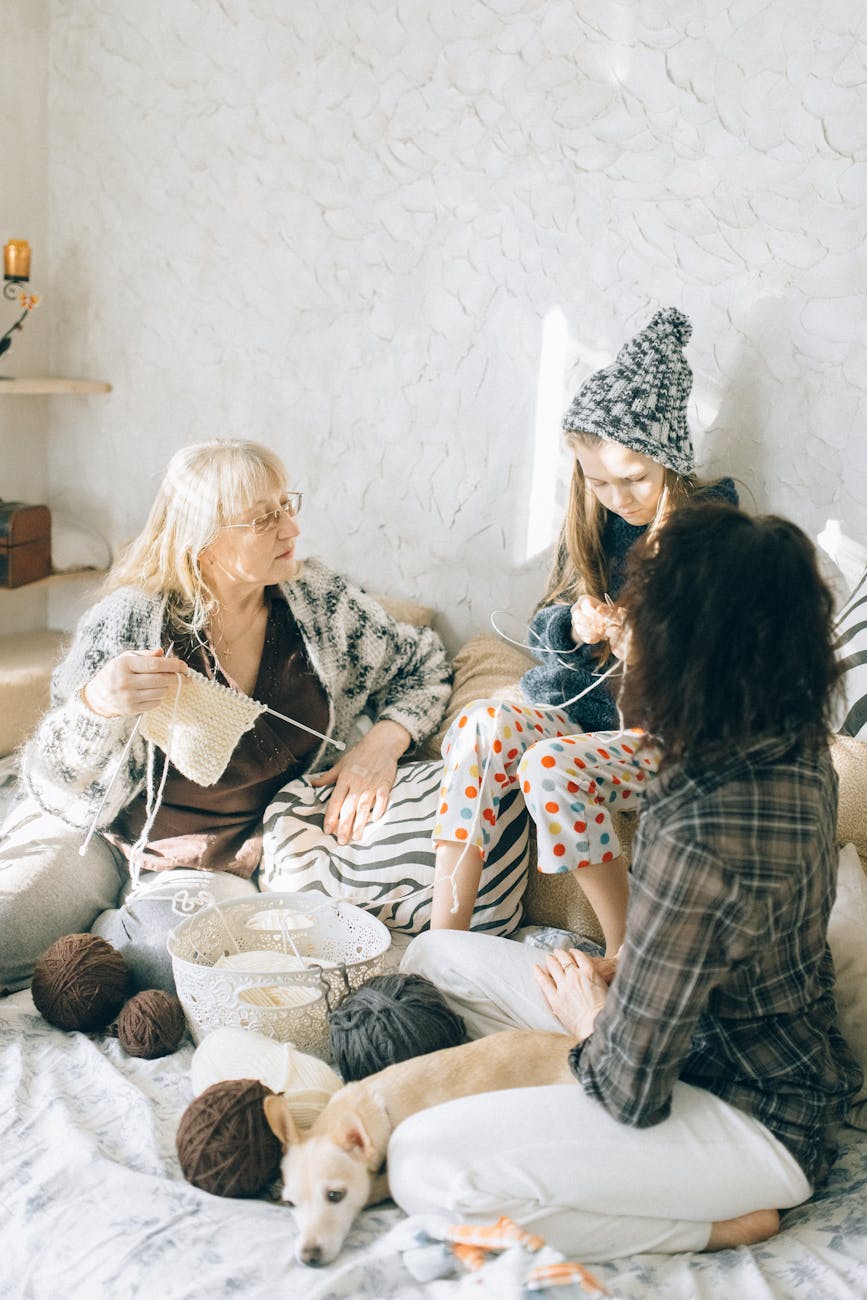
3. Observe and Listen to Who Your Children Actually Are
What are they about? Who are they becoming?
Even young children drop big hints about who they are. A child who loves earning money might start with a lemonade stand and work up to marketing their baking or doing yardwork for neighbours. A crafty kid might fall deep into Pinterest and emerge wanting to knit, tie-dye, or sew their own cushions.
Observe. Listen. You will help them learn more about themselves just by paying attention.
4. Don’t Educate Out of Fear
There will always be gaps. Imperfect educations. I love the term lopsided education — because that’s what all of us got, whether we were homeschooled, publicly schooled, or privately schooled.
When someone says, “But what if they miss something?” — they’re probably right. Your kids might not learn something. Welcome to humanity!
But after twelve years of academics, are you hoping your child can outwit Google? No? Then stop educating out of fear.
What about college? Kids who’ve been unschooled have gone on to college. They often arrive more self-directed, more curious, and more capable of learning independently than kids who spent twelve years being told exactly what to do when. Gaps can be filled. Curiosity is much harder to rebuild once it’s been schooled out of our kids.
What about math? Math can be learned anytime, and in a consumeristic world, they’ll be required to anyway. A child who wants to run a business will learn to manage money. A kid who loves building will learn geometry. Or a teenager preparing for a specific college program can catch up on specific math skills with focus and intention. It’s not as fragile as we’ve been led to believe.
5. Enjoy the Process
If you’ve been asking how do I unschool my child, this last step might be the most important one: enjoy it.
Your kids are growing up right in front of you. They are becoming independent and capable and eventually they will grow right out of your home.
You didn’t have them so you could check boxes off a list. You didn’t start homeschooling so you could add another impossible makework project to your life.
They already want to learn. They were hardwired for it. So have fun with it.

What About Screens and AI? The Digital Learning Question
This is the question that wasn’t as front-of-mind even a few years ago, but it’s a common discussion I hear from unschooling families: What do we do about screens? What about AI?
Here’s my honest take: the same principles apply.
Watch how your child engages. Are they consuming passively or are they genuinely curious and exploring? Are they using tools to go deeper into something, or to check out entirely?
AI in particular is worth paying attention to — not because it’s dangerous, but because it’s genuinely powerful. A child who learns to use AI as a thinking partner (asking it questions, pushing back, then going to verify things in the real world) is developing exactly the kind of intellectual habits unschooling has always been about.
A child who uses it to avoid thinking? That’s a conversation to have — but it’s worth remembering that resistance to hard thinking was happening long before AI existed.
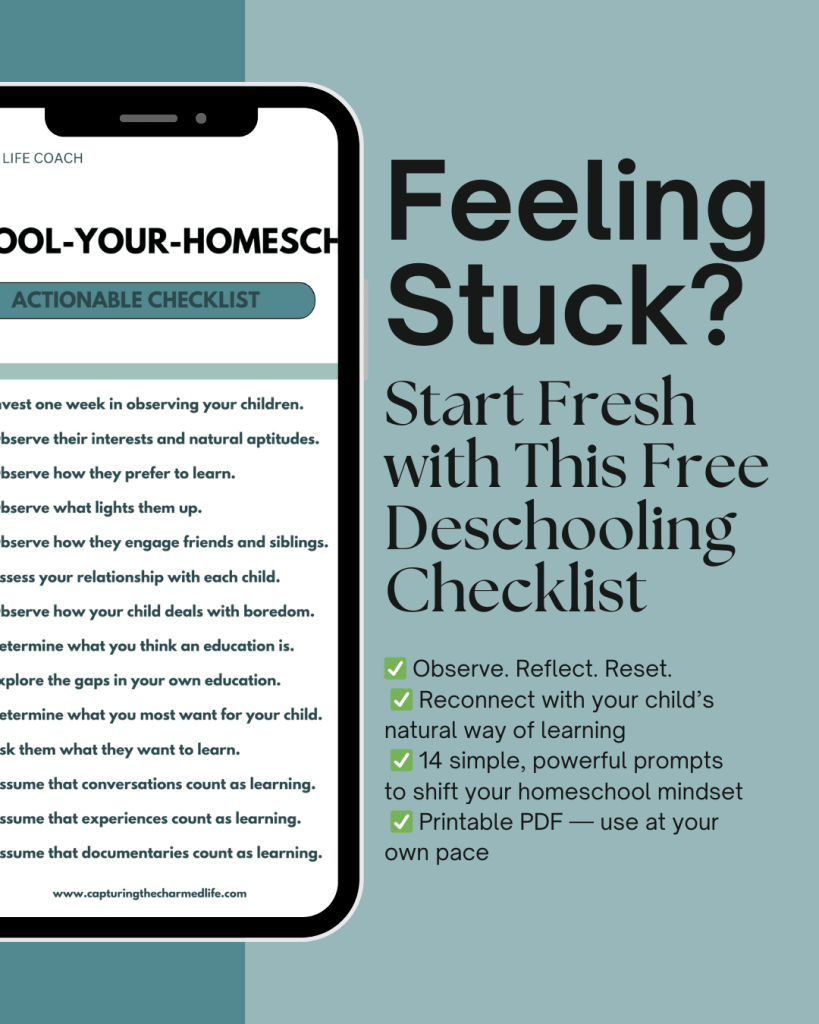
Not Sure Where to Start? Grab the Deschool Checklist
If you’re transitioning out of traditional school — or just feeling like your homeschool needs a reset — deschooling is often the first and most overlooked step. It’s the process of letting go of school-think before you try to build something new. This free checklist walks you through exactly what that looks like, so you can move into unschooling (or any homeschool approach) without dragging all the old baggage with you.
Frequently Asked Unschooling Questions
What does a typical unschooling day actually look like?
Honestly? It depends on the season. In a more relaxed stretch, a day might look like a slow morning, some independent reading or tinkering, a project they’ve been absorbed in for weeks, outdoor time, and maybe a family dinner conversation that turns into an hour-long discussion about something nobody planned.
How do I know if it’s working?
Watch your child. Are they curious? Are they asking questions, pursuing things, learning skills — even ones you didn’t assign? And are they growing into someone who knows how to figure things out? That’s it. That’s the measure. You won’t find it on a test.
Do I need to keep records?
That depends entirely on where you live. Some jurisdictions require annual reporting or portfolios; others ask for almost nothing. Know your local homeschool laws and keep whatever documentation is required — but beyond legal requirements, records are really just for you. Many unschooling families keep a simple running list of what their kids are into, books read, places visited, projects completed. It adds up faster than you’d think.
How do I unschool my child through high school — doesn’t it get harder?
It gets different, not necessarily harder. High school is when kids often have a clearer sense of what they’re working toward — and when unschooling can become incredibly purposeful. A teenager who wants to study nursing, go to trade school, or start a business can build a genuinely tailored path. That said, this is also the season where some families shift back toward more formal studies to hit specific prerequisites. And that’s fine — remember the two seasons.
What about socialization? (Yes, we have to address it.)
Unschooled kids tend to socialize more broadly than traditionally schooled kids — across ages, across communities, in real-world contexts rather than just with thirty same-age peers in a classroom. Co-ops, community classes, sports, volunteering, neighbourhood friendships, family relationships — it all counts. The socialization question is usually coming from a place of genuine care, so answer it generously. But don’t let it shake you.
My child seems content just… doing nothing. Is that okay?
For a season, yes. Especially after a period of heavy structure or a deschooling transition, kids often need to decompress before their natural curiosity re-emerges. It’s uncomfortable to watch, but it’s usually not a sign that something is wrong. Give it time. Keep the environment rich with interesting things. Stay connected. The nothing rarely lasts.
Can I unschool just one child if my others do a more structured curriculum?
Absolutely. Children are different. One might thrive with a loose structure of living books and nature study; another might genuinely love a formal math curriculum. You’re not locked into one philosophy for your whole family — or for your whole life.
Is unschooling legal?
Yes — in most places, unschooling is legal under homeschool legislation. Because unschooling is a method of homeschooling rather than a separate category, it falls under whatever homeschool laws exist in your region. Requirements vary widely: some jurisdictions ask for annual assessments or portfolios, others require almost nothing beyond a simple notice of intent. If you want to know “how do I unschool my child”, know your local laws, meet the minimum requirements, and within that you have tremendous freedom in how your children learn.
What’s the difference between unschooling and homeschooling?
Homeschooling is the umbrella — it simply means educating your child outside of a traditional school setting. Unschooling is one approach within that umbrella. A homeschooling family might follow a structured curriculum, replicate a school-at-home schedule, or use a mix of textbooks and classes. An unschooling family lets the child’s curiosity and interests drive the learning, with the parent facilitating rather than directing. All unschoolers are homeschoolers, but not all homeschoolers are unschoolers.

Starting your homeschool journey? Let’s set you up for success.
The early days of homeschooling can feel exciting—but also full of doubts. You might be wondering if you’re “doing it right,” how to handle the random questions (or opinions!) from others, or how to quiet that little voice that whispers imposter syndrome.
That’s why I created the Aligned Homeschool Reset Session.
In this 1:1 session, you’ll:
- Gain clarity on what matters most in your homeschool (not someone else’s)
- Learn how to confidently respond to the “What about socialization?” questions
- Identify the unique strengths you already bring to homeschooling
- Create a simple, aligned plan to begin with calm, confidence, and joy
You don’t need to prove yourself—you just need a little space to align your homeschool with your family’s values and vision.
👉 Book your Aligned Homeschool Reset Session today and begin your journey with confidence, clarity, and a whole lot less second-guessing.



You’ve Got This!
There. Unschooling in a nutshell — and it’s not as daunting as it looked from the outside, is it?
Your kids were put on this earth for a purpose. They are growing, becoming, and learning right in front of you. You don’t have to engineer every moment of that.
Trust them. Trust yourself. And enjoy the ride.
The answer to ‘how do I unschool my child’ was always simpler than we thought: trust them, show up, and get out of the way.
People also ask…
- How to unschool high school.
- How to Unschool High School and Prepare for College
- Seasons in our Homeschool: Embrace the Ever-Changing Rhythms
- do you know who you are homeschool mama?
- Revolutionary AI Thinking Partner for Homeschool Moms Who Feel Overwhelmed
- Unschool Mothers: Candid Conversation with Virtual Kitchen Table
- What is the Reimagine Your Homeschool Group Coaching?
- Is there an art and a science to an education?
- The truth behind the homeschool room & if you really need one
- 7 Freedom-Loving Ways John Taylor Gatto Informs your Homeschool
- Can you homeschool without a homeschool room?
- How to Encourage Independence in your Homeschool
- how to live your simple homeschool life on purpose
- Allowing for Two Seasons in our Homeschool & How to Do It
- Unschool music training by doing nothing at all
- John Holt & Pat Farenga Teach Homeschoolers How to Learn
- The Ultimate Homeschool Burnout Prevention Plan
Latest episodes
Subscribe to the Homeschool Mama Self-Care podcast
Call to Adventure by Kevin MacLeod
Link: https://incompetech.filmmusic.io/song/3470-call-to-adventure
License: http://creativecommons.org/licenses/by/4.0/
Updated 2026

You warm the cockles of my heart – perfectly said – onward unschooling friend! I tend not to think of myself as an unschooler, because I provide some loose structure, but when I read this I can’t agree more – so unschooler it is from now on.
As a long-time unschooler, I’ve felt that the kernel at the centre of the nutshell is trust: trust that children raised with freedom and autonomy in a reasonably rich environment with access to caring adults will learn what they need to become who they want to be. And trust that when included in the real world of family and community life, what is necessary and useful knowledge and skills will be self-evident, and their drive for competence will motivate them to master it. So I would substitute trust for your #1 and #2. I would say 1. Trust them to occupy *themselves* in meaningful ways and 2. Trust that they will know better than you what and when it is important for them to learn.
Wonderful article! And I so agree with moominmamma that it is about trust. Your kids are lucky with a educator mom who almost outwits Google and God. 🙂
Haha Well those are big shoes–outwitting Google & God–I will always have things to learn about myself;)
you’ve given me a good understanding of what you consider unschooling. Good read. Some of your sentences made me smile. I wish that more people could articulate their unschooling philosophy as well. 🙂
Thank you. This is my way of defining unschooling in my home. I’m certain many unschoolers wouldn’t necessarily see it that way. There is, emerging recently, a form of radical unschooling, which I have tried, and eventually moved away from too. The different seasons of learning how best to homeschool in my home I guess.