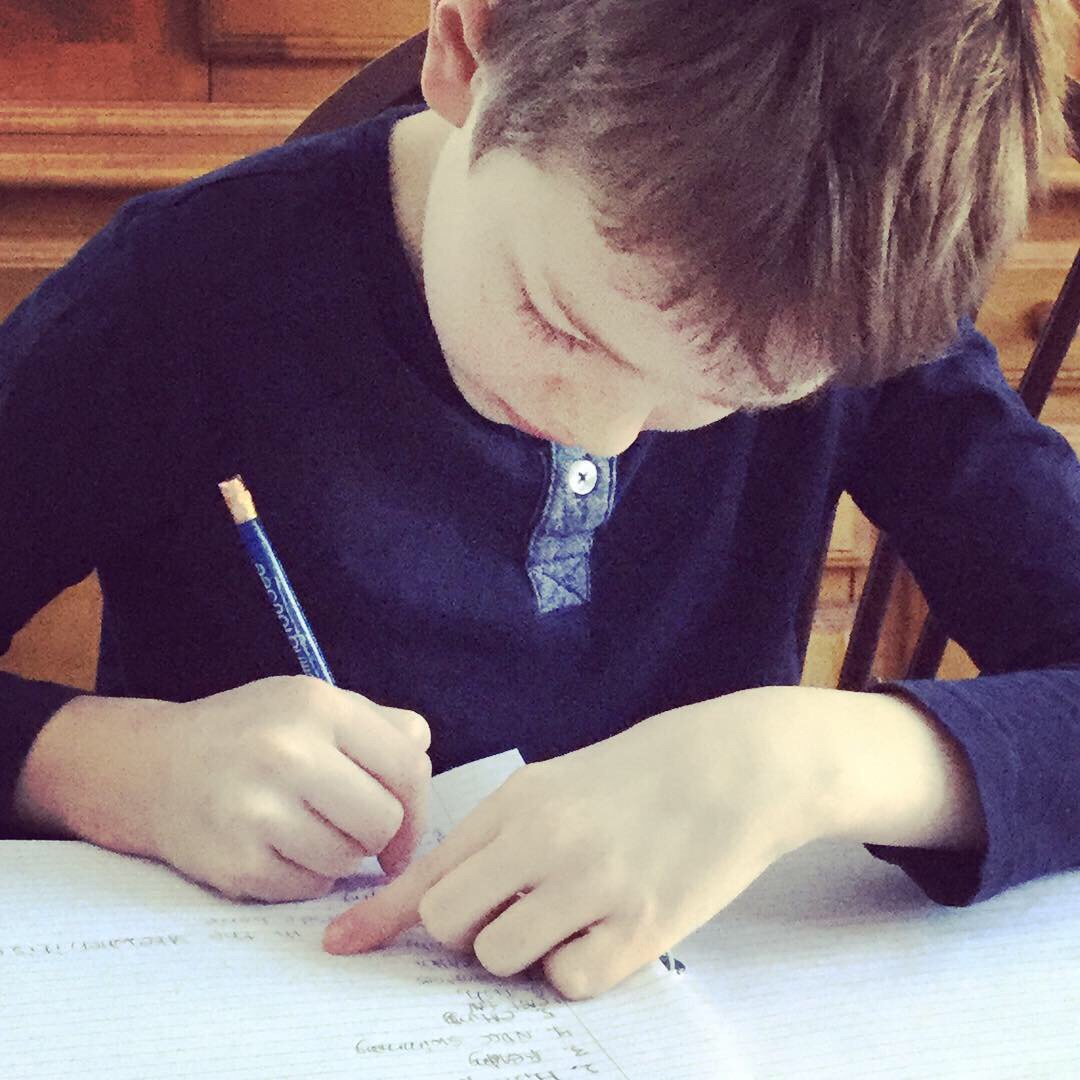
Can you get rid of the spelling program and still teach spelling in a child-directed way? Yes — and I can tell you exactly what I’ve learned about ditching the program and letting my kids learn to spell in a child-directed way instead.
A new-to-homeschool mama asked me:
“Do you have any advice on how to teach a child spelling? My daughter is a terrible speller. She loves to write stories, but I can’t even read them because the words are so badly spelled. I have tried All About Spelling, but the rules seem to confuse her. She is a struggling student in general. She is my creative, head-in-the-clouds girl. School to her is in the way of her having time to be creative. She struggles with reading too. She completely confuses me in how to teach her. Any advice would be great. I’m at a loss right now. For other reasons, my motivation for school has decreased, however, I have a husband and mother-in-law who are results people, and they want my kid to be a Little Einstein. EEEEKKKK!”
If that sounds like your house too, you’re probably not just stuck on spelling — you’re stuck in a “school-at-home” mindset that’s fighting your kid’s natural learning style. Before we get into spelling itself, grab this free tool to help you loosen that grip:
Download the free checklist here →
How to Teach Spelling to Kids in a Child-Directed Way: Read With Them
Spelling is a subject that came into my consciousness as I watched our second daughter not spell at the level, I thought she probably could. I got out the mental magnifying glass, watched her closely, read about learning to spell, and attempted to resolve this trouble.
I’ve been homeschooling long enough that I now know there is no perfect teaching approach to any subject.
There is no perfect way to teach each child, but parent-teachers are motivated to figure out what their kids need and are determined to piece together the puzzle of their child’s learning mind.
Education isn’t about results.
The education system is, but an education is not.
If results refer to continued growth and an ever-curious mind, then an education occurs.
The notion of an education being proven by a series of papered results, grades, and exam marks is so ingrained in our culture that it’s hard to get the notion out of our heads.
But if we chose to think of education differently, we would infuse a lot less anxiety toward our kids and enable us to enjoy our homeschool freedoms.
Personal experience has taught me that force-feeding any learning doesn’t work.
Though I really, really, really wish it worked that way because I have instinctively tried it many, many, many times.
Surely my children will receive my mommy wisdom because I’ve learned a “few things”….haha. It simply does not work that way.
As for how to teach spelling to kids…
Phonics programs are more useful to you than to your child.
There are a lot of phonics programs (which are essentially the origin of spelling rules). They’re all useful attempts at decoding the English language.
None of them do it perfectly because the English language has too many exceptions. There is no precise formula or painstakingly perfect program. There is no internationally-taught English language system for a reason; everyone doesn’t agree on how to teach it.
Some of them cost a lot. Don’t spend that money.
Some of these programs take a lot of time to understand. And also, to teach. Don’t waste your time trying to figure them out.
We reading adults take for granted spelling or phonics rules. Most of us know that ‘ph’ says ‘f’ or that ‘e’ says ‘ee’ sometimes, but mostly ‘e’ sounds like a short ‘e’ when surrounded by consonants…etc, etc, etc.
We know because we READ. We recognize those words because we see them A LOT.
We’ve likely been taught phonics, or possibly the whole word approaches if we were in school when it was in vogue, but we don’t remember phonics rules (unless we teach kindergarten, or recently had our child in kindergarten).
So it would benefit parents to study phonics; phonics rules help explain a lot of words.
If taught ALONGSIDE reading and writing, we could learn some of the phonics rules, so we can naturally teach them to our kids.
Reminding our kids of “sounding out” rules will reinforce their awareness as they read. These rules need to have relevance to their present experience, not just random trivia they don’t care to know.
I know there are phonics systems to introduce kids to diphthongs and blends and word families, but I have not seen my kids learn to read, write or spell because of those little lessons.
(Though I really hoped they would, because I thought it would be simpler if someone else could do it through a book.)
I have seen my kids learn to read, write, or spell because they wanted to read a story, or because they ask wanted to write a story, or a thank you card, or a letter, or a homemade theatre playbill for their homemade drama productions: “Mom, how do you spell…” (An excellent question that facilitates spelling.)
My approach is super simple: read with them and explain some of the rules as you go. Focus on a few words that you know they struggle with.
Help them to slow down and see the word: “See the word “February” — it sure is a strangely spelled word because almost no one pronounces it as it’s spelled.”
Or ask them which word explains the rule “the first vowel does the talking, the second one does the walking”. Make it a game.
Point these things out occasionally. Not every single word or they won’t want to read with you. Definitely don’t scold as you go. They’ll definitely not want to read with you.
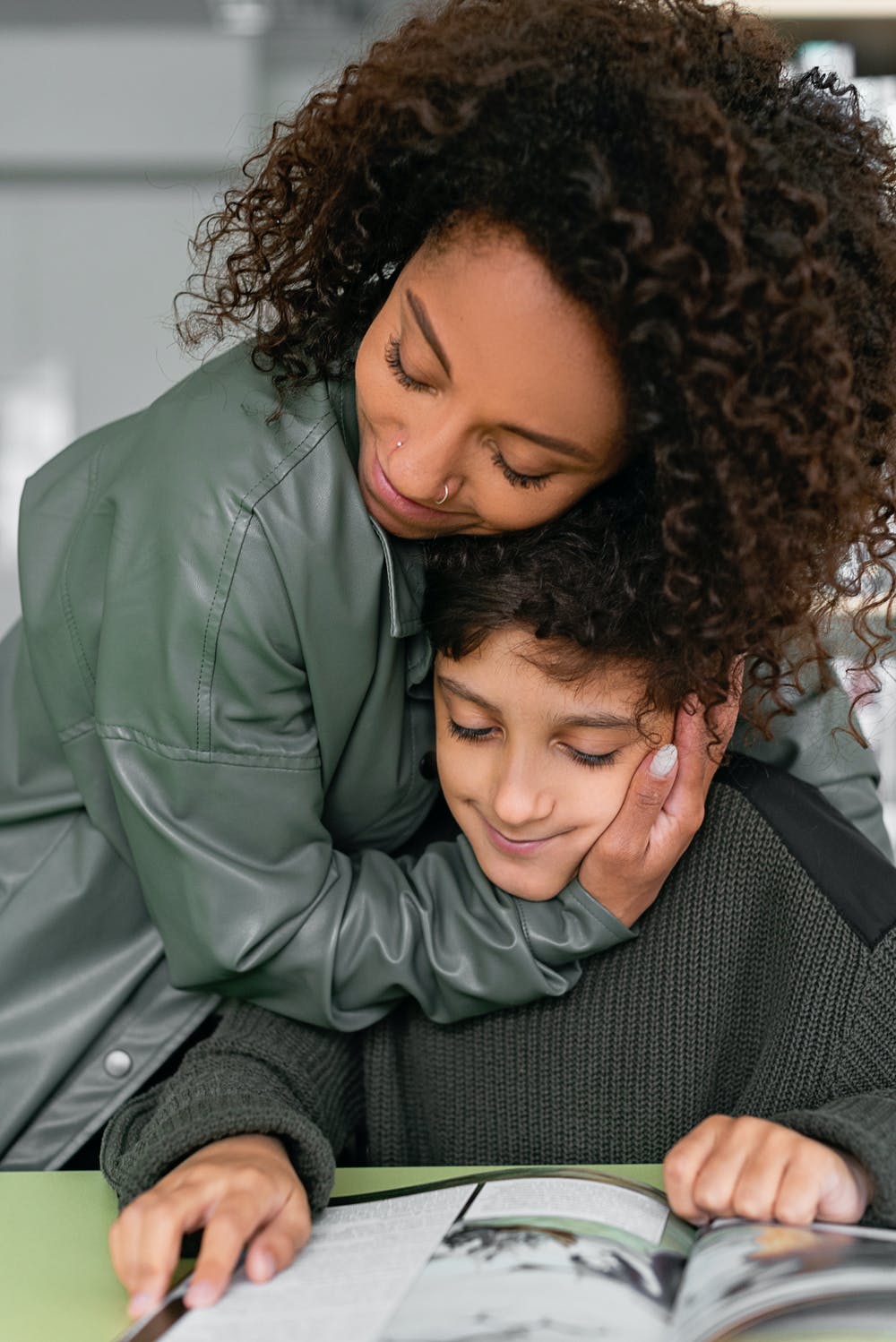
Kids do want to sit on their parent’s lap, cuddle under a blanket, taking paragraph turns while reading something THEY want to read.
Reading builds their ear for words. Writing is where that awareness turns into real spelling — which is why the next shift matters just as much.
Teaching Spelling in a Child-Directed Way Through Their Own Writing
If your daughter is writing and writes even when not asked, you can be certain that she will grow up to be a great speller. She loves words. Perfect. Be confident, and patient, as her word awareness grows organically.
Writing prompts get their creative juices flowing. They know that there’s no wrong answer to their stories. They can have fun finishing a story start, or tell you where they would go in outer space, or share their dreams from last night, or why their Lego creations were built the way they were.
You can oooh, and ahh, over their clever little minds and their funny stories, or their ability to paint a picture with their words, or their well-crafted dialogue. Share these stories at lunch.
The next day you can help them flesh out their stories. What happened to that other character…can you write about that? How might you show me that your main character is happy, instead of saying, Jane was happy? Did you know that every sentence has a stop sign? Did you know that “Wednesday” is not spelled the way most people say it?
(Watch closely so that you don’t overwhelm their senses with too many suggestions, or they might question whether their writing is a failure.)
But their written work becomes fodder for their grammar, writing, and spelling lessons.

Do dictation exercises.
Dictate a sentence, or even just a word, from their favourite book. Have them write that word in their spelling book. Have them do that a couple of times a week. They will begin to recognize that word, and memorize it. Then point out the phonics rules that make that word function the way that it does.
Include spelling cards. Reinforce the dictation exercise words with a weekly spelling card review.
Charlotte Mason believed that to understand the spelling of words, a child must repeatedly be exposed to the correct spelling of a word, not mindlessly guessing at the wrong spelling of a word once a week for spelling tests. (Well said, CM!)
Our girls have a spelling notebook with the letters A to Z in the upper corner. Like their own personal dictionary When they misspell a word, I have them write the correct spelling of that word in their notebook. Then they write that word as a flashcard, they read it once a day, and at the end of the week, we decide whether they know that word.
Play spelling games.
The best way to learn anything is with fun, so choose one of these games to teach spelling to your kids. Spelling games are another easy way to teach spelling in a child-directed way — the child is playing, not drilling.
Boggle, Scrabble, and Bananagrams — these are fun, and actually, reinforce spelling and new vocabulary.
Spelling City is a fun online site that introduces new vocabulary with games. There are grade suggestions for spelling words, which might give you a few words to learn if you don’t know where your child is struggling.
Spelling apps like A+ Spelling make spelling quizzes easy. I have my kids type in their spelling words into the program (and check the list to make sure they’ve inputted correctly), and they use their spelling words in unscramble games, practice tests, and even quizzes. My policy: sound it out, before you ask mom!
When asked the question, “Mom, how do you spell”… I require them to first attempt the spelling so I can see assess their understanding. I can reinforce the rules, like “Sorry honey, there are always vowels in words,” or “There’s more than one way to spell an “ee” sound”. First, they must attempt the spelling for me.
When I shared this with one mom, she responded incredulously, “But I don’t WANT to answer my kids constantly about how to spell words…she’d be asking me ALL the time”. Indeed. Welcome to homeschool parenting: we answer a ton of questions.
My approach to educating my children is intensive; however, it reaps results.
That’s really the heart of how to teach spelling in a child-directed way — following your child’s own words back into the rules.
Where to Go From Here With Child-Led Learning in Your Homeschool
If the Deschool Your Homeschool Checklist got you rethinking how much “curriculum” your homeschool actually needs, the Deschool Your Homeschool Journaling Workbook is the natural next step — it’s where you go deeper…

Deschool your Homeschool Journaling Workbook
The Deschool Your Homeschool Journaling Workbook is a self-coaching tool designed to help you redefine your homeschooling journey with clarity and confidence. Through thoughtful prompts and guided exercises, this workbook empowers you to:
People also ask:
- How to Choose Homeschool Writing Activities for Any Kid
- How to Teach Writing in a Child-Directed Way
- Why (& How) to Get Your Homeschool Kids to Journal
- How to practically deschool your homeschool
- How to Facilitate Child-Led Learning in your Homeschool
- teaching vocabulary
- How to Teach Kids to Write Effectively: A Brave Learner Review
- How to Engage Art History in a Child-Directed Way
- why you should teach kids to handwrite (in 23 easy ways)
- how to do homeschool science in a child-directed way
- Breaking Free: How Deschooling Helps You Live a Purposeful Life
- 5 Useful Things I Learned after I Assessed my Last Homeschool Year
- just write, they say: how to teach writing in homeschool
- How to Do Fine Arts in your Homeschool in a Child-Directed Way
- Do you offer one-on-one homeschool coaching? Why, yes I do!
Subscribe to the Confident Homeschool Mom podcast
Published April 8, 2020, 5:00 am · Updated August 21, 2026
