
Podcast: Play in new window | Download
If you’re ready to learn how to deschool 101, you have some homework to do. Homework, get it? A homeschool mom prescribing homework. These 7 lessons in how to deschool 101 propelled me toward more satisfaction, individualization, and freedom — and they can do the same for you.
So, here’s a story from last fall.
Despite being invited to a not-back-to-school picnic last fall, it did not dawn on me that public school started that same day. Summer activities still occupied our schedule until the first week of September, because the weather was still, well, summery.
Since our family is not bound by provincial outcomes or guidelines, we don’t follow conventional school schedules or curricula.
We’ve learned to do what works, we follow our kid’s interests (and ours), and we allow for interruptions and changing rhythms of our family.
FYI this was not always so. I began with a private school-at-home approach — which is exactly why learning how to deschool 101 became so essential for our family.
(And it didn’t last long, because it was exhausting and impossible. It wasn’t just me that didn’t like it.)
7 Lessons to Help You Deschool 101
Lesson 1: How to Deschool 101 — Let Your Family’s Rhythm Define Your Schedule
For many years, autumn has been our season to travel.
I find it challenging to reign in energies before Christmas, so we don’t do traditional learning most of December.
Family birthdays are equivalent to school holidays for us, so no traditional learning either.
Since there’s so much to do outside in May, we direct our energies toward botany (gardening & nature drawing) and weather study (just a good excuse to use outdoor activity in science).
And if you want to determine your family’s rhythm, consider this:
- How to homeschool plan: find fresh ideas, create renewed routines & include kids’ ideas
- How to Create a Homeschool Routine that Works for You
- Are you homeschooling good enough?
- Creating Learning Opportunities, not Recreating School Subjects
Sometimes our homeschool moves in and out of different seasons:
- two seasons in our homeschool: formal studies or unschooling
- the surprising transition from school to homeschool
Whatever season of our homeschool we are in; we can build on and lean into more homeschool freedoms.

Lesson 2: How to Deschool — Stop Overbuying Curriculum
Textbooks, workbooks, novels. Bookstores, homeschool mama blogs, Facebook threads. Curriculum fairs and websites abound. I have 3 suggestions about buying a curriculum here.
How to deschool 101? Don’t overbuy curriculum.
During our first year of homeschooling, I overbought, assuming we were able to cover more than we could. Every year in the last eleven, I have bought less and less, sometimes relying on the previous year’s purchases. Sometimes I heavily rely on library cards.
Kids should influence your choice of curriculum.
I have even heard my kids comment on curriculum: “I don’t want to get a curriculum that I don’t want to use.” They know they will be expected to follow through with the use of their purchase. (This is also a way to discover how they learn and encourages them to take responsibility in choosing useful resources.)
I am often asked about our less-than-conventional approach, and if we’re not following public education outcomes, where do we find curriculum?
This is what I’ve learned about curriculum:
- when you buy a new homeschool curriculum: 5 clever suggestions
- choosing the right homeschool curriculum
- what to ask yourself to choose the best curriculum for your homeschool
When they are engaged in their educational choices, they are engaged in their learning.
If my kiddo can read, the world is an adventure for that child.

Lesson 3: How to Deschool 101 — Let the Child Lead the Learning
Who are we educating? Only our specific children.
If we’re educating that specific child, then we should allow that child to lead the learning. They should be our point of reference for what curriculum we choose, how we assign their time, or whether we assign their time at all.
Learning should be child-led. That’s at the heart of how to deschool 101 — letting go of the formula and following the actual child in front of you.
Not every resource we think we’ll use is quite what we thought. There are some wasted resources.
Every Child Learns Differently — And That’s the Point
- One child prefers reading history independently.
- One child likes colouring worksheets.
- Kinesthetic activities like wiki sticks in creating letters when one kiddo was learning to spell.
- A National Geographic chemistry set was purchased for three kids.
- There were many other science boxes over the years.
- Apologia and Brave Writer online classes have been used.
- One of my teens is taking a college writing class at present.
Every child is different and every year is different.
Consider learning more about this child-led learning approach here:
- What is an education anyway?
- curiosity and education: how to facilitate it
- The Scientific Benefits of Play in the Homeschool
- How to Facilitate Child-Led Learning in Your Homeschool
PS This is an ongoing process of learning about your child & learning about learning. Your goal? just to embrace it.

Lesson 4: Deschooling Changes How You Spend — And Why That Matters
Here’s something nobody talks about when they talk about deschooling: it changes how you open your wallet.
When I think back to my own school experience, I remember tucking new outfits into a bunk bed drawer that I wasn’t allowed to touch until the first day of school. I still have that blue plaid, two-button shirt. We visited Zellers for grade-specific supply lists — another box of non-broken crayons and a package of those smelly markers.
That back-to-school ritual was about readiness. About having the right things to signal you were prepared. And when I started homeschooling, I brought that same belief with me — that buying the right curriculum, the right resources, the right supplies meant I was doing it right.
Now I’ve collected six hundred and fifty-two broken crayons (I didn’t count, but I’m pretty sure I’m close), oodles of white erasers that only resurface under sofa cushions, eight Crayola markers that didn’t dry up, and 67 barely sharpened pencil crayons. And somewhere along the way I realized: I was spending out of fear, not intention.
From Spending Out of Fear to Spending With Intention
Fear that I wasn’t enough. That I was missing something crucial. That the right curriculum would finally make it all click.
Deschooling taught me to pause before I purchase and ask: do I actually need this, or am I buying confidence? Now I buy what’s in front of me — a real need, a genuine interest, a resource a child actually asked for. Not a security blanket.
That shift in how you spend is a sign you’re deschooling your mindset, not just your schedule.
Lesson 5: How to Deschool 101 — Redefine What Education Actually Means
If I thought of education as solely ‘in the classroom’, ‘textbook driven’, ‘test proven’, or ‘teacher taught,’ I would follow the system, its schedule, and its curriculum.
An education includes academics, of course, but the sky’s the limit to what we could know and how we could learn it.
Google is called Google for a reason, and it contains more knowledge than the most knowledgeable human might embody. Is our goal for education to enable our children to match Google?
Our family might not be going to school, but we’re still learning in our way.
I believe an education is learning to live this life well, engage in meaningful work, nurture our community, and experience life. That’s what how to deschool 101 is really pointing toward — a bigger, freer definition of what learning can be.
Lesson 6: Deschooling Means Celebrating Your Own Homeschool Rhythm
One of the quiet gifts of deschooling is this: you get to decide what your homeschool year looks and feels like. You don’t have to mourn the September ritual or feel left out when the school buses roll by — you get to create your own.
In our family, we have a Not Back to School party every year. We plan our daily rhythms in rainbow-colored pens, take grade photos — not because anyone requires them, but because we want to mark the moment — and talk about our hopes for the year ahead.
It sounds small. But it matters.
Because deschooling isn’t just about letting go of what school was. It’s about building something that’s genuinely, joyfully yours. Your traditions. Your rhythms. Your celebrations.
When you stop mourning the school calendar and start building your own — that’s deschooling at work.
“There isn’t a right way to become educated. There are as many ways as there are fingerprints.” — John Taylor Gatto
You can find more ideas on how to celebrate your Not Back to School party here.
You can find 15 ways to incorporate fun into your homeschool here.
Lesson 7: How to Deschool 101 — Recognize That Life Is Learning
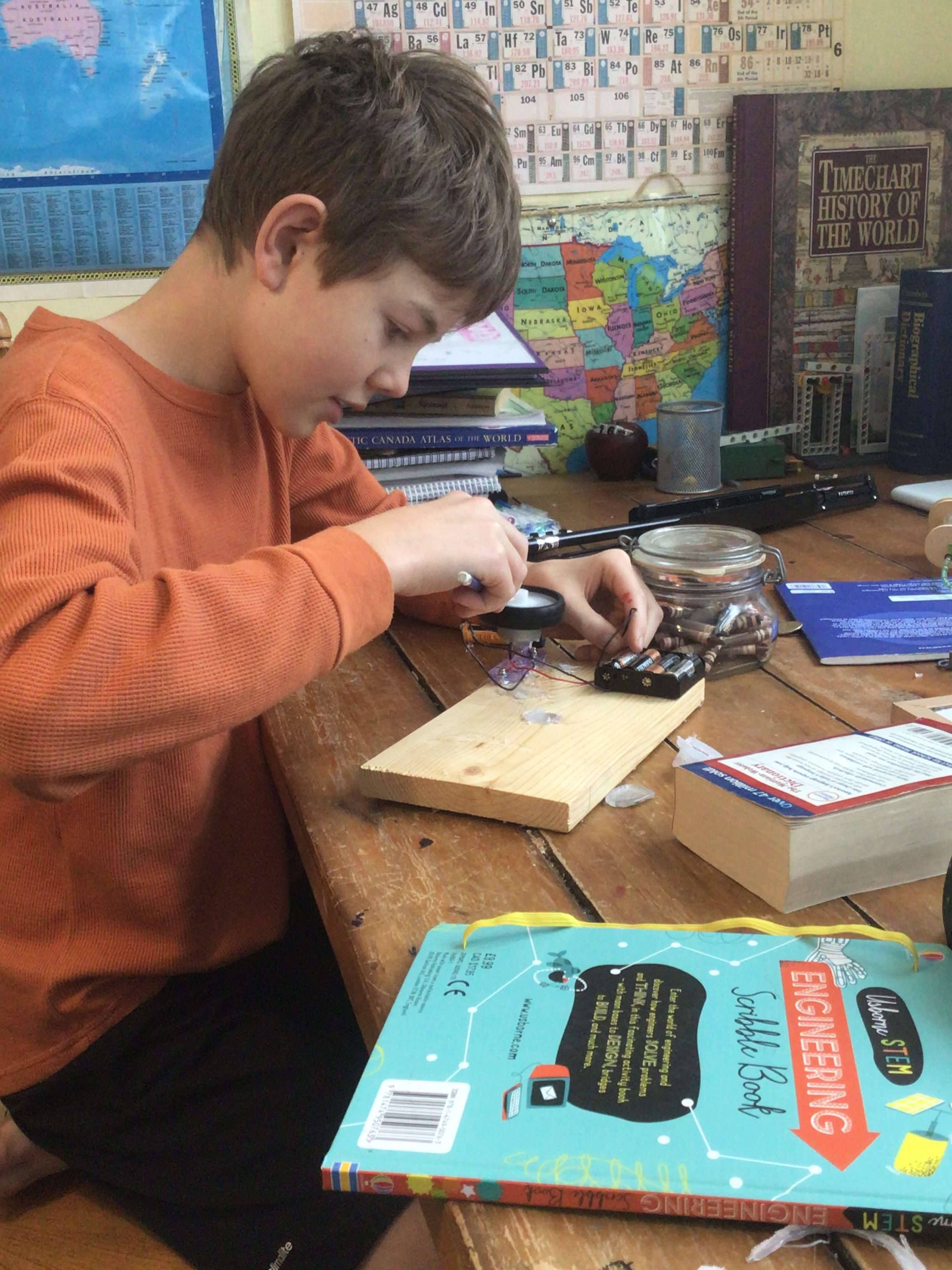
In the meantime, we have Legos to play with, dogs to walk, chickens to coral, trampolines to bounce on, a garden bounty to process, and a few more late evenings.
There are one million and one things we’re going to learn from the moment we’re born to the moment we die.
We’ll have fewer than a million, but still many, iterations of what we do in this life.
We might work at…
- a fast food restaurant on the cash,
- a grocery store in the bakery,
- a real estate office as the receptionist,
- a billing clerk at a doctor’s office,
- a unit clerk in the labour & delivery at the local hospital,
- a registered nurse in the perinatal float pool,
- a new mom at home with two little girls,
- a homeschool mom of four kids,
- a writer for a website,
- a host of a podcast,
- and life coach for homeschool moms.
(A few of my iterations.)
Throughout each of those roles, I have learned one million and one thing, and I continue to too.
So homeschool mama — your homework is waiting. What’s one belief you’re ready to let go of today?

Deschool your Homeschool Journaling Workbook
The Deschool Your Homeschool Journaling Workbook is a self-coaching tool designed to help you redefine your homeschooling journey with clarity and confidence. Through thoughtful prompts and guided exercises, this workbook empowers you to:
Your Homework, Homeschool Mama
You just read seven lessons that took me years to learn. And if you’re sitting here thinking this all makes sense but I genuinely don’t know where to start with MY family — that’s completely normal. Deschooling isn’t a checklist you complete in an afternoon. It’s a process of getting curious about your kids, questioning beliefs you’ve held for years, and slowly building something that actually fits.
You don’t have to figure that out alone.
The Aligned Homeschool Reset Session is a free 30-minute coaching conversation — just you and me — where we look at what’s not working in your specific homeschool and map out what could. No pressure, no pitch. Just clarity.
Because you didn’t start homeschooling to recreate school at home. You started it because you believed something better was possible.
Let’s find out what that looks like for your family.
👉 Book your free Aligned Homeschool Reset Session here.
Book your free Aligned Homeschool Reset Session
I help homeschool moms trust themselves, edit expectations, and make intentional choices that create a more confident, connected, and present homeschool life.
Frequently Asked Questions About Deschooling
Still have questions about how to deschool 101? Here are the ones I hear most often.
There’s a popular rule of thumb that says one month of deschooling for every year your child was in traditional school. But honestly? Deschooling isn’t a destination — it’s an ongoing process. I’ve been homeschooling for over a decade and I still find moments where I need to deschool a belief or assumption I didn’t even know I was holding. Give yourself grace and don’t put a deadline on it.
Does deschooling mean no structure at all?
Not at all. Deschooling is about releasing beliefs that don’t serve your family — not about throwing out everything that works. Some kids thrive with rhythm and routine. Some need more freedom. Deschooling helps you figure out which is true for your child, so your structure is intentional rather than inherited.
Do I need to deschool even if I’ve been homeschooling for years?
Yes — and this surprises some seasoned moms. Deschooling isn’t just for beginners. If you’re still feeling like you’re not doing enough, still comparing your homeschool to others, still pushing through subjects nobody cares about — there’s likely still some deschooling to do. It’s not a one-and-done process. It’s more like peeling an onion. There’s always another layer.
How do I know when I’m done deschooling?
You’ll know you’re making progress when the guilt starts to quiet down. When you can watch your kid follow a rabbit trail of curiosity without panicking that they’re falling behind. When your homeschool starts to feel more like your family and less like school with a different address. You may never be completely “done” — but you’ll feel the shift.
Both, actually. Kids who’ve been in traditional school often need time to decompress — to remember what it feels like to be curious without being graded, to play without it being scheduled, to learn because they want to. But even kids who’ve never been to school can absorb school-think from you, from curriculum choices, from the pressure you bring into the room. Deschooling is a family process.
Deschooling is the process — the intentional unlearning of conventional school beliefs. Unschooling is a philosophy and an approach to education that’s entirely child-led, without formal curriculum or structured lessons. You can deschool without becoming an unschooler. Many moms deschool and land somewhere in the middle — more intentional, more child-responsive, but still with some structure. Deschooling just helps you figure out where you actually want to land.
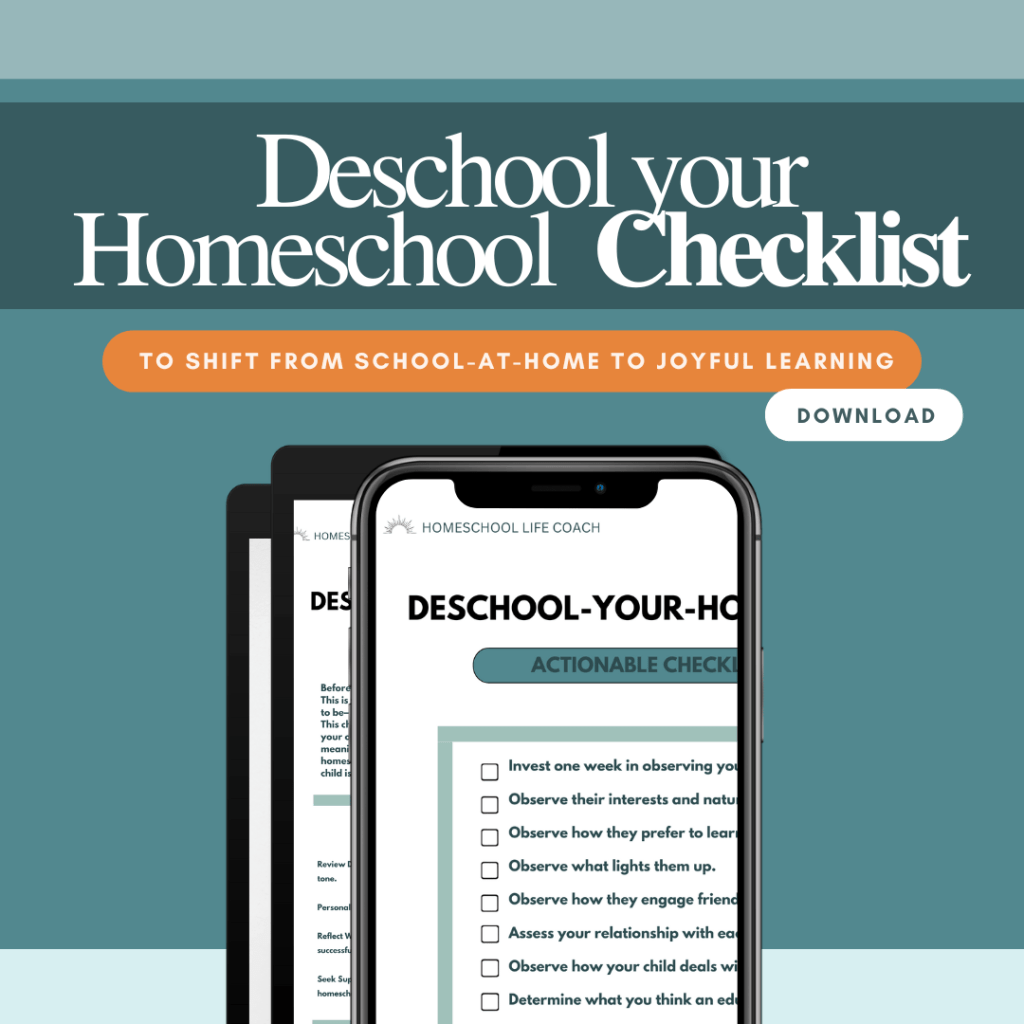
Start with curiosity rather than a plan. Ask yourself: what beliefs about education did I inherit that I’ve never questioned? What am I doing in my homeschool because I think I should, rather than because it’s actually working? The free Deschool Your Homeschool Checklist is a great first step — it helps you identify exactly where school-think is sneaking into your homeschool so you can start building something that actually fits your family.
People also ask…
- How does Deschooling Help You Live a Purposeful Life
- How to Start Homeschooling Confidently in Year 1
- John Holt & Pat Farenga Teach Homeschoolers How to Learn
- How to Use the Practical Deschool your Homeschool Checklist
- Unschool music training by doing nothing at all
- Self-Care & Deschooling: Is there a Helpful Connection?
- How Do I Unschool My Child? Embrace Natural Learning in 5 Ways
- Why does someone want to deschool?
- Get free Deschool Coaching for More Freedom & Individualization
- How I Saw Then & How I See It Now: 13 Homeschool Tips for Parents
- curiosity and education: how to facilitate it
- What do homeschoolers want to deschool from: let’s get specific.
- How to practically deschool your homeschool.
- How to Homeschool Better (& Why Do you Want to?)
- Deschooling and Life Purpose: Is there a connection?
- How to Know if Deschooling is Right for You: 7 Signs you Need to Deschool
- Why Seasoned Homeschool Moms Still Struggle (And How to Break Free)
- How to unschool high school.
- How my story of deschooling brought more freedom & purpose
- Unschool Mothers: Candid Conversation with Virtual Kitchen Table

Teresa Wiedrick
I help homeschool mamas shed what’s not working in their homeschool & life, so they can show up authentically, purposefully, and confidently in their homeschool & life.
Originally published February 5, 2024. Updated and expanded April 2026.
Subscribe to the Homeschool Mama Self-Care podcast

“There isn’t a right way to become educated, there are as many ways as there are fingerprints“. John Taylor Gatto
I love this quote! We will be having a “Kindergarten” kick off party even though they are not going to school. It finally sank in with all the back to school prep going on, and how relax I am that we will not be taking part in all the craziness!
Indeed! Prescribed, system/culture driven crazy! Having said that, I can make my own crazy busy–Im good at that;) But always with a purpose, for my family’s reasons…
I love that your crazy busy has purpose!
It sounds like you have some awesome plans! We started homeschooling in February, so this is our first ‘back to school’ season. I love thinking about what we’ll miss: shopping for supplies (at multiple stores because I could never find everything I needed in one place), feeling the pressure to purchase new clothes (even if they weren’t really needed), packing lunches, waking the girls up at an inhumane hour, waiting in unfathomably long drop off/pick up lines. More than what we’ll miss, though, this time of year evokes a sense of gratitude in me for the family time and love of learning we’ve gained by homeschooling.
I have always loved the flexibility homelearning offers… September the golden month – too beautiful to stay indoors – was the time we would start thinking about the new school year but just gently engage it, outside on the deck, soaking in the golden rays. I miss that, now that our daughter is off to school in a big brick building. But we do catch the rays on the edges of her schedule and I allow myself to linger in that September liminal space a bit longer. Similarly the weeks before Christmas – growing up it never felt right that we would have exams right up to a few days before the celebration. I needed time to write cards, sink into the spirit and meaning of the feast. Homelearning allowed for that so beautifully too, with many opportunities for creative, contemplative learning and sharing. Thanks for the reminders of some of the aspects of homelearning that I will cherish forever!
Well it was a pleasure to share some of those years with you and your daughter!
Great post, I love this! And agreed- life is learning. Happy not-back-to-school from our also not-back-to-school family 😉
Thank you! You too!
I absolutely LOVE everything about this post! To me the beauty of homeschooling os that you can see to each individual Childs need, and way of learning. Thank you for the inspiration!!
You’re welcome. A fellow Sagittarian…
Lovely, kindred spirited words. Thanks.
Thank you.