If you’ve been searching for how long deschooling actually takes, you’ve probably already found the formula. The formula you’ve heard isn’t wrong per se — it’s just wildly incomplete. Here’s what no one tells you about how long deschooling actually takes.
You’ve probably heard the rule. One month of deschooling for every year your child was in school. Neat. Tidy. Almost like a prescription you can fill.
But here’s what I’ve learned after years of deschooling — first with my own four kids, and now alongside hundreds of families in my coaching practice: that formula is a starting point at best, and a source of false reassurance at worst.
The honest answer to how long deschooling takes? It depends on every single person in your household. And it almost certainly takes longer than you think.
So, how long does deschooling actually take? Here’s the real answer.
Deschooling is the process of unlearning the assumptions, fears, and conditioned beliefs that school instilled — in your children, yes, but also in you. It’s the mental and emotional detox that happens when you leave an institution that has told everyone in your family, for years, what learning is supposed to look like.
It looks like a lot of things. Resistance. Relief. Boredom. Anxiety. Days where no one does anything that resembles “school” and you spiral wondering if you’re ruining your child’s future. Days where everything clicks and you think you’ve figured it out. Then more disorientation.
Deschooling doesn’t feel like a clean process. It feels disjointed, uncomfortable, and unclear — and that discomfort is actually the work.
The “1 month per year” rule misses something critical
The formula has been popularized for convenience sake. And the spirit of it is sound: respect that your child needs real time to decompress from the structure and pressure of institutional schooling and that educational lifestyle.
But it calculates only one variable — your child’s years in school. It leaves out everything else.
What the formula doesn’t account for:
- How many years you spent in school — and how deeply school shaped your beliefs about learning, productivity, and your child’s worth
- How compliant or how resistant your child was in the school environment
- Whether your child experienced academic trauma, learning labels, or chronic stress
- How strongly your extended family or community reinforces “school = learning”
- How different each of your children is — because yes, every sibling deschools differently
I pulled four kids from school over the years. Each one deschooled on their own timeline, in their own way. There was no synchronized family reset. One thrived within weeks. One took years. And I — the one running this whole operation — am still deschooling.
Kid you not! Despite no longer having kids to homeschool, because they’re all grown up, I still see ways that I’m deschooling!
Parents deschool too. This part is not optional.
This is the piece many homeschool articles quietly skip past, and it’s the one that matters most.
Think about what twelve-plus years inside an institution actually teaches a person. Not just the academics — but the beliefs. What smart looks like, what a productive day looks like, or what counts. Rubrics, bells, gold stars, and grade-level benchmarks became the invisible measuring stick for everything. Learning, you were shown over and over, requires a teacher, a curriculum, and an outcome you can point to.
Now you’re home, watching your kid build something with LEGOs at 11am on a Tuesday, and some part of your brain is screaming: this doesn’t count.
That voice? That’s you, still in school.
If you’re just getting started, How to Deschool 101 walks you through exactly what that unlearning process looks like in practice.
The parents who struggle most in the first year of homeschooling aren’t struggling because their kids aren’t learning. They’re struggling because they haven’t deschooled themselves yet and have expectations of HOW things should look at home, except they don’t look that way.
I see this with the homeschool moms I coach. A parent who was a high-achiever in school carries the deepest conditioning. A parent who was a teacher carries an entirely different but equally complicated set of assumptions. Or a parent who felt failed by school often brings unresolved grief into the homeschool room that colours everything.
Your deschooling is not separate from your child’s. It’s tangled up with it.
If you’re still not sure what I mean by that — if part of you is still picturing a whiteboard, a schedule, and a stack of workbooks — this video is for you. In Why Your Homeschool Shouldn’t Look Like School, I walk you through exactly how and why so many families accidentally recreate the institution they just left, and what it actually looks like to build something different from the ground up.
Watch this before you plan anything else.
What it actually feels like (and why that’s okay)
Deschooling is uncomfortable.
I want to say that plainly, because so much of the homeschool content online makes it look like a peaceful unfolding — children reading by the fire, families on nature walks, everyone learning at their own pace with a serene smile.
Sometimes it looks like that. But a lot of the time it looks like arguments about whether screen time counts as learning. It looks like a kid who seems to be doing absolutely nothing for three months and a parent white-knuckling their way through it. It looks like questioning every decision you made to leave school in the first place.
It also feels disjointed.
Deschooling is not a linear process with a clear before and after. It circles back.
You think you’ve arrived somewhere solid, and then a new season of life surfaces an old belief you thought you’d released. A new child presents a new version of the challenge.
You hit a “moment” — a standardized test your state requires, a comment from a grandparent, a child entering high school, a college conversation that’s suddenly no longer hypothetical — and you realize there’s another layer. Or even when your kids enter college and you realize that even those institutions aren’t enabling a meaningful education for your grown kids.
Each child is a different deschooling journey
If you have more than one child, you’ve already learned this: they are not the same person. This is obvious in every other area of parenting, but somehow we expect deschooling to happen similarily.
One child may have loved school, thrived socially, and grieves the structure and friendships. Their deschooling is partly grief work. Another may have been quietly suffering — anxious, bored, or misunderstood — and rebounds faster than you’d imagine. A third may seem fine but carries invisible damage from years of being told they’re “behind.”
What they all need is time, and they need different amounts of it. Your job is not to rush them toward a new system of learning. Your job is to hold the space while they remember how to be curious and be engaged again.
Not sure if your child is ready? Read 10 Signs They Need to Deschool Right Now to know what to look for.
The real goal: your “to live” list
Here’s the reframe I come back to again and again, with myself and with every family I work with: the goal was never to recreate school at home. And the goal isn’t even to “finish deschooling” so you can start the real work.
The goal is to build a life your family actually wants to live.
A list of what you’re actually here for — what your child is curious about, what lights them up, what you want your days to feel like. When you orient around that instead of orienting around what school would have done, something shifts.
The waiting ends. The idea that deschooling is just a hallway you pass through before real life begins dissolves. Living fully, curiously, and intentionally with your kids is the thing. It always was.

Signs that deschooling is happening (even when it feels like nothing is)
In the middle of the disorientation, it helps to know what to look for. Just signals that the unlearning is real and something new is taking root.
What deschooling can look like in practice:
- Your child asks a question out of pure curiosity, not to get an answer “right”
- You catch yourself watching your kid play and feeling peace instead of panic
- Family life starts to feel like yours rather than a school schedule you brought home
- Your child says “I want to learn about…” without you asking
- You stop mentally converting everything into grade-level equivalents
- The discomfort is still there — but you’re no longer convinced it means something is wrong
So how long does deschooling actually take? The real answer.
Longer than the aforementioned formula. Different for every person in your family. Ongoing, really — because you will keep encountering moments that reveal another layer of conditioning to work through. That’s how thoroughly our systematic school system has shaped us.
What I can tell you is this: the families who come out the other side with a homeschool life that genuinely fits them are not the ones who rushed through deschooling, or tried to force school in their homes either.
They’re the ones who got honest about it — who acknowledged the discomfort, took it seriously for every person in the home, and kept coming back to the question of what they actually wanted their lives to look like.
Ready to start living your homeschool life on purpose?
Whether you’re just pulling your kids from school or years into the journey and feeling stuck, these resources will help you move forward with clarity.
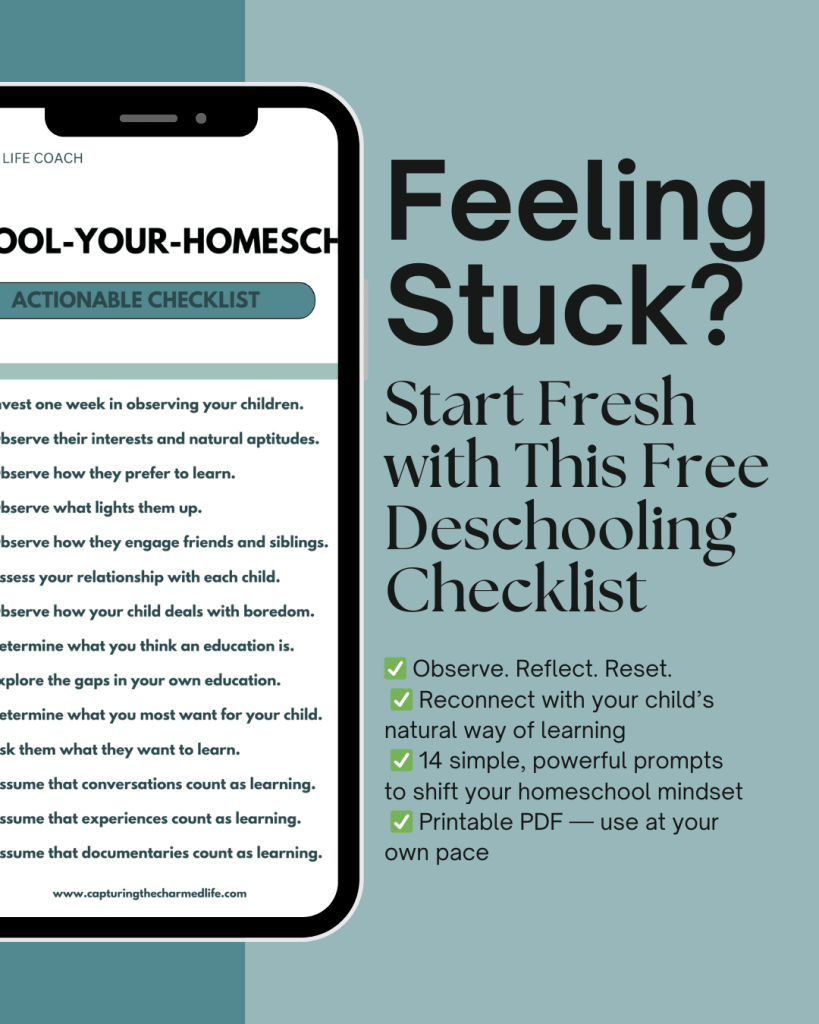
Free Deschool Checklist
Most families don’t fail at deschooling because they don’t try hard enough — they fail because they’re still doing school without realizing it. This free checklist helps you identify exactly which school habits are still running the show in your home, so you can finally let them go.
Deschool Action Plan
The checklist tells you what to stop. The Action Plan tells you what comes next — for you and your kids. This guided resource walks you through the full deschooling process for every person in your household, so no one gets left behind in the unlearning.
Deschool Action Plan for New (& Stuck) Homeschoolers
The Deschool ACTION Plan is a printable PDF guide to help you reset your homeschool mindset, reconnect with your child’s natural learning style, and take intentional steps toward a more confident, calm, and custom-fit homeschool.
Book your free Aligned Homeschool Reset Session
Whether you’re six weeks in or six years in, if something feels off — you’re in the right place. This 1:1 session is for parents who are done guessing and ready to build a homeschool life that actually fits their family. We’ll find where you’re stuck, clear what’s not working, and get you moving toward the life you actually want.
Book your free Aligned Homeschool Reset Session
I help homeschool moms trust themselves, edit expectations, and make intentional choices that create a more confident, connected, and present homeschool life.
Continue Exploring How to Deschool Your Homeschool
- Self-Care & Deschooling: Is there a Helpful Connection?
- How to Use the Practical Deschool your Homeschool Checklist
- 3 Deschooling Mistakes First Year Homeschool Moms Make — And How To Fix Them
- Why Deschooling? To Feel Confident, Certain & Good Enough
- Join the Deschool your Homeschool Challenge
- The Honest Truth About Homeschooling: Struggles You’re Not Talking About (and How Homeschool Mom Support Can Help You Overcome Them)
- What do homeschoolers want to deschool from: let’s get specific
- How my story of deschooling brought more freedom & purpose
- Deschooling and Life Purpose: Is there a connection?
- Is deschooling a fad or is it here to stay?
- 7 Important Reasons for Project-Based Homeschooling
- How to Know if Deschooling is Right for You: 7 Signs you Need to Deschool
- Why Seasoned Homeschool Moms Still Struggle (And How to Break Free)
- Breaking Free: How Deschooling Helps You Live a Purposeful Life
- How to practically deschool your homeschool mindset
- Why do you want to deschool? Clarify before you begin.
- Overcoming Imposter Syndrome: How to Build Confidence as a Homeschool Mom
- Get free Deschool Coaching for More Freedom & Individualization
- How my story of deschooling brought more freedom & purpose
- Do you offer one-on-one coaching to deschool?
