Podcast: Play in new window | Download
How long will it take to develop boundaries in your homeschool life, a homeschool mama asked me.
That depends, is the honest answer. Anything valuable and meaningful doesn’t happen without the work of the interior.
And the work of the interior depends upon your clarity and intention toward that work. That work isn’t always easy to determine, but it almost always takes time.
So how do you develop boundaries in your homeschool life? Let’s chat.
Real Families, Real Change: How These Homeschool Families Learned to Develop Boundaries in Their Homeschool Life
Before we talk strategy, let’s talk reality. Because sometimes what we need most isn’t a checklist — it’s proof that other families have walked this road and come out the other side with more connection, more peace, and more joy.
Story 1: The Mama Who Developed Boundaries Around Her Morning Time
Charlotte had been homeschooling her three kids for four years when she realized she hadn’t had a quiet cup of coffee — alone — without it going cold and reheating for a very, very long time. Her mornings began the moment her feet hit the floor: questions, arguments, someone needing something. By lunch, she was done.
The shift came gradually. She started getting up 30 minutes before the kids. Just 30 minutes — a journal, a candle, her coffee while it was still hot. Her oldest noticed first: “Mom doesn’t get mad so much.” Her youngest noticed said to her dad: “Mommy laughs more now.”
“I kept thinking I was taking something away from them by taking time for myself,” Charlotte said. “But the boundary I set — protecting that morning time — gave them a better mother every day I did it.”
What changed for her family: Mornings were calmer. The kids learned to settle into their own quiet routines. The tone for the day shifted.
Reflection question: What time of day do you feel most depleted? What would 20 protected minutes in that window do for you?
Story 2: How One Family Developed Boundaries with Outsiders’ Questions
Melissa had been fielding the same questions for years: “But what about socialization?” “Are they really learning enough?” “What grade are they in?”
At first, Melissa answered every question patiently, and even in detail — as if she had to justify their family’s choice to every curious stranger. She came home from errands drained, a little defensive, and often questioning herself. Are they right to be concerned?
Then her 11-year-old son Caleb, wise beyond his years, started responding with a simple smile and, “I love it — I get a lot of time to do Minecraft.” And though others probably wondered if all he did was play Minecraft all day, she knew that wasn’t so.
Melissa watched him do it once, then twice. Then she started doing it too: telling others about the amazing parts of this lifestyle.
“I realized that strangers’ questions were never really my responsibility to answer fully,” she says. “My kids were happy. We were thriving. That was enough.”
What changed for her family: Less second-guessing. More confidence. She stopped bracing herself in public and started standing taller in their identity as homeschoolers.
Reflection question: What questions or comments drain your energy most? How might a short, warm boundary response free you from that drain?

Story 3: How the Hendersons Developed Boundaries Through Communication
For the Hendersons, learning to develop boundaries in their homeschool life started with communication.” Their homeschool was productive on paper — the kids were learning, they didn’t even think they were “behind” most days. But the emotional climate was stormy: the kids spoke to each other with sharp words, and honestly, their mom admitted, so did she.
They began slowly. Stacey set a timer in her phone and when that alarm went off, she asked herself how she was feeling. Then the kids followed suit.
She noticed they were doing it too. So then she asked, “How are YOU feeling?” Practicing what it sounded like to ask for something instead of demand it. Their family didn’t transform overnight, but month by month, the emotional temperature in their home dropped.
“We started having conversations instead of standoffs,” Stacey said. “When my daughter started coming to me with her frustrations instead of exploding at her brother, I knew something had genuinely shifted.”
What changed for her family: The kids became more emotionally articulate. Conflicts shortened. The family developed a shared language for navigating hard moments — a real homeschool education in emotional intelligence.
Reflection question: What does the emotional atmosphere in your home feel like right now? What would you want it to feel like?
Before we get into the 9 boundary challenges, I recorded something for you — because sometimes it’s easier to hear this than to read it:
What Other Homeschool Families Say About Developing Boundaries in Homeschool Life
Sometimes it’s the small shifts that say the most.
“I put a timer outside my office door. When it goes off, the kids know they can knock. It took two weeks of practice, but now it works. I get real focused work time — and they are learning patience.” — Homeschool mom of four
“We stopped trying to replicate school at home. Once I let go of what I thought our days ‘should’ look like, I stopped feeling like a failure. Our kids are thriving in a completely different way than I expected.” — Homeschool mom of two
“The biggest boundary I set was with myself — I stopped scrolling homeschool social media that made me feel inadequate. Turns out my kids didn’t need me to do it all. They needed me present.” — Homeschool dad
“We took a whole month off. No lessons, no curriculum. Just living. I was terrified. My kids were the happiest they’d ever been — and so was I. We came back to our homeschool with fresh eyes.” — Homeschool mom of three
So what do all these families have in common?

Why You Need to Develop Boundaries in Your Homeschool Life
These stories point to something deeper: when your needs are met, you have the emotional capacity to actually be with your children — not just to make it through your days.
Boundaries protect your:
- Your needs — the fuel you need to keep showing up
- Goals worth protecting — your vision for what this homeschool life is actually for
- Energy that lasts — the capacity to keep giving without burning out
- Peace of mind — the internal quiet that makes you a calm presence
- Quiet that restores — the stillness you need to come back to yourself
- A home that supports you — cleanliness and order that breathes life rather than drains it
- Organization on purpose — the structure that keeps your days intentional
Here’s more on why you require them.
Without them, resentment builds. When our goals and needs are met, we have the energy and mental space to extend nurture to those around us too.
The Inner Work Behind Developing Boundaries in Your Homeschool Life
Here’s the thing about boundaries — they grow from the inside out. And that means doing the kind of interior work most of us were never taught. First, it starts with shifting perspective, recognizing when the story you’re telling yourself isn’t serving you. From there, it means navigating conflict well and rendering your painful stories — processing what you carry so it doesn’t carry you.
Beyond that, it also looks like building resilience for the hard days, creating life-giving practices that make you feel alive rather than just functional, and identifying your real challenges honestly so you can make a plan. In the same way, it means practicing acceptance — meeting your life’s realities with openness rather than resistance — and, meanwhile, fostering secure attachment with your kids along the way.
And perhaps most importantly, it means knowing your “enough”, building self-compassion, and ultimately developing the emotional literacy to name what you’re feeling so you can work with it, not against it.
I swapped “However” for “Beyond that,” since the second paragraph adds to the first rather than contrasting with it.
9 Common Homeschool Boundary Challenges — and How to Develop Boundaries Around Each One
So what are your boundary challenges?
I share more about what boundary challenges might be in your homeschool life here, but I know from experience, and from coaching other homeschool moms, that boundary challenges are as varied as the humans experiencing them.
Perhaps you might recognize a few boundary challenges in your own homeschool life here:
1. Develop boundaries around your time
If you do not want to be interrupted during your regular homeschool hours? Then unplug your landline and remove the notifications from your phone. And you don’t have to answer the front door. Then let your family and friends know that you have a job, it’s called homeschooling.
Do you want to have time just for yourself once a week that isn’t interrupted by kids, partners, or family members?
Then you’ll have to find a time and place where no one can access you. Away from home.
2. Develop boundaries around working from home while you homeschool
This is a tricky one as kids and family members need to learn your expectations.
You both need to be realistic, the kids still need to see your eyeballs on the regular & younger kids don’t abide by separateness very well, so you’ll need to practice practice practice teaching them your expectations and make it very very clear (might I recommend placing a timer outside your closed door, so when the timer goes off, the kids can knock and get your attention).
3. Develop boundaries around your morning quiet time
Oh, I know, it feels almost impossible to get quiet times in our parenting journey, but it is a requirement for long-term parenting.
Even as a non-morning mom in my early homeschool days, I wish I had told myself, um sorry, but you have to get out of bed with a carafe of coffee, a journal, and a yoga mat, so you can have just a wee bit of time by yourself before the voices find their way to you again (voices=not your inner voices, I mean the little voices that you adopted/birthed).
Getting separate time every day isn’t an option.
4. Develop boundaries around quiet time in your homeschool day
Maybe it’s a ten-minute coffee break after lunch when the oldest is leading the play in the backyard (don’t you love those leader-firstborns?)
On the other hand, maybe you need to hire a babysitter (another homeschooled kid you know?)
Or, if all else fails, maybe you just intentionally turn on Magic School Bus and sit those kids down in front of a screen so you can take a Pinterest time-out.
(Admittedly, that’s a kinda specific suggestion, because I have done this myself. While I’m at it, I’ll also suggest you keep a stash of cookies under your corner chair in your bedroom; after all, the kids will never know.)

5. Develop boundaries around outsider questions
Or should you answer random questions about homeschooling in the grocery store?
Just cause someone asks you a question about homeschooling doesn’t mean you have to answer.
You’re right, sorry about that. Here it is with your bullets intact and transitions added:
It was my kids who figured this out before I did. At first, they were the ones:
- Explaining that yes, they are homeschooled — and no, there’s no day off from school today
- Then insisting that “no grade” is a perfectly valid answer, whatever age-appropriate grade you’re expecting them to be in
- Also clarifying that Mom doesn’t hold every knowledge bit known to a public school teacher (although their dad almost can 😉)
- And finally, pointing out that plenty of social opportunities exist, and yes, they’re absolutely socialized — as evidenced by the respectful way they’re answering your roll-your-eyes, stereotypical questions
Eventually, I took a cue from their behaviour and recognized I don’t have to answer anybody’s questions about homeschooling.
6. Develop boundaries around communication in your homeschool home
We teach our kids how to relate, engage, listen, care, empathize, understand…all the relational words. What does respectful communication look like in your home — from children to parents, siblings to siblings, and yes, from you to yourself?
We teach the relational skills we practice. When kids are heard, they learn to listen. When they’re spoken to with care, they learn to care. Decide what tone and language you want to model — and what your plan is when the hard moments come.
7. Develop boundaries around your needs
You cannot give endlessly what you do not replenish.
You are not a machine, and you are not a god. And you are a whole person who chose a meaningful and demanding life — and that person needs tending. Protecting your own needs isn’t stealing from your kids. It’s the most sustainable thing you can do for them.
8. Develop boundaries around digital distractions
Notifications, social media comparison, the constant ping of availability — these quietly erode your focus and your peace. Decide what access others have to you during your homeschool hours, and protect it like the working boundary it is.
9. Developing boundaries with your own inner critic
This one often goes unspoken. But the harshest boundary violations in a homeschool mama’s life are sometimes the ones she commits against herself — the mistruths she repeats on a loop, the impossible standards she holds herself to, the relentless self-criticism after an imperfect day.
You are enough. That’s not a platitude. It’s a practice.

A Journal Practice to Develop Boundaries in Your Homeschool Life
Pull out your journal and work through these questions honestly:
- Where in your homeschool life do you feel most depleted or resentful? That’s a signal.
- Who are you most often in boundary conflict with — family, friends, your children, yourself?
- Do you have time for yourself during the week? What would it look like if you did?
- What does your morning currently look like? What would you want it to look like?
- How do you want to be spoken to — during calm times, and during conflict?
- Do you speak to others in that same way?
- What unkind things do you regularly say to yourself? Are they true?
- What needs of yours are consistently going unmet?
Self-awareness is the foundation. Everything else is built on it.
The journey to developing boundaries in your homeschool mom life is a deliberate and introspective process, requiring time and intentional actions.
By addressing various aspects such as time management, communication, self-compassion, and recognizing the need for personal space, you create more opportunities for a more fulfilling homeschool mom experience. So you can nurture the nurturer!

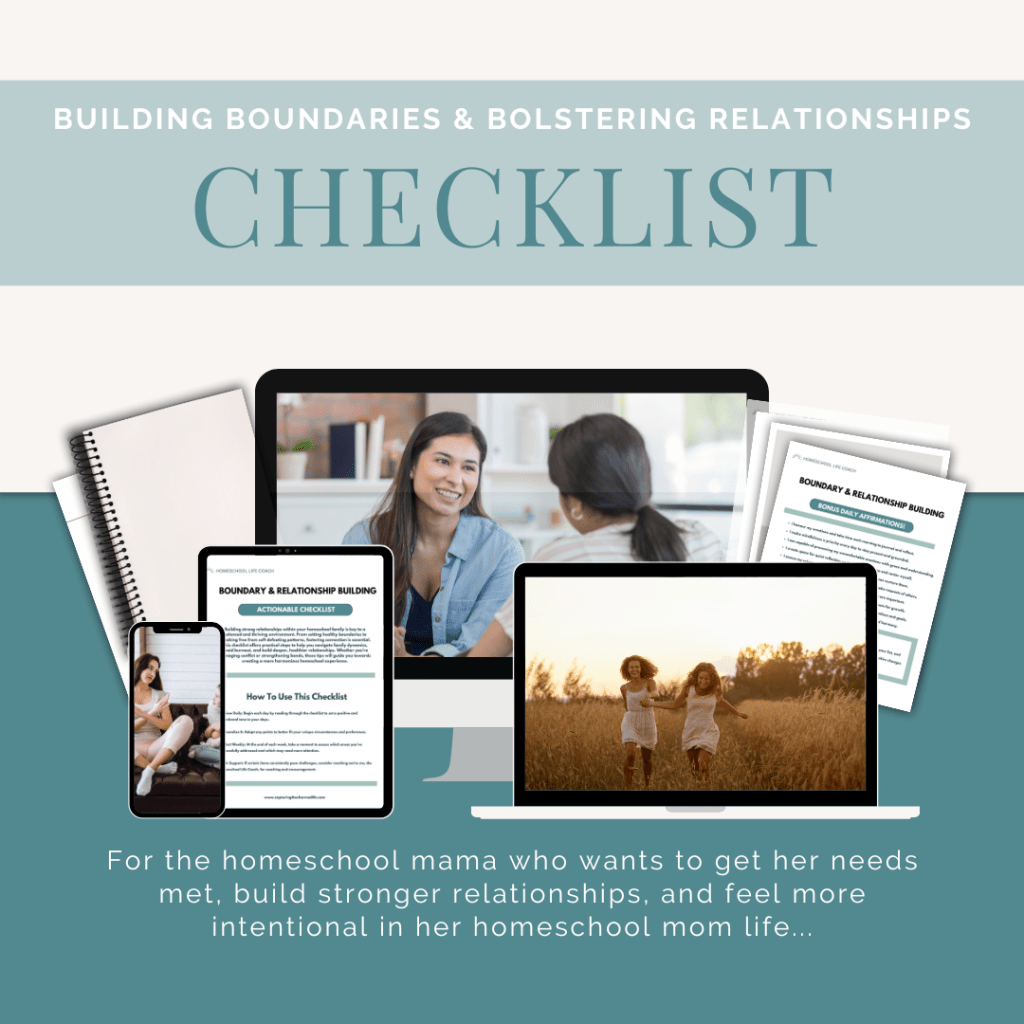
Build Boundaries in Your Homeschool (& Life) Journaling Workbook
Build Boundaries in Your Homeschool (& Life) Journaling Workbook
You’ve done the reflection. Now stock your shelf.
The Reading List: Books to Help You Develop Boundaries in Your Homeschool Life
1. Healthy communication.
Read the book Nonviolent Communication by Marshall Rosenberg.
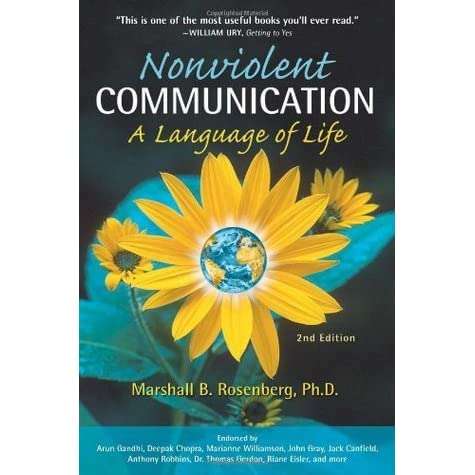
As we’ve seen, all criticism, attack, insults, and judgments vanish when we focus attention on hearing the feelings and needs behind a message. The more we practice in this way, the more we realize a simple truth: behind all those messages we’ve allowed ourselves to be intimidated by are just individuals with unmet needs appealing to us to contribute to their well-being. When we receive messages with this awareness, we never feel dehumanized by what others have to say to us. We only feel dehumanized when we get trapped in derogatory images of other people or thoughts of wrongness about ourselves.
Nonviolent Communication: A Language of Life, by Marshall B. Rosenberg
2. How to frame our hard stories.
Read the book The Choice by Edith Eger.

Our painful experiences aren’t a liability—they’re a gift. They give us perspective and meaning, an opportunity to find our unique purpose and our strength.
The Gift: 12 Lessons to Save Your Life, by Edith Eger
3. Learning how to grow yourself up alongside parenting your own children.
Read the book Growing Yourself Up by Jenny Brown.
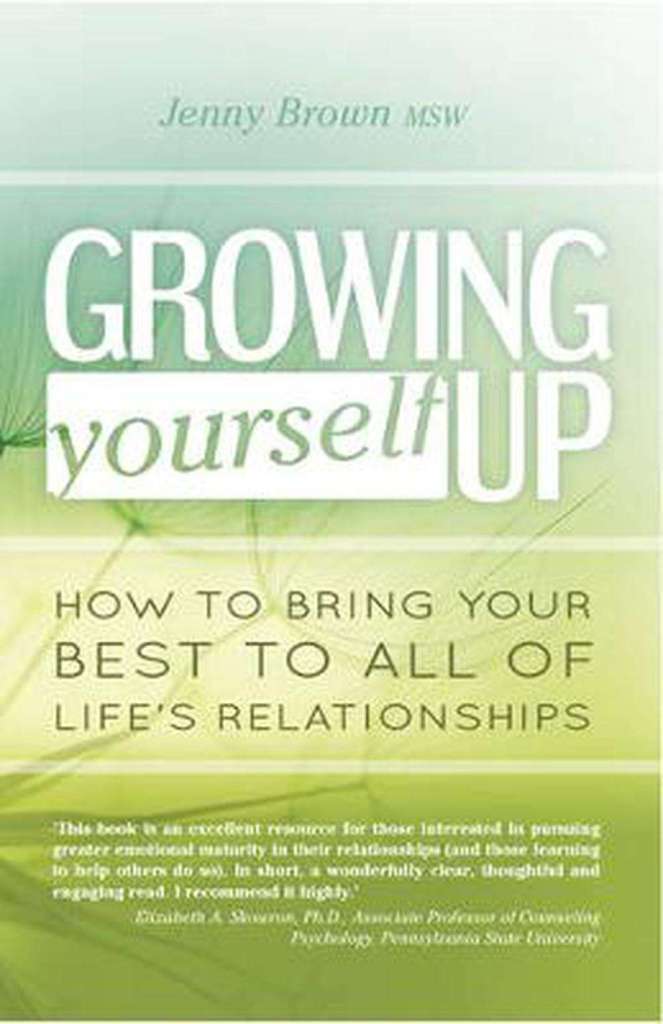
The ability to be both a distinct self and part of a close relationship is at the core of being able to grow our genuine adult maturity.
Growing Yourself Up: How to bring your best to all of life’s relationships, by Jenny Brown
4. Create resilience-strengthening practices to deal with all the bumps and bruises along life’s journey.
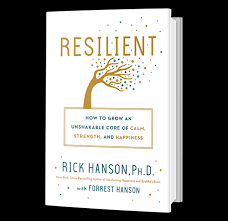
Read the book Resilient by Rick Hanson.
First, we need to experience what we want to grow, such as feeling grateful, loved, or confident. Second—critically important—we must convert that passing experience into a lasting change in the nervous system.
Resilient: How to Grow an Unshakable Core of Calm, Strength, and Happiness, by Rick Hanson
5. Enabling new habits to reinforce the real you.
Read the book Breaking the Habit of Being Yourself by Joe Dispenza.
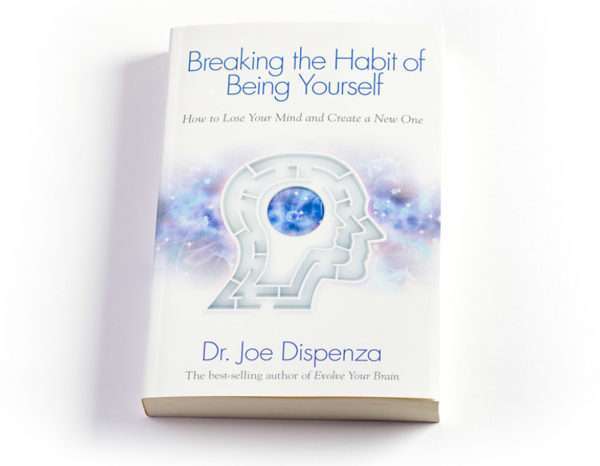
“If you want a new outcome, you will have to break the habit of being yourself, and reinvent a new self.” “Warning: when feelings become the means of thinking, or if we cannot think greater than how we feel, we can never change. To change is to think greater than how we feel.
Joe Dispenza, author of Breaking the Habit of Being Yourself
6. Fostering creativity.
Read the book The Charge by Brendan Burchard.

No matter your position, circumstances, or opportunities in life, you always have the freedom of mind to choose how you experience, interpret, and, ultimately, shape your world.
Brendon Burchard, The Charge: Activating the 10 Human Drives That Make You Feel
7. Acknowledging our homeschool realities.
Read my book, Homeschool Mama Self-Care: Nurturing the Nurturer.

Teresa gets to the heart of the issues surrounding your less-than-thriving experience with homeschooling and offers helpful tips and strategies that will take you beyond mere survival. While it contains tips for nurturing the nurturer, it is much more than just another thing for your to-do list. You will feel validated and understood, and enjoy some humor as well. Just starting out? Teresa has wisdom for you as an experienced Mama.
Homeschool Mama Self-Care: Nurturing the Nurturer, by Teresa Wiedrick
8. Embracing acceptance.
Read the book Radical Acceptance by Tara Brach.
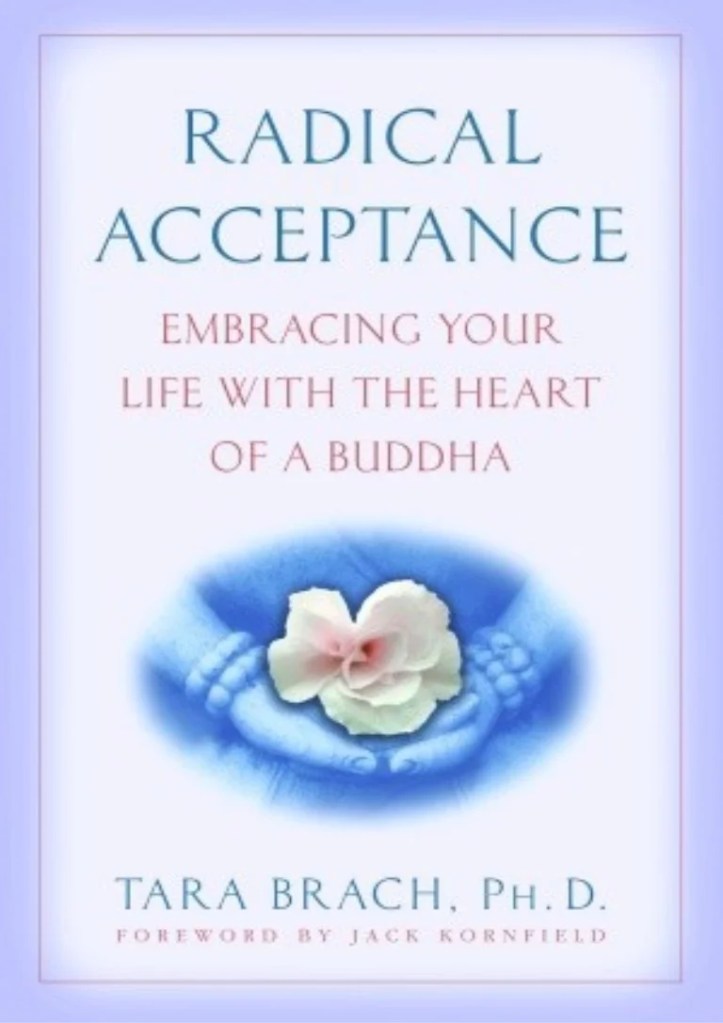
Radical Acceptance is the willingness to experience ourselves and our lives as it is.
Tara Brach, Radical Acceptance: Embracing Your Life With the Heart of a Buddha
9. Understanding attachment.
Read the book Hold onto Your Kids by Gordon Neufeld.
Unconditional parental love is the indispensable nutrient for the child’s healthy emotional growth. The first task is to create space in the child’s heart for the certainty that she is precisely the person the parents want and love. She does not have to do anything or be any different to earn that love – in fact, she cannot do anything, since that love cannot be won or lost…The child can be ornery, unpleasant, whiny, uncooperative, and plain rude, and the parent still lets her feel loved. Ways have to be found to convey the unacceptability of certain behaviors without making the child herself feel unaccepted. She has to be able to bring her unrest, her least likable characteristics to the parent and still receive the parent’s absolutely satisfying, security-inducing unconditional love.
Gordon Neufeld, author of Hold On to Your Kids: Why parents need to matter more than Peers
10. Living your life on purpose.
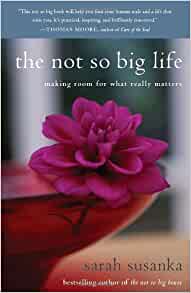
Read Not So Big Life by Sarah Susanka.
11. Accepting yourself as enough.
Read the book More Than Enough by Kara S. Anderson.

Our job is inherently different than that of a teacher in a traditional school. So, let’s break out of the mental shackles and embrace the freedom that homeschooling offers. Homeschooling is hard work. But we make it harder when we try to measure up to standards that weren’t meant for us to follow.
12. Developing self-compassion.
Read the book Self-Compassion by Kristin Neff.
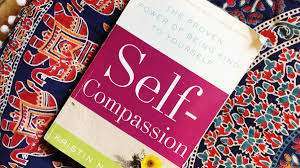
With self-compassion, we give ourselves the same kindness and care we’d give to a good friend.
Kristin Neff, author of Self-Compassion: The Proven Power of Being Kind to Yourself
13. Fostering emotional self-awareness.
Read the book Atlas of the Heart by Brené Brown.

To form meaningful connections with others, we must first connect with ourselves, but to do so, we must first establish a common understanding of the language of emotion and human experience.
Brené Brown, Atlas of the Heart: Mapping Meaningful Connection and the Language of Human Experience
You Are Worth the Work to Develop Boundaries in Your Homeschool Life
The journey to develop boundaries in your homeschool life is a deliberate and introspective process — one that pays dividends every day in more peace, more presence, and more joy.
You took on one of the most meaningful roles imaginable. You deserve to show up for it as a whole, well-tended person.
Nurture the nurturer. Everything else follows.
If you’d like to work through these challenges with support, reach out — or consider the interactive self-directed course designed specifically for homeschool mamas ready to do the interior work.
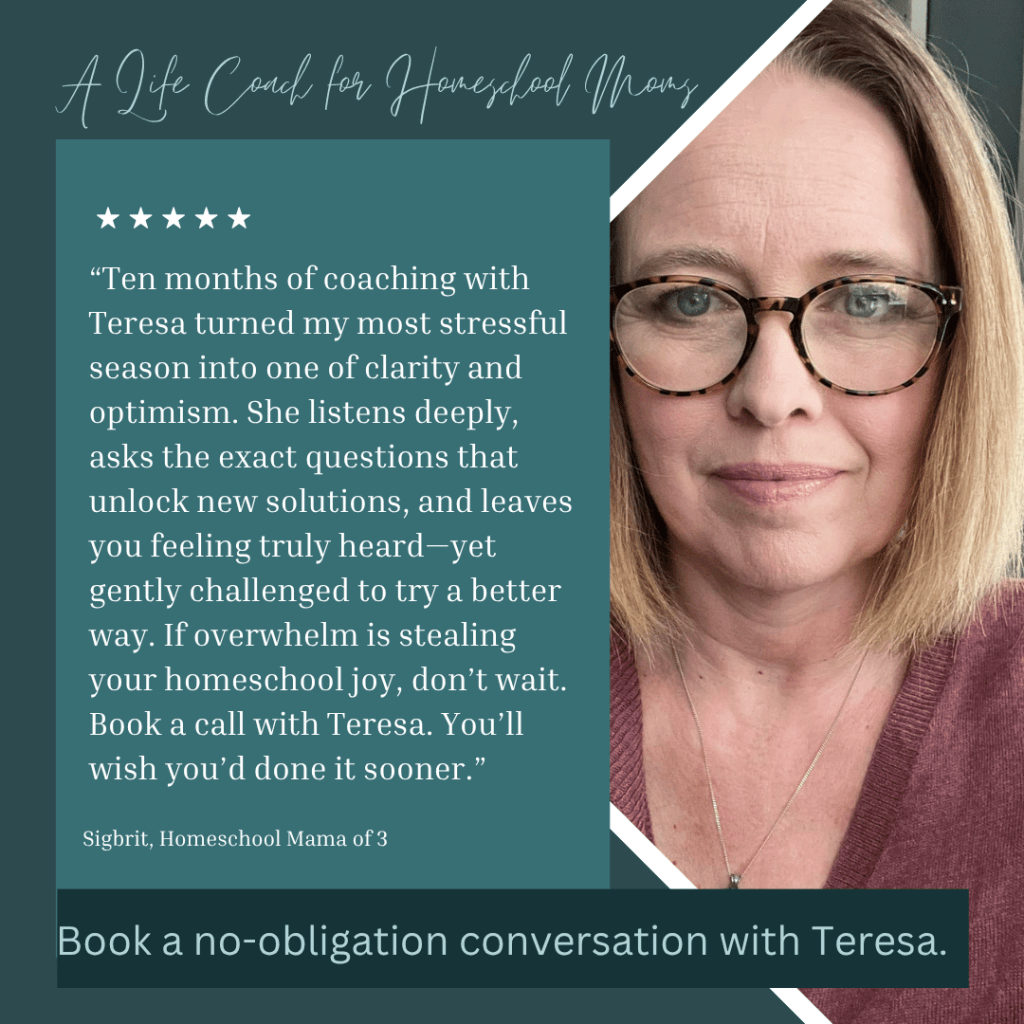
Book your free Aligned Homeschool Reset Session
I help homeschool moms trust themselves, edit expectations, and make intentional choices that create a more confident, connected, and present homeschool life.
People also ask…
- Master Boundaries to Become a Confident Homeschool Mom
- Foster Strong Relationships in Your Homeschool Family
- 9 Typical Homeschool Mom Boundary Challenges & How to Overcome Them
- 8 Ways to Build Healthy Relationships in Your Homeschool Family
- Practical (& useful) steps to dealing with boundaries in your homeschool
- The Ultimate Guide to Building Boundaries and Healthy Relationships for Homeschool Moms
- 7 Effective Tools to Build Boundaries (& Why You Require Them)
- Developing YOU Beyond the Homeschool Mama Role
- What a Coach Does That Even Your Best Friend Can’t
- A Homeschool Mom Podcast for Boundary Breakthrough
- Reclaim You: Rediscover Life Beyond the Homeschool Mom Role
- 5 Reasons Your Homeschool Child Won’t Do Work & How to Motivate Your Child
- Relationship Revolution: Level Up Your Homeschool Mom Connections!
Subscribe to the Confident Homeschool Mom podcast
Originally published January 6, 2024. Updated May 22, 2026.
Call to Adventure by Kevin MacLeod
Link: https://incompetech.filmmusic.io/song/3470-call-to-adventure
License: http://creativecommons.org/licenses/by/4.0/
